Price YouTube Sponsorships: $25 CPM Math for Creators & Marketers
15 min read
The main YouTube sponsorship types are dedicated videos, mid-roll or pre-roll integrations, Shorts bundles, product seeding, and affiliate or ambassador partnerships, paid through flat fees, CPM rates, affiliate/CPA commissions, or hybrids combining a guarantee with revenue share. Most deals originate through YouTube BrandConnect, inbound brand interest, talent agencies, or a creator's own outbound pitch.
TL;DR:
- Most YouTube sponsorships are paid through flat fees, CPM rates, or revenue-sharing models, with deal sources including BrandConnect, agencies, or direct pitches.
- Mid-roll integrations are the most common and cost-effective, while dedicated videos offer more airtime but come with higher production risk and cost.
- CPM rates for sponsorships typically range from $15 to $40, and larger channels may earn more due to higher engagement and niche appeal.
- Combining long-form videos with Shorts in multiformat campaigns drives higher search interest and conversions than single-format strategies.
- Clear contracts detailing payment, usage rights, and disclosure are essential to prevent disputes and ensure compliance with regulations.
Table of Contents
- What Are the Main YouTube Sponsorship Formats?
- How Do Creators Get Paid for Sponsorships?
- Where Do YouTube Sponsorship Deals Come From?
- How Much Do YouTube Sponsorships Pay?
- What Should a Sponsorship Contract Include?
- Why Do Multiformat Campaigns Outperform Single-Format Buys?
- How Does a Curated Marketplace Improve Sponsorship Matching?
- What Legal Issues Go Beyond Disclosure?
- What I've Learned Watching Creators Price and Pitch Deals
- Where Influenna Fits Into Your Next Sponsorship
- Sources
- FAQ
What Are the Main YouTube Sponsorship Formats?
Every sponsorship boils down to how much of the video a brand owns and how disruptive that ownership feels to a viewer. That's the real axis to think about before you touch a rate card.
A mid-roll integration is a segment (usually 30 to 90 seconds) woven into an existing video, where the creator talks about the product in their own voice, on their own set. It's the workhorse format because it's cheap to produce and doesn't require a topic pivot. A pre-roll mention sits at the top of the video, before the content starts, and tends to get skipped or ignored more than mid-roll, which is why it's usually priced lower.
A dedicated video is built entirely around the sponsor, from the thumbnail to the title. It costs more to produce and carries more creative risk, since a bad dedicated video can tank a channel's average view duration for that upload. But it also gives the brand the most airtime and the clearest call to action.
Shorts bundles package several short vertical videos, sometimes with a companion community post, aimed at reach and trend participation rather than depth. Product seeding means the brand sends free product with no guaranteed coverage. It's cheap for the brand and works well for testing fit with a creator before committing budget. Affiliate and ambassador arrangements stretch over weeks or months, with the creator earning on sales rather than (or in addition to) an upfront fee.
Here's how those formats map to common campaign goals:
- Awareness at scale: dedicated video or a multiformat push combining long-form and Shorts.
- Low-risk product trial: seeding, sometimes followed by a paid deal if the creator likes the product.
- Direct sales: affiliate/CPA links or discount codes tracked through UTM parameters or platform-native codes.
- Ongoing brand association: ambassador deals with a retainer and recurring content cadence.
- Fast, low-cost reach: Shorts bundles, often run alongside a hero video rather than alone.
Creator-led integrations tend to build brand familiarity roughly four times more effectively than celebrity endorsements, largely because audiences trust the creator's own framing more than a scripted ad read. That's the argument for giving creators real creative latitude instead of a word-for-word script, regardless of which format you choose.
How Do Creators Get Paid for Sponsorships?
Payment structure matters as much as format, because the same integration can pay wildly different amounts depending on how it's priced.
Flat fees are the most common model for one-off integrations and dedicated videos. Brands like flat fees because the cost is known upfront; creators like them because payment isn't tied to unpredictable view counts. A flat fee makes the most sense when a channel has consistent, predictable viewership and the brand wants budget certainty.
CPM-based deals price the spot per thousand views, calculated after the video airs or against a rolling average. The math is simple: (average views ÷ 1,000) × agreed CPM. This model shifts risk toward the creator, since a video that underperforms pays less, but it rewards creators whose videos tend to outperform their historical average.
Affiliate and CPA arrangements pay per sale, sign-up, or download, tracked through a unique link or code. These outperform flat fees for creators whose audience actively buys what they promote, especially in categories like software, supplements, or subscription boxes, but they're a poor fit for awareness-only campaigns where there's no direct purchase path to track.
Hybrid models combine a smaller guaranteed fee with a commission on results. This gives creators an income floor while still rewarding strong conversion, and it's increasingly common for brands unwilling to pay pure CPM but also uncomfortable asking a creator to work entirely on commission.
A few negotiation levers worth knowing:
- Ask for a flat fee when your views are stable and you don't want performance risk.
- Push for CPM or hybrid when you're confident a video will outperform your channel average.
- Request affiliate terms in addition to (not instead of) a base fee, whenever a purchase link is realistic.
- Revenue share deals, common in ambassador arrangements, usually pay a percentage of sales generated over the partnership term rather than per video.
Where Do YouTube Sponsorship Deals Come From?
Deals arrive through four channels, and channel size dictates which one dominates.
- Platform marketplaces. YouTube BrandConnect lets brands search for creators and get recommendations based on signals like reach and price analysis, plus built-in reporting. It was invite-only and in beta as of 2026, so not every channel has access yet.
- Inbound requests. Larger, established channels get approached directly by brands or their agencies, often without ever touching a marketplace.
- Talent and influencer marketing agencies. Agencies negotiate on a creator's behalf, handle contracts, and often secure better rates in exchange for a commission, which matters most for creators without the time or leverage to negotiate solo, as explained by Adwize - EVOLVE Commerce.
- Outbound pitching. Smaller and mid-tier creators typically have to pitch brands directly, which works best with a short, specific proposal: audience data, a content idea tied to the brand, and a clear rate.
YouTube's 2026 Creator Partnerships initiative, including its Brand Deal Desk resources, was built specifically to help creators pitch, negotiate, and report on deals, and to surface creators who share native channel insights more often to advertisers.
How Much Do YouTube Sponsorships Pay?
Rates swing enormously by niche, audience quality, and format, but there are usable anchors. Integrations commonly fall in the $15 to $40 CPM range, with dedicated videos commanding roughly double that effective rate given the extra airtime and production commitment.
A practical formula used across the industry: (average views ÷ 1,000) × brand CPM × format multiplier, with adjustments layered on for exclusivity or extended usage rights. Typical multipliers run dedicated ≈2.0, integration ≈1.0, pre-roll ≈0.5 to 0.7, and Shorts bundles ≈0.3 to 0.5, according to industry pricing guides.
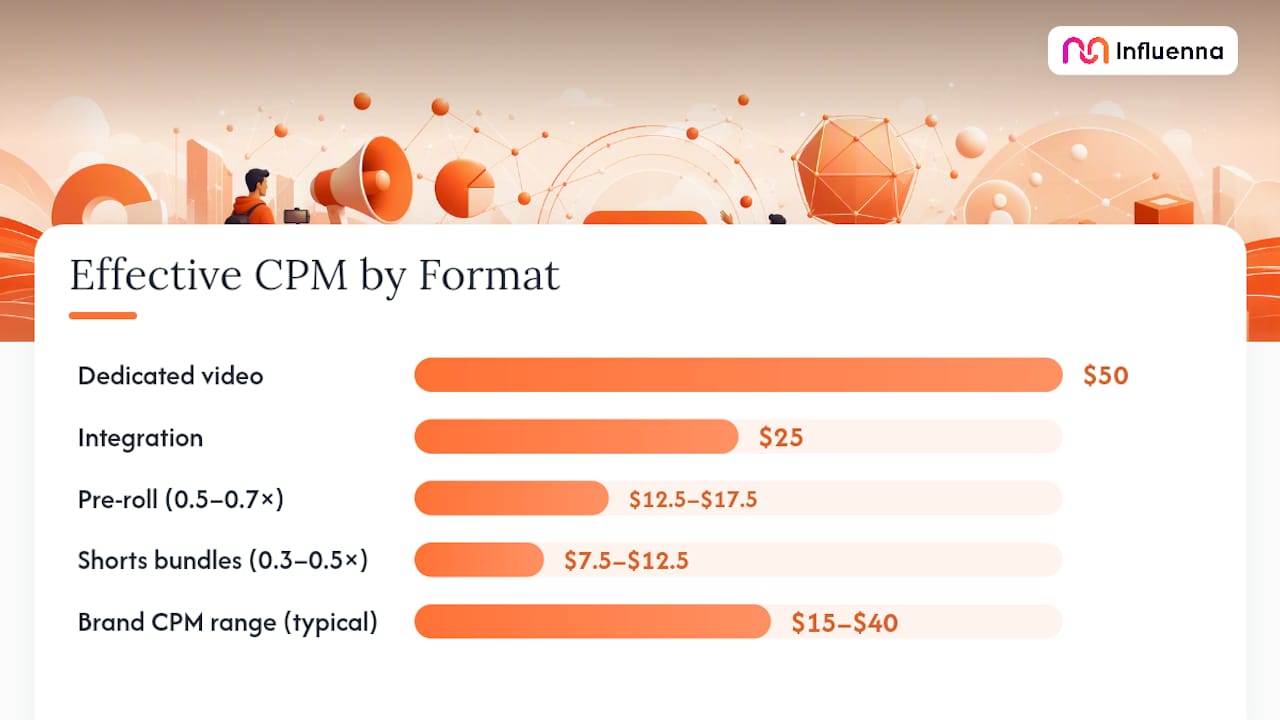
Here's what that looks like across channel tiers, using a $25 CPM baseline:
Smaller channels often make up for lower absolute fees with stronger engagement rates, which is exactly why nano and micro creators land a disproportionate share of product-seeding and affiliate offers. Brands chasing performance, not just reach, will pay for that engagement even at modest view counts. You can sanity-check your own numbers with a engagement rate calculator before quoting a brand.
Line items that should add to the base fee, not get absorbed into it: exclusivity periods (locking you out of competitor deals), usage rights (letting the brand run your content as an ad), cutdowns (shorter edits for other platforms), and posting the content on additional platforms like Instagram or TikTok. Each of those is a separate ask, not a freebie.
Pro Tip: Quote your rate as a range tied to deliverables, not a single number. "$2,000 to $3,500 depending on exclusivity and usage rights" gives you room to negotiate up without looking like you're making up a number on the spot.
For a fuller picture of what brands are budgeting overall, a influencer marketing budget breakdown is worth reviewing before your next quote.
What Should a Sponsorship Contract Include?
A weak brief is the fastest way to end up in a dispute over what you were supposed to deliver. A solid one covers the target audience, the campaign's KPI (views, clicks, sales, app installs), exact deliverable specs (length, platform, posting window), the timeline, required assets, and how many rounds of revision the brand gets before approval. A copy-paste brief template removes most of the back-and-forth here.
The contract itself needs to go further than the brief. At minimum, it should spell out:
- Payment schedule (deposit, net-30, milestone-based)
- Usage rights (how long, on what platforms, whether it covers paid ad spend)
- Cutdown and repurposing terms
- Exclusivity clauses and their duration
- Makegoods (what happens if the video underperforms or gets taken down)
- Reporting cadence and what metrics get shared
A contract clause checklist is worth keeping on hand so nothing gets negotiated verbally and forgotten.
On disclosure: the FTC's endorsement guides require that paid endorsements be clearly and conspicuously disclosed, and that obligation sits with both the creator and the brand. On YouTube specifically, creators must declare branded content in the advanced settings, which can affect ad eligibility and how the video gets treated in recommendations. Skipping this step isn't a gray area; it's a stated platform and regulatory requirement.
One more item creators overlook: sponsorship income is reportable, and the IRS treats it as self-employment income if you're not an employee of the brand. Keep invoices and payment records from day one.
Why Do Multiformat Campaigns Outperform Single-Format Buys?
Pairing a long-form hero video with a cluster of Shorts vignettes tends to beat running either format alone. A Think with Google playbook found brands combining long-form and Shorts saw notably higher search interest and conversion lift than single-format campaigns, since the hero video builds context while Shorts extend reach into casual scrollers who'd never click a 12-minute video.
Tiered rosters, mixing a macro creator for reach with several micro creators for engagement, follow the same logic. A tier comparison guide explains why this structure often beats putting the entire budget behind one big name:
- One macro deal concentrates all your risk in a single creator's audience and creative choices.
- A tiered roster diversifies both the message and the risk, and lets you test creative angles cheaply through micro creators before scaling one that works.
- Measurement gets more complex with tiered campaigns; you're tracking view-through and engagement per creator tier, not one aggregate number, so build that into your reporting template from the start.
Single-creator buys still make sense for a narrow launch moment or when a brand needs one authoritative voice, but for sustained awareness, mixing formats and tiers is the stronger default.
How Does a Curated Marketplace Improve Sponsorship Matching?
Discovery is the part of this process most people get wrong, not pricing. A structured collaboration request beats a cold DM because it forces both sides to state terms upfront: audience data, rate expectations, deliverable format, and timeline, before either party invests time in a back-and-forth.
Human-reviewed marketplaces cut down on wasted outreach because every account on the other side has already been vetted, so a creator isn't guessing whether a "brand" account is legitimate, and a brand isn't wading through inflated follower counts. A few operational habits make this work in practice:
- State your rate range publicly or in your profile so you're not fielding offers far below your floor.
- Put an expiry on outgoing requests (roughly 14 days is standard) so neither side is left waiting indefinitely.
- Keep contact details private until both sides confirm interest. It filters out the mass-blast pitches that never had a real fit to begin with.
Pro Tip: Treat a collaboration request the way you'd treat a brief: specific numbers and a specific ask get answered faster than a vague "interested in collaborating?" message ever will.
What Legal Issues Go Beyond Disclosure?
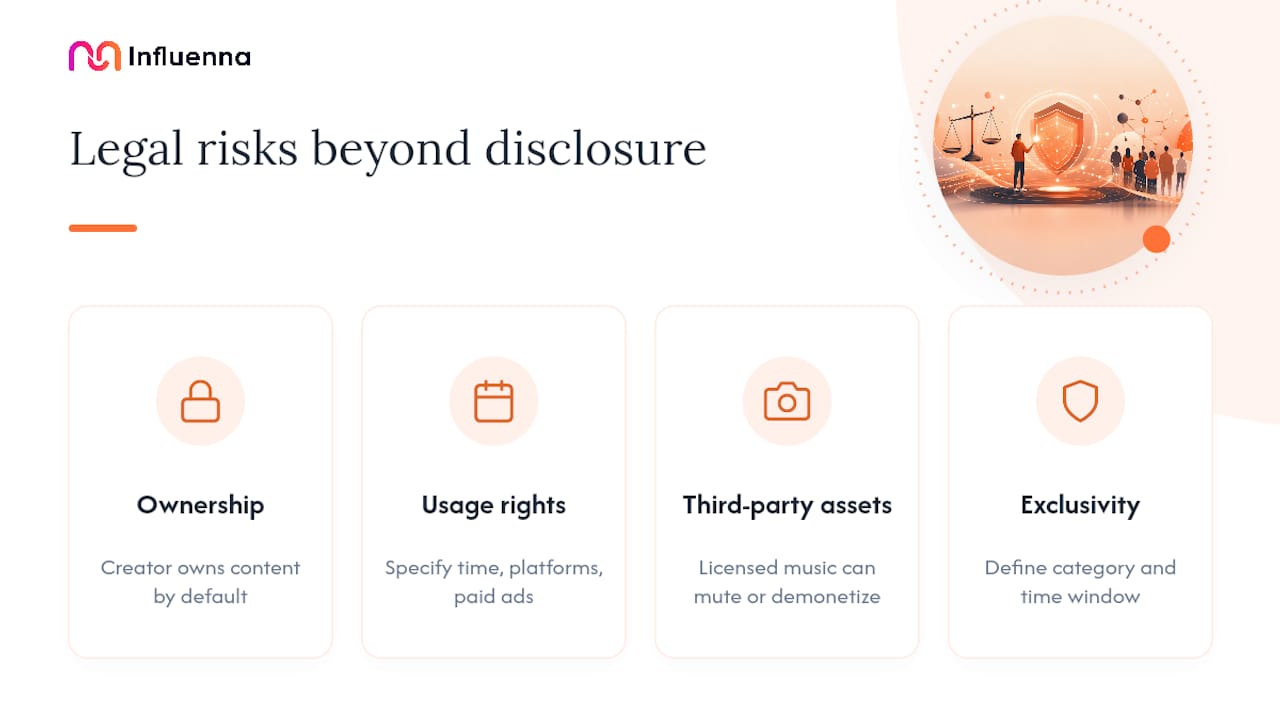
Disclosure gets most of the attention, but the contract's intellectual property terms usually cause more disputes down the line. Who owns the final video matters: by default, the creator owns their content unless the contract explicitly transfers or licenses rights to the brand. Usage rights need a defined scope, meaning how long the brand can run the content, on which platforms, and whether that includes paid advertising, because "usage rights" without a time limit can mean the brand runs your face in ads indefinitely for a fee you negotiated for a single post.
Music and third-party assets are another quiet risk. A dedicated video built around licensed music or a clip from another creator can trigger a copyright claim that mutes or demonetizes the video, which affects the brand's campaign as much as the creator's channel.
Exclusivity clauses need a defined category and time window, not a vague "no competitors." A creator who signs an unlimited exclusivity clause with a skincare brand could unknowingly forfeit deals in an entire adjacent category for a year. Finally, morality or brand-safety clauses, letting either party exit if the other's conduct damages the partnership, protect both sides and should be spelled out rather than assumed.
None of this replaces a lawyer for a high-value deal, but knowing these terms exist means you'll actually read for them before signing.
What I've Learned Watching Creators Price and Pitch Deals
Most creators underprice their first few deals, then overcorrect and price themselves out of the next ten. The fix isn't a magic rate card. It's tracking what actually converts.
Three things consistently separate creators who build sustainable sponsorship income from those who don't: they quote a range instead of a single number, they ask for usage rights and exclusivity terms explicitly instead of letting a brand define them by omission, and they treat every deal as a reference for the next one, not a one-off transaction.
Two habits sour brand relationships fast: missing agreed posting dates without communicating, and quietly reusing sponsored content for a competitor during an exclusivity window. Both get a creator quietly blacklisted by agencies, who talk to each other more than most creators realize.
Before accepting any offer, ask yourself one thing: does this deal specify payment terms, usage rights, and a reporting expectation in writing? If any of those three is missing, it's not a deal yet. It's a conversation.
— Igor
Where Influenna Fits Into Your Next Sponsorship
Most of the friction in this article traces back to one problem: finding the right partner before you've wasted weeks on the wrong ones. Influenna is a curated marketplace where every creator, brand, and agency account is reviewed by a person before they can even search the platform, so you're not filtering fake accounts or lowball inbound out of a pile of cold DMs.
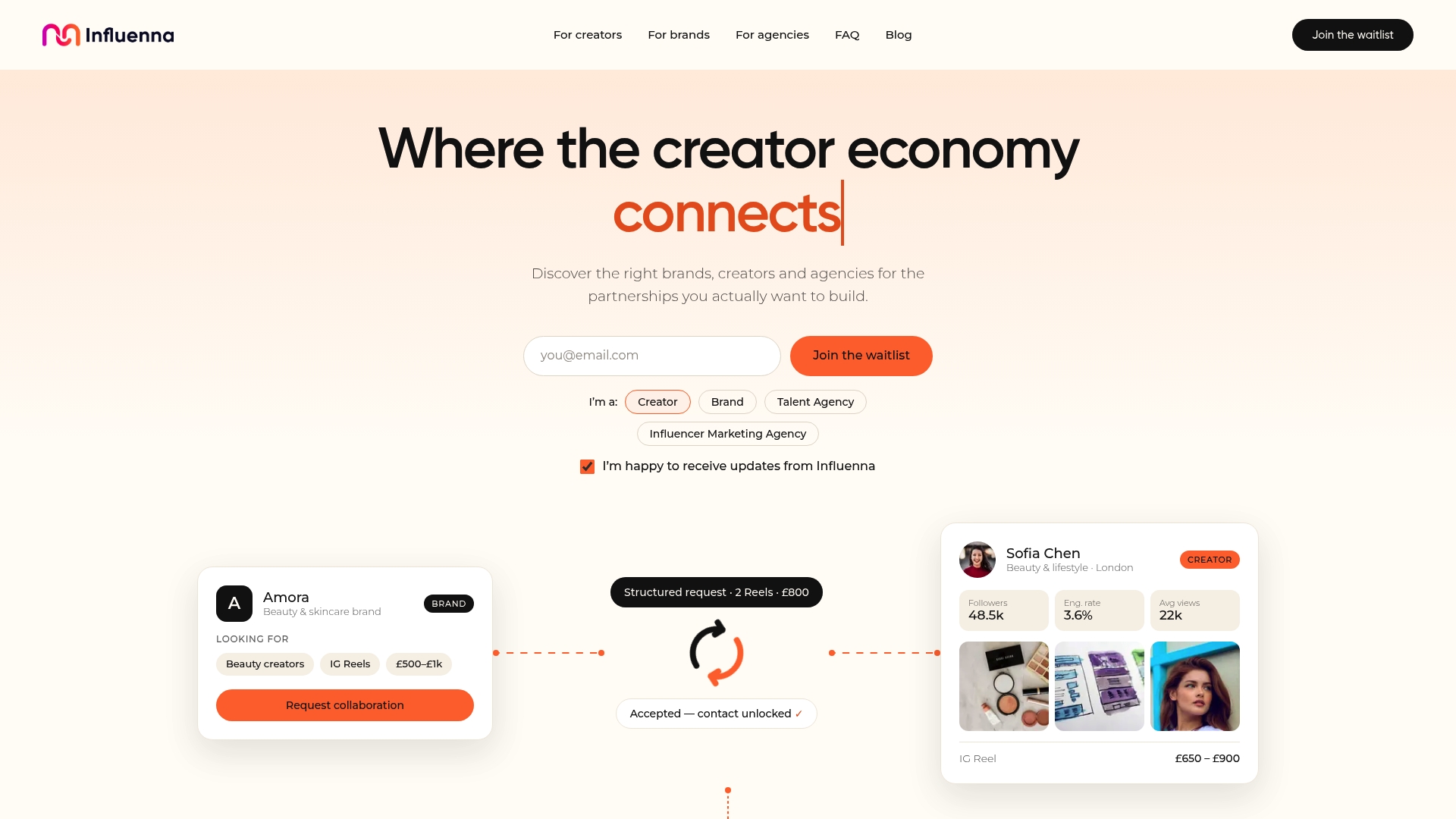
Instead of pitching into a void, you send a structured collaboration request with your rate, audience data, and deliverable expectations built in, so the other side can say yes or no with real information instead of guessing. Contact details stay private until both parties approve, which means the only conversations that reach your inbox are ones where there's already mutual interest. That structure matters more for smaller and mid-tier creators, who otherwise rely entirely on outbound pitching with no way to know if a brand is even a fit before reaching out.
Influenna is currently pre-launch, and the public site is open as a waitlist for creators, brands, talent agencies, and influencer marketing agencies who want structured matching instead of cold outreach when the platform opens.
Sources
- About YouTube BrandConnect - Google Ads Help
- YouTube Creator Partnerships: A new era for brand and creator collaborations - YouTube Blog
- FTC's endorsement guides: What people are asking
- YouTube creator campaign playbook - Think with Google (Search & Video)
FAQ
What Are the Four Main Types of YouTube Sponsorship?
The four most common types are dedicated videos, integrated mentions (pre-roll or mid-roll), Shorts bundles, and product seeding, with affiliate and ambassador deals layered on top of any of these as a payment structure rather than a separate format.
What Are Some Common YouTube Sponsorship Examples?
Common examples include a mid-roll product demo inside a tutorial video, a fully branded dedicated review, a Shorts series testing a product trend, and a months-long affiliate partnership using a discount code tracked to sales.
How Many YouTube Views Do I Need to Make $2,000 a Month From Sponsorships?
At a $25 CPM, a single video needs roughly 80,000 views to generate $2,000 from one integration, though most creators combine several smaller sponsored videos or a mix of formats to reach that monthly total rather than relying on one video.