UGC Rates in 2026: What Brands and Creators Actually Pay
17 min read

A single 30–60 second UGC video from a mid-tier creator typically costs $150–$300 as a base fee, but the all-in price after usage rights and overhead lands closer to $270–$720. Industry data from Spark UGC puts the all-in multiplier at 1.8x–2.4x the quoted base. That gap is where most brands blow their budgets and most creators leave money on the table.
The three things that move the price most:
- Usage rights. A 12-month paid-media license typically adds 50%–100% on top of the base fee. Perpetual or exclusive buyouts can double it again.
- Production complexity. A talking-head clip with one hook costs far less than a scripted, multi-scene product demo with B-roll and voiceover.
- Revisions and ghosting. Unlimited revision rounds and creator no-shows are the two most common hidden costs in any UGC program.
Key Takeaways
Mid-tier UGC creator rates typically run in the $150–$300 per short-form video range as a base, but the all-in cost after usage rights and overhead can be significantly higher.
| Point | Details |
|---|---|
| Base rate vs. all-in cost | Budget 1.8x–2.4x the quoted base to cover rights, revisions, and overhead. |
| Paid-media rights uplift | A 12-month paid-media license adds 50%–100% to the base fee; perpetual adds 100%–150%. |
| Retainer threshold | At 8–10 deliverables per month, a retainer saves 20%–25% per unit vs. per-video pricing. |
| Ghosting overage | Budget a 15%–20% overage on freelance programs to cover no-shows and unusable footage. |
| Influenna | A curated marketplace where creators share rates upfront and brands send structured briefs before contact details are exchanged. |
Table of Contents
- What do UGC rates actually look like in 2026?
- How do UGC pricing models work?
- Usage rights and licensing: the cost that brands consistently underestimate
- How should brands budget UGC across platforms?
- How should creators set their rates?
- Sample rate cards for a 30-second UGC video
- Why clear briefs and curated discovery reduce your real UGC cost
- What brands and creators consistently get wrong about UGC pricing
- Influenna connects brands and creators before the negotiation starts
- Sources
- FAQ
What do UGC rates actually look like in 2026?
The market is wider than most rate guides admit. At the low end, AI-generated UGC clips run $5–$25 per finished video at scale. At the high end, produced UGC spots with professional talent, scripted hooks, and full post-production clear $1,500. Most real human creator work sits between those extremes.
Tiksly's 2026 analysis confirms that deliverable complexity and usage rights drive price variance far more than follower count. That's the key structural difference between UGC creator rates and influencer rates: a UGC creator is selling you a usable asset, not audience access. Sepia's comparison of UGC vs influencer marketing makes this distinction clearly: influencer deals buy reach; UGC deals buy creative inventory for paid social testing.

Rate benchmarks by deliverable and creator tier
| Deliverable | Entry ($) | Mid-Tier ($) | Specialist ($) | Pricing Model | Paid-Rights Uplift | Platform Notes |
|---|---|---|---|---|---|---|
| 30–60s video | 100–200 | 150–300 | 500–1,500 | Flat fee | +50%–100% | TikTok/Reels/Shorts |
| Static photo pack (3–5 images) | 50–100 | 100–200 | 250–500 | Flat fee | +25%–50% | IG feed, Meta ads |
| Carousel (5–10 slides) | 75–150 | 150–250 | 300–600 | Flat fee | +25%–50% | IG, LinkedIn |
| Stories/Reels (3-pack) | 100–200 | 200–400 | 500–1,000 | Flat or bundle | +50%–75% | IG Stories, Reels |
| Raw footage (unedited) | 50–100 | 100–200 | 200–500 | Add-on or flat | +0%–25% | Any platform |
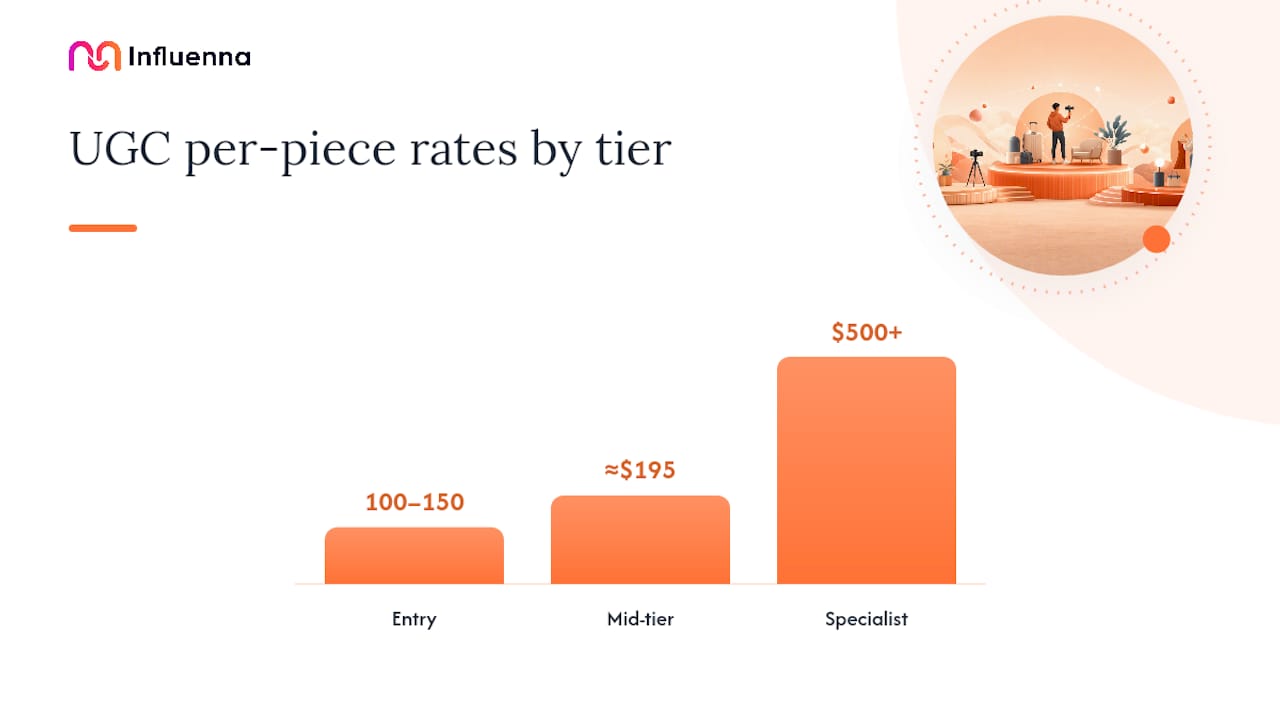
Public survey data clusters average creator charges near $175–$212 per content piece for mid-tier work, with a marketplace-reported median around $195. Entry creators often quote closer to $100–$150 for a basic clip; specialists with niche authority or produced-quality output regularly clear $500 per video before rights.
The outlier cases worth knowing:
- Very cheap AI-generated content ($5–$25) is increasingly used as a testing layer before committing to human creator spend.
- Premium produced spots ($1,000–$1,500+) typically include professional lighting, scripted hooks, multiple scene setups, and talent fees.
- Niche specialists (medical, finance, legal) command premiums of 30%–50% above general lifestyle rates because brand-safe expertise is genuinely scarce.
How do UGC pricing models work?
The structure of a deal matters as much as the per-unit rate. Here are the main models creators use and when each one makes sense.
-
Per-deliverable flat fee. One video, one price. Simple, low-commitment, and easy to compare. Best for testing a new creator or a one-off campaign. The downside: brands pay full rate every time, and creators spend time re-quoting and re-briefing for each project.
-
Package or volume pricing. A bundle of 3, 5, or 10 videos at a discounted per-unit rate. A creator charging $250 per video might offer a 5-pack at $200 each, saving the brand $250 while guaranteeing the creator a larger check. The math works for both sides when the brand knows it needs volume.
-
Monthly retainer. A fixed monthly fee for a set number of deliverables. A creator producing 8–10 videos per month for one brand typically negotiates a retainer rather than per-video pricing. At that volume, the per-unit admin overhead alone justifies a structured agreement. Retainers also give creators income predictability and give brands priority access to a creator's calendar.
-
Performance-linked pricing (CPM or view bonuses). The creator charges a base fee plus a bonus tied to views, clicks, or conversions. Useful when a brand wants the creator invested in performance. The risk: creators can't fully control distribution, so pure performance deals often undervalue their work. A hybrid (base + modest bonus) is more common in practice.
-
Revenue-share. The creator takes a percentage of sales driven by their content, often tracked via affiliate links. Common in creator-led e-commerce and DTC brands. Rarely the primary model for UGC-only work, but sometimes layered on top of a reduced base fee.
-
Agency or studio retainer. A managed service where a studio or agency delivers a set volume of assets per month. Higher monthly cost than freelance sourcing, but managed services reduce ghosting and internal coordination overhead, which matters when a brand needs 50+ variations per month.
Worked example: per-unit vs. bundle vs. retainer
- 1 video at $250 flat = $250 total, $250 per unit.
- 3-video package at $220 each = $660 total, $220 per unit (12% savings).
- 10-video monthly retainer at $190 each = $1,900/month, $190 per unit (24% savings, plus priority scheduling).
At fewer than 8 deliverables per month, per-video or bundle pricing usually wins on flexibility. Above that threshold, a retainer typically saves enough per unit to justify the commitment.
Usage rights and licensing: the cost that brands consistently underestimate
Base rates are just the starting point.
The main license categories:
- Organic-only. The creator posts to their own channel; the brand cannot run paid ads using the content. Lowest cost, lowest utility for performance marketers.
- Paid media, limited term (6 or 12 months). The brand can run the content as a paid ad on specified platforms for a defined period. A 12-month paid-media license typically adds 50%–100% to the base fee.
- Perpetual license. No expiration date. Adds 100%–150% to the base, sometimes more. Rarely worth it for most brands; creative fatigue usually makes content obsolete before the license matters.
- Exclusivity. The creator agrees not to work with competing brands for a defined period. Expect a 50%–100% premium on top of whatever rights package is already in place.
- Whitelisting / Spark Ads. Running paid ads through the creator's own handle rather than the brand's account. Whitelisting is typically priced either as a one-time uplift of 50%–100% or a monthly fee of 20%–50% of the base rate, depending on how the creator structures their rate card.
- Raw footage buyout. The brand receives unedited files to edit and repurpose. Usually priced as an add-on ($50–$200 depending on tier), not included in a standard deliverable fee.
- Territory limits. A license covering one country costs less than a global license. Relevant for brands running localized campaigns.
Every usage agreement should spell out:
- Which platforms are covered (Meta, TikTok, YouTube, programmatic, OOH, etc.)
- Geographic territory (country, region, or worldwide)
- License term (start date, end date, or perpetual)
- Exclusivity scope (category, direct competitor, or full exclusivity)
- Whether creator attribution is required
- Payment terms, currency, and applicable taxes
Pro Tip: Instead of negotiating a perpetual buyout upfront, propose a 6-month paid-media license with a renewal option at a pre-agreed rate. You test the creative, and if it performs, you renew. If it doesn't, you've saved the premium.
How should brands budget UGC across platforms?
Translating a per-video rate into a campaign budget requires three inputs: the all-in cost per asset, the expected impressions per asset, and the number of creative variations you need to test.
Converting creator rates to CPM equivalents (worked examples):
-
A $250 base video with 12-month paid rights at +75% = $437 all-in. If that video generates 500,000 impressions on Meta, the creative CPM is $0.87. Compare that to a $25 CPM media buy and the creative cost is a rounding error.
-
A $150 base video with organic-only rights = $150. No paid amplification allowed, so the creative CPM is undefined unless you track organic reach. For performance marketers, organic-only content has limited utility.
Platform notes:
- TikTok and Reels. Raw, lo-fi clips often outperform polished content on these platforms. Entry-tier creators ($100–$200) can produce effective TikTok-native content. Spark Ads (whitelisting) adds cost but typically improves performance.
- Meta feed and YouTube pre-roll. Higher-production content tends to hold attention longer. Mid-tier to specialist creators ($250–$600+) are more appropriate here.
- YouTube Shorts. Pricing is similar to TikTok/Reels; the format rewards quick hooks and vertical framing.
Budget scenarios:
- Small program (1–5 videos/month): $150–$500 per video all-in, $750–$2,500/month total. Per-deliverable flat fees work fine at this scale.
- Mid program (10–30 videos/month): $150–$350 per video all-in with bundle discounts, $1,500–$10,500/month. Bundle or retainer pricing starts making sense.
- Scale program (50+ variations/month): $100–$250 per video all-in via managed studio or high-volume marketplace, $5,000–$12,500+/month. Internal coordination costs become significant; BLS occupational wage data is a useful reference for estimating internal producer hours at $25–$45/hour depending on role and market.
Budget a 15%–20% overage for ghosting and unusable footage when sourcing from freelance creators. A 10-video program should plan for 12 briefs sent to account for at least one no-show or unusable delivery. Managed studios and curated marketplaces reduce that rate, but rarely to zero.
For marketing analytics platforms that help translate creative spend into CPM and ROAS reporting, several tools integrate directly with Meta and TikTok campaign data.
How should creators set their rates?
Pricing UGC consistently requires a formula, not a feeling. Here's one that works:
-
Base production fee. Estimate your time (scripting, filming, editing) at an hourly rate you'd accept for any skilled freelance work. Add gear depreciation and software costs. A 30-second video that takes 3 hours at $50/hour = $150 base.
-
Rights uplift. Add 50%–100% for 12-month paid-media rights. Organic-only? No uplift needed. Perpetual? Add 100%–150%.
-
Revision buffer. Include one round of revisions in the base. Charge $25–$75 per additional round, depending on complexity.
-
Platform or marketplace fee. If you're sourcing work through a platform that takes a cut, factor that into your quote so your net matches your target.
-
Tax and benefits buffer. As a self-employed creator, you're responsible for self-employment tax and benefits. Add 25%–30% to your net target to cover taxes, health insurance, and retirement contributions.
Worked example:
- Base production: $250
- 12-month paid-media rights (+75%): $187
- One revision included, second revision: $50
- Tax/benefits buffer (25% of $437): $109
- Final quote: $546
That $546 quote on a $250 base is not price gouging. It's accurate pricing.
Negotiation checklist for creators:
- Confirm the exact deliverables (length, format, aspect ratio, number of hooks)
- Agree on revision rounds included before signing
- Specify turnaround time and what happens if the brand delays feedback
- Clarify payment terms (net-15 or net-30, deposit required)
- Include FTC disclosure obligations in the contract: sponsored content must be clearly labeled
- State which platforms and territories the license covers
- Note applicable taxes and whether the brand will issue a 1099 (US) or equivalent
When a brand asks for 10+ videos per month or wants exclusivity in your niche, that's the moment to request a retainer rather than per-video pricing. Volume and exclusivity both justify a structured agreement with a monthly floor.
Sample email reply to a brand brief:
"Thanks for reaching out. Based on your brief, here's my rate for a 30-second UGC video with 12-month paid-media rights on Meta and TikTok: $[X]. This includes one round of revisions and delivery within 7 business days. Raw footage and additional hooks are available as add-ons. Let me know if you'd like a full rate card."
Sample rate cards for a 30-second UGC video
These are templates. Adjust the numbers to your market, niche, and experience level.
Entry-level creator rate card
- Base fee (30–60s video): $125
- 12-month paid-media rights: +$75 ($200 total)
- Whitelisting/Spark Ads (monthly): +$40/month
- Raw footage add-on: +$50
- Extra hook (per hook): +$30
- Additional revision round: +$25
- Rush delivery (under 48 hours): +$50
Mid-tier creator rate card
- Base fee (30–60s video): $250
- 12-month paid-media rights: +$175 ($425 total)
- Whitelisting/Spark Ads (monthly): +$75/month
- Raw footage add-on: +$100
- Extra hook (per hook): +$50
- Additional revision round: +$50
- Rush delivery: +$100
Specialist creator rate card
- Base fee (30–60s video): $600
- 12-month paid-media rights: +$400 ($1,000 total)
- Whitelisting/Spark Ads (monthly): +$150/month
- Raw footage add-on: +$200
- Extra hook (per hook): +$100
- Additional revision round: +$75
- Rush delivery: +$200
How a $250 base becomes $500–$750 all-in:
A mid-tier creator's $250 base video, with 12-month paid-media rights ($175), one extra hook ($50), and raw footage ($100), totals $575 before any rush or whitelisting fees. That's not unusual.
Brand negotiation script: "We'd like to test 3 videos before committing to a larger program. Can you offer a 3-pack rate with 6-month paid-media rights included? We'd also want to discuss whitelisting terms if the creative performs."
Creator response: "Happy to discuss a 3-pack. My 3-video rate with 6-month paid-media rights is $[X]. Whitelisting is available at $[Y]/month per video. I'd suggest starting with a 3-month whitelisting term so we can both evaluate performance before extending."
Why clear briefs and curated discovery reduce your real UGC cost
The biggest hidden cost in any UGC program isn't the per-video rate. It's the time spent briefing creators who ghost, reviewing content that misses the mark, and re-shooting because the original brief was vague.
A brief that reduces rework includes:
- Exact deliverable specs (length, aspect ratio, format, number of hooks)
- Brand tone and style references (links to approved creative examples)
- A usage rights checkbox (organic only / paid media / whitelisting / raw footage)
- Disclosure requirements (per FTC guidelines, sponsored content must be clearly labeled)
- Revision policy (how many rounds, what counts as a revision vs. a new deliverable)
- Payment terms and timeline
Human vetting before a creator joins a marketplace reduces mismatched expectations at the source. When a creator's rate card, niche, and content style are visible before any conversation starts, brands spend less time in back-and-forth and more time reviewing finished assets. Labeled metrics (verified vs. estimated vs. self-reported, broken out by platform) prevent the common mistake of comparing a TikTok view count to an Instagram reach figure as if they measure the same thing.
For agencies managing multiple brand clients, content reporting tools that track creative performance alongside spend help translate per-video costs into campaign-level efficiency metrics.
What brands and creators consistently get wrong about UGC pricing
The most common mistake brands make is treating the base rate as the budget. A $200 video with 12-month paid-media rights, whitelisting, and raw footage is a $450–$550 line item. Plan for the all-in cost from the start, or the program will run over budget every single time.
Creators make the mirror mistake: quoting a base rate without accounting for rights, revisions, or taxes, then feeling underpaid when the work is done. A quote that doesn't include a rights uplift is a quote that subsidizes the brand's ad spend.
One thing most guides skip: the value of a small paid-rights pilot before committing to a perpetual buyout. Run a 6-month paid-media license on a new creative. If it performs, renew at a pre-agreed rate. If it doesn't, you've saved the perpetual premium and the creative is already retired. Brands that insist on perpetual rights upfront are paying for optionality they rarely use.
Influenna's curation model addresses a related problem: when every creator on a platform has been reviewed by a person before joining, the baseline quality of briefs and rate cards is higher. Brands aren't guessing whether a creator understands usage rights; creators aren't fielding briefs from brands that have no budget clarity. That structural transparency reduces the negotiation friction that inflates real program costs.
Influenna connects brands and creators before the negotiation starts
Knowing the right rate is only half the problem. Finding a creator who understands usage rights, responds to structured briefs, and delivers on time is the other half, and that's where most programs lose time and money.
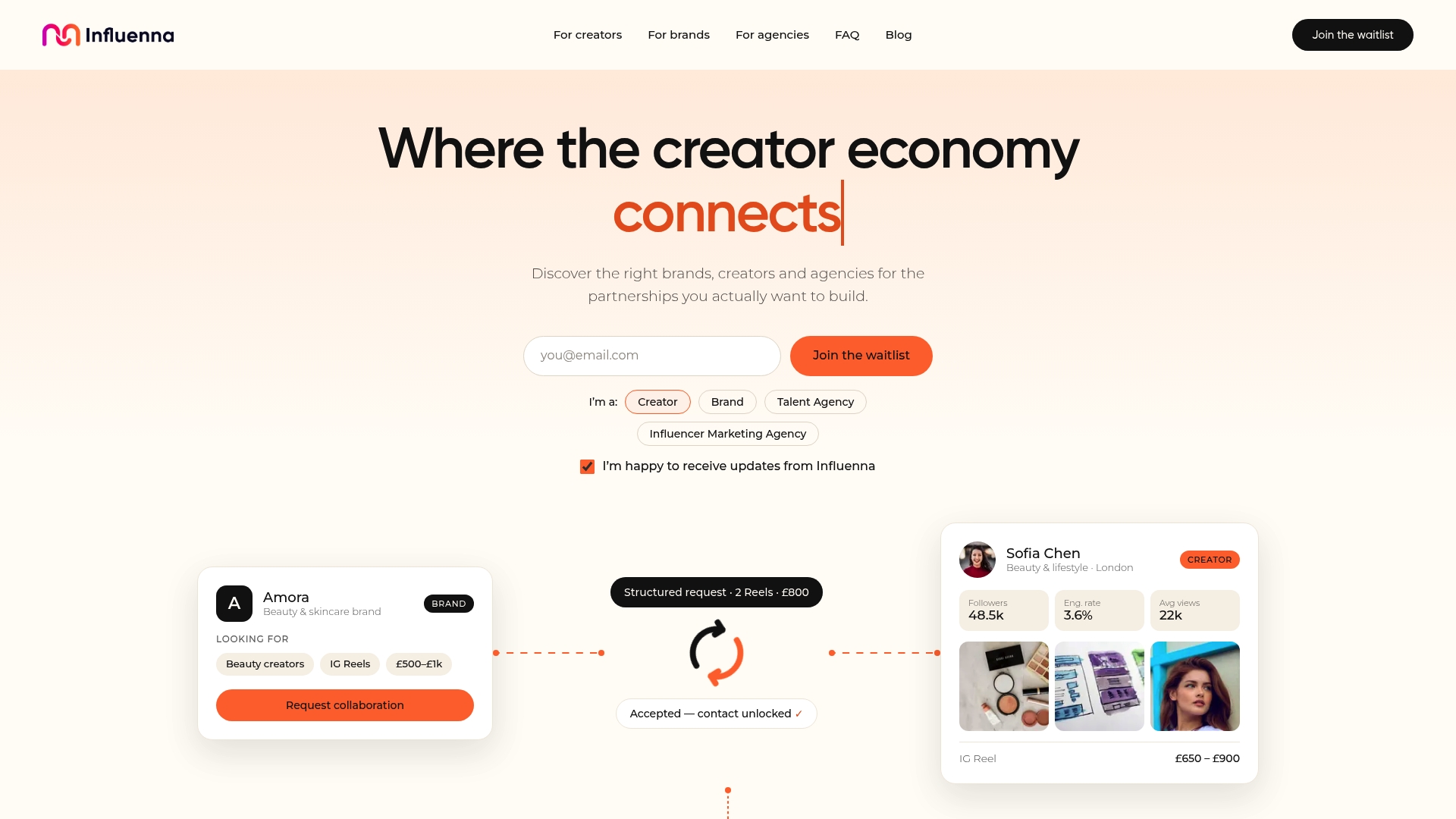
Influenna is a curated collaboration marketplace where every creator, brand, talent agency, and influencer marketing agency is reviewed by a person before joining. Brands send structured collaboration requests with brief details, budget ranges, and usage requirements upfront. Creators share their rates and preferences before any conversation begins. Contact details are exchanged only after both sides approve, which means the first real conversation is already qualified. No cold DMs, no ghosting from creators who were never a fit, no brands who discover their budget is half the going rate after three email exchanges.
Influenna is currently pre-launch. Join the waitlist at Influenna to be among the first to access the marketplace when it opens.
Sources
The following sources directly support the rate benchmarks, legal guidance, and budget frameworks in this guide:
- Disclosures 101 for social media influencers | FTC
- Self-Employed Tax Center | IRS
- UGC Creator Rates 2026: The Real All-In Cost | Spark UGC
- UGC Creator Rates 2026: What Brands Actually Pay
- Occupational Employment and Wage Statistics (OES) | BLS
FAQ
What are typical UGC rates in 2026?
Mid-tier creators charge $150–$300 per 30–60 second video as a base fee.
How much should I charge for a 30-second UGC video?
Entry creators typically charge $100–$200; mid-tier creators $150–$300; specialists $500–$1,500+.
What should I charge as a content creator?
That formula produces a defensible, all-in quote rather than a guess.
How do I charge for UGC content without underpricing?
Quote the all-in rate from the start: base production fee plus usage rights plus any add-ons (raw footage, extra hooks, whitelisting). Never quote only the base and add rights later; brands budget from the first number they see, and a surprise invoice damages the relationship.