TikTok Influencer Rates in 2026: A CPV-Based Pricing Guide
19 min read

Nano creators (1,000 to 10,000 followers) typically charge $25 to $300 per in-feed video, micro creators (10,000 to 100,000) run $200 to $2,500, mid-tier creators (100,000 to 500,000) land between $2,000 and $10,000, and macro and mega creators push into five-figure territory depending on niche and recent virality. Those ranges are a starting point, not a quote you should accept blind.
The number that actually protects your budget is cost per view. Take a creator's median views over their last 30 to 90 days, multiply by a CPV benchmark of roughly $0.008 to $0.150 depending on niche, and you get a defensible baseline fee, not a follower-count guess.
The formula: Baseline Fee = Median Views × CPV Benchmark.
Three things move that baseline up or down before you sign anything:
- Engagement rate. Above 5% often adds a premium; below 2% often justifies a discount.
- Niche and audience geography. Finance, tech, and US-heavy audiences price higher than general lifestyle content.
- Usage rights and Spark Ads. Paid amplification permission or whitelabel usage adds a separate line item on top of the base creative fee.
Key Takeaways
Fair TikTok influencer pricing comes from converting a creator's median views and engagement rate into a CPV baseline, not from reading their follower count.
| Point | Details |
|---|---|
| Use tiered ranges as a starting point | Nano to mega creators run roughly $25 to five figures per post; treat these as ranges, not fixed quotes. |
| Anchor every quote to CPV | Multiply median views by a niche CPV benchmark of $0.008 to $0.150 to get a defensible baseline fee. |
| Adjust for engagement rate | Apply a 10 to 30% premium above 5% engagement, or a 15 to 30% discount below 2%. |
| Price deliverables separately | Spark Ads, whitelabel usage, and live streams carry their own surcharge ranges on top of the base fee. |
| Verify metric provenance before quoting | Curated marketplaces like Influenna label audience data as verified, estimated, or self-reported so brands negotiate from real numbers. |
Table of Contents
- TikTok Influencer Rates by Follower Tier
- How Content Format and Deliverable Type Change the Price
- What Actually Moves TikTok Sponsorship Rates Up or Down
- Which Pricing Model Fits Your Campaign Goal
- How to Evaluate Any Creator's Rate Quote
- Negotiating TikTok Rates Without Overpaying
- Where TikTok Rates Fit Against Instagram and YouTube Budgets
- What to Plug Into a TikTok Rate Calculator
- An Editor's Notes on Requesting the Right Data
- Why the Follower-Count Habit Is So Hard to Break
- Find TikTok Creators Through Influenna's Curated Marketplace
- Sources
- FAQ
TikTok Influencer Rates by Follower Tier
Follower count is the first filter brands look at, and it's also the most misleading one. A creator with 300,000 followers and a dead comment section can cost more than a 40,000-follower creator whose audience actually watches to the end. Still, tiers give you a workable starting range before you dig into the numbers that matter more.
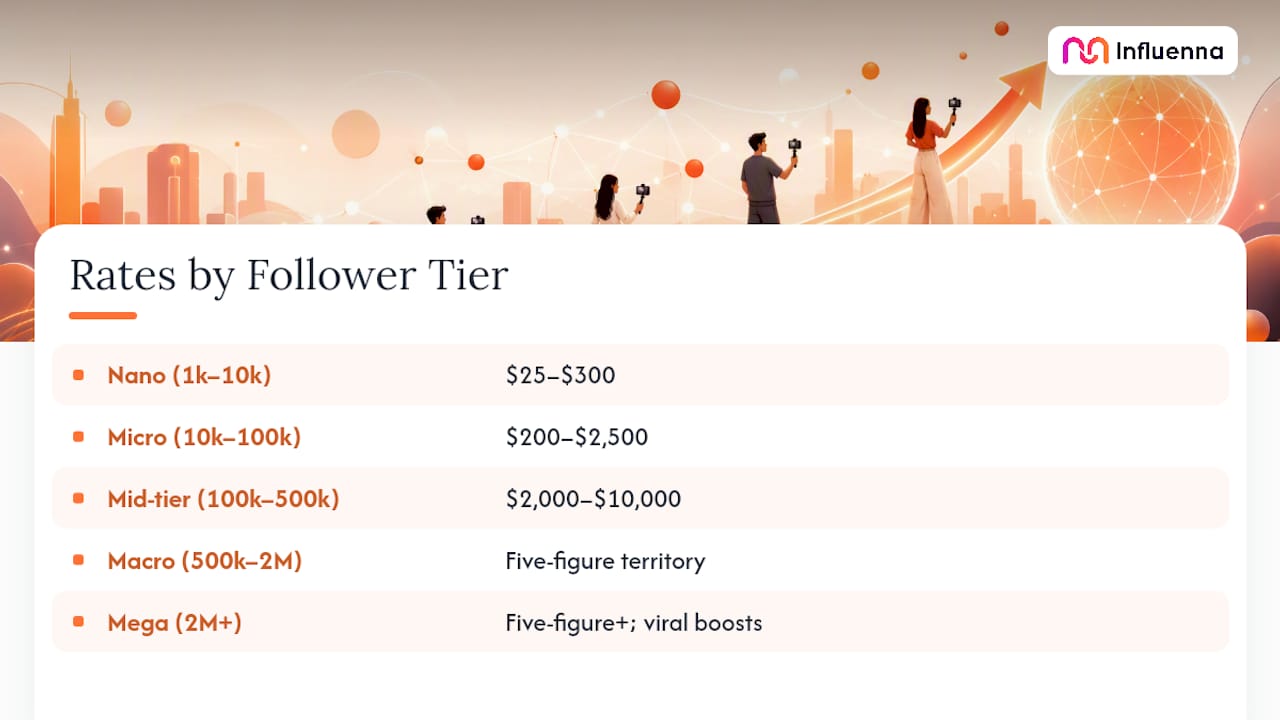
Nano creators (1,000 to 10,000 followers) typically run $25 to $300 per in-feed video. These accounts work best for hyper-niche categories, like a specific skincare ingredient or a regional food scene, where the audience trusts the creator precisely because they aren't famous. Expect wide variance here since many nano creators have never priced a brand deal before.
Micro creators (10,000 to 100,000 followers) land in the $200 to $2,500 range. This tier is where engagement rate starts to swing price meaningfully, because these creators still tend to have tight, responsive communities rather than passive follower counts inflated by one old viral clip.
Mid-tier creators (100,000 to 500,000 followers) run $2,000 to $10,000 per video. At this size, media kits get more polished, and brands should expect creators to negotiate with actual view and engagement data rather than vague promises.
Macro creators (500,000 to 2 million) and mega creators (2 million-plus) expand into five-figure territory, with the exact ceiling depending heavily on niche and whether the creator has had a recent viral moment. A mega beauty creator with a video that hit 20 million views last month can reasonably charge multiples of their usual rate for a few weeks, then settle back down.
How engagement rate repositions a creator within their tier
Two creators can sit in the same follower band and deserve wildly different prices. Engagement above roughly 5% commonly commands a 10 to 30% premium over the tier's midpoint, while engagement under 2% can justify a 15 to 30% discount. That's not a minor adjustment. On a $5,000 mid-tier quote, a strong engagement rate could push the fair price to $6,500, while weak engagement should pull it down to $4,000 or less.

Here's why this matters more on TikTok than almost any other platform: the algorithm decides who sees a video largely independent of follower count, so a creator's follower number tells you almost nothing about how many people will actually watch a sponsored post.
Pro Tip: Ask for the average engagement rate across the last 10 posts, not the creator's single best-performing video. One viral outlier can make a mediocre account look elite.
A worked example: converting views to a fair price
Fitness content tends to sit in the middle of the CPV range, so apply a benchmark of roughly $0.05 per view:
45,000 views × $0.05 = $2,250 baseline fee.
That number, not the creator's 80,000 follower count, is what should anchor your negotiation.
How Content Format and Deliverable Type Change the Price
The deliverable you're asking for changes the fee just as much as the creator's tier does. A single in-feed post and a 45-minute live stream with product callouts are not the same purchase, and pricing them identically is how brands overpay for low-effort work or underpay for high-effort work.
In-feed video posts are the baseline unit most rate ranges are built around: a standalone sponsored video that lives on the creator's own profile.
Spark Ads permission lets the brand run paid ads through the creator's original post and handle, borrowing their organic credibility for a paid campaign. This typically adds 20 to 75% on top of the base creative fee, depending on how long the brand wants amplification rights and how large the intended ad spend is.
Live streams with product demonstrations or shopping integrations command their own pricing structure entirely, often billed hourly or per session rather than per post, since they demand real-time engagement and typically longer creator commitment.
Whitelabel or UGC content (footage the brand owns and can repost as its own paid ad creative, stripped of the creator's handle) commands a steep premium: commercial ownership or extended usage rights can add 100 to 200% depending on territory and duration.
TikTok Shop affiliate arrangements often blend a smaller flat fee with a commission percentage on sales driven through the creator's shop link, which shifts some of the campaign risk onto the creator in exchange for upside if the product sells well.
Match the deliverable to your actual KPI:
- Brand awareness campaigns favor standard in-feed posts and Spark Ads amplification.
- Direct response and conversion campaigns favor TikTok Shop and whitelabel UGC, since both are built for paid distribution.
- Product education or high-consideration purchases favor live streams, where a creator can answer questions in real time.
Whatever you choose, specify the deliverable's expected metrics in the brief itself: median views for that format, not the creator's overall channel average, and whether usage rights extend beyond TikTok to other paid channels.
What Actually Moves TikTok Sponsorship Rates Up or Down
Follower count is the least reliable input in the entire pricing equation. Here's the order of operations smart buyers actually use when they open a creator's media kit.
- Check engagement rate first. Engagement above 5% supports a 10 to 30% premium; below 2% supports a 15 to 30% discount. Calculate it yourself from likes, comments, and shares divided by views across recent posts. Don't trust a self-reported number without the raw data behind it.
- Calculate median views, not average views. A single viral post skews an average badly. Pull the creator's last 15 to 20 videos, exclude obvious outliers, and take the middle value. That's the number you multiply by CPV.
- Compute view rate. Divide median views by follower count. A creator with 200,000 followers and 15,000 median views has a view rate under 8%, a real warning sign that their audience isn't actually watching.
- Weigh niche. Finance, tech, and B2B content generally sell at a premium CPV compared to general lifestyle or comedy content, because advertisers in those categories pay more for conversions downstream.
- Weigh audience geography. US-heavy audiences often command a 20 to 40% premium over creators whose audience skews toward lower-CPM regions, since ad rates in those markets are simply higher.
- Price recent virality carefully. A creator riding a viral moment from the last two to three weeks can justify a temporary rate spike, but that spike should not become the new permanent baseline once the moment fades.
None of these factors work in isolation. A finance creator with 4% engagement and a US-heavy audience might still price higher than a comedy creator with 7% engagement and a mostly international one, because the downstream ad value of that audience differs so much.
Which Pricing Model Fits Your Campaign Goal
TikTok deals get priced through four main structures, and picking the wrong one for your objective is a common way brands overspend without realizing it.
- Flat fee. A fixed price for a defined deliverable, paid regardless of performance. This fits brand awareness campaigns where reach and impressions matter more than direct conversions, and it's the easiest structure to budget against.
- CPV/CPM anchoring. The fee is calculated directly from expected views (median views × CPV benchmark), which keeps pricing tied to actual delivery rather than a creator's self-reported influence. Shopify's guide on influencer pricing frames this as the more defensible structure for brands trying to think in ROI terms rather than flat industry averages.
- Hybrid fee plus commission. A smaller guaranteed flat fee combined with a commission on sales through an affiliate link or TikTok Shop tag. This fits conversion-focused campaigns and splits risk between brand and creator.
- Performance bonuses. A base fee plus a bonus triggered by hitting agreed thresholds, like a certain view count or click-through rate. This works well when you want to reward strong delivery without paying full commission-style rates.
Converting between models: if a creator quotes a $3,000 flat fee and their median views run 60,000, that works out to $0.05 CPV, a reasonable mid-range benchmark. If their quote comes in at $6,000 for the same 60,000 views, that's $0.10 CPV, which should trigger a conversation about what justifies the premium: engagement, niche, or usage rights.
Whatever structure you land on, get these four items into the contract explicitly: the usage rights window (how long the brand can use the content and where), territory (which countries the usage rights cover), reporting requirements (screenshots, analytics access, or a shared dashboard), and the exact deliverable count and format.
Pro Tip: If a creator resists a CPV-based structure, ask them to share their last three brand deal results instead. Reluctance to share performance data is often the clearest signal that their rate is priced on follower count, not results.
How to Evaluate Any Creator's Rate Quote
Every quote deserves the same five-step check before it goes to your finance team for approval.
- Request median views for the last 30 to 90 days, broken out by format if the creator posts a mix of content types. A single average number across their whole account isn't specific enough.
- Request engagement rate, calculated from likes, comments, shares, and saves divided by views, ideally across at least 10 recent posts.
- Request audience geography and demographic breakdown directly from the creator's TikTok analytics dashboard, not a third-party estimate.
- Convert to CPV. Divide the quoted fee by expected views to see what you're actually paying per view, then compare that number against the $0.008 to $0.150 CPV range for the relevant niche.
- Compare the resulting CPV against tier and niche benchmarks before countering. If the quote lands well above benchmark, ask specifically what's driving the premium: engagement, usage rights, or exclusivity.
Watch for these red flags along the way:
- A creator who can't produce screenshots of their own analytics dashboard.
- Follower counts that don't match view counts at all (a sign of purchased followers).
- Engagement that's suspiciously uniform across every single post, which can indicate bot activity.
- Reluctance to share median views, offering only a single best-case example instead.
If a quote checks out on all five steps, you have a number you can defend internally and negotiate from with confidence.
Negotiating TikTok Rates Without Overpaying
Open with a number, not a question. Something like: "Based on your median views of X and our niche CPV benchmark, we're looking at a baseline around $Y. Can you share what's driving your quote above that?" This puts the creator in the position of justifying the gap, rather than you guessing at what's fair.
- Anchor every opening offer to CPV math, never to a round number pulled from thin air.
- Ask what specifically drives a quote above benchmark before countering blind.
- Be transparent about your total campaign budget early. It saves both sides negotiation cycles.
- Put usage rights and Spark Ads pricing in the brief before the creator sends a quote, not after.
Aggregating small creators versus investing in one bigger name comes down to cost-per-result, not cost-per-post. Five micro creators at $500 each with strong engagement can often outperform one macro creator at $2,500 on a cost-per-conversion basis, particularly for DTC brands where micro and lower mid-tier creators between roughly 50,000 and 200,000 followers tend to deliver stronger cost-per-result thanks to higher engagement and better conversion potential.
Sizing performance bonuses works best as a percentage of the base fee tied to a specific, measurable outcome: a 15 to 25% bonus for exceeding an agreed view threshold, or a set bonus per conversion tracked through an affiliate link. Keep the bonus structure simple enough that both sides can verify it without a dispute.
Pro Tip: Never negotiate rate and usage rights in the same breath. Settle the base creative fee first, then negotiate usage separately. Creators price these two things very differently, and blending the conversation makes it harder to tell what you're actually paying for.
Where TikTok Rates Fit Against Instagram and YouTube Budgets
Budget holders splitting spend across platforms need a shared unit, and CPV works better for that than raw per-post rates, which vary too much by platform format to compare directly.
- TikTok pricing leans harder on CPV and median views than Instagram or YouTube, because the algorithm's discovery-driven distribution makes follower count a weaker predictor of reach.
- Instagram rates still track closer to follower count and Story/feed placement, since its distribution favors existing followers more than TikTok's does.
- YouTube commands higher per-post rates at comparable tiers, largely because long-form video demands more production time and delivers longer average watch time per viewer.
- For pure brand awareness at scale, TikTok often delivers the lowest CPV of the three; for high-consideration purchases needing detailed explanation, YouTube's format still justifies its premium.
Treat platform allocation as an extension of the same CPV framework you use within TikTok, not a separate budgeting exercise.
What to Plug Into a TikTok Rate Calculator
Any calculator or spreadsheet model is only as good as its inputs, and the four that matter are median views, engagement rate, US audience percentage, and niche CPV benchmark. Rate estimators that rely mainly on follower count routinely overstate fair price for accounts with inflated followings and understate it for smaller, highly engaged creators.
Worked example: a tech creator with 150,000 median views and a mid-range niche CPV of $0.06 gives you a baseline of $9,000.
| Input | Why It Matters |
|---|---|
| Median views (30 to 90 days) | The actual delivery number CPV should be calculated against |
| Engagement rate | Drives the 10 to 30% premium or 15 to 30% discount |
| US audience percentage | Drives a 20 to 40% geography premium where applicable |
| Niche CPV benchmark | Sets the base multiplier before adjustments |
Track delivered views and conversions after every campaign. That data becomes your own internal benchmark, and it's more reliable than any industry-wide range.
An Editor's Notes on Requesting the Right Data
Most brands ask creators for a media kit and call it due diligence. That's backwards. A media kit is marketing material the creator controls. What you actually need is raw analytics: median views over 60 to 90 days, engagement rate calculated from the underlying numbers, and an audience geography breakdown pulled straight from TikTok's own creator dashboard.
Build your brief around those three data points before you ask for a quote, not after. Specify the deliverable format, the usage rights window, and the reporting you expect in return. A brief that asks for this upfront filters out creators who aren't prepared to negotiate on real numbers.
This is also where a lot of negotiation friction actually starts: brands and creators approaching each other without shared context on rates, metrics, or expectations. A structured request process, rather than a cold DM with a vague "we'd love to collaborate," tends to surface the right fit faster and with fewer wasted messages. Curated marketplaces built around verified or clearly labeled metrics, like Influenna, are designed around exactly this problem: matching brands and creators who've already been reviewed, with rate expectations and preferences stated upfront instead of discovered three emails into a negotiation.
- Ask for raw analytics, not a polished media kit.
- Specify deliverable format and usage window before requesting a quote.
- Treat metric provenance (verified versus self-reported) as part of your evaluation, not an afterthought.
Why the Follower-Count Habit Is So Hard to Break
Brands keep pricing off follower count because it's the number they see first, and old habits from Instagram's earlier, more follower-driven era die slowly. But TikTok's discovery algorithm broke that link years ago. A 300,000-follower account and a 40,000-follower account can deliver the same number of views on a given post, and treating them as different price tiers just because one has a bigger number attached is a mistake dressed up as diligence.
The uncomfortable part for a lot of marketers: this means your procurement process needs an extra step most teams skip, actually pulling median views and engagement data before a quote gets approved, rather than after a campaign underperforms. That step is inconvenient. It's also the difference between a defensible budget and a guess with a number attached to it.
If there's one place conventional advice falls short, it's treating rate cards as fixed price lists instead of starting points for a CPV conversation. The tiers in this guide are useful for a first estimate. They should never be the last word in a negotiation.
Find TikTok Creators Through Influenna's Curated Marketplace
Influenna gives brands and agencies a faster route to the data this guide keeps pointing you toward. Every creator on the platform is reviewed by a person before joining, and audience metrics are labeled by provenance, verified, estimated, or self-reported, so you know exactly what you're pricing against instead of guessing from a screenshot.
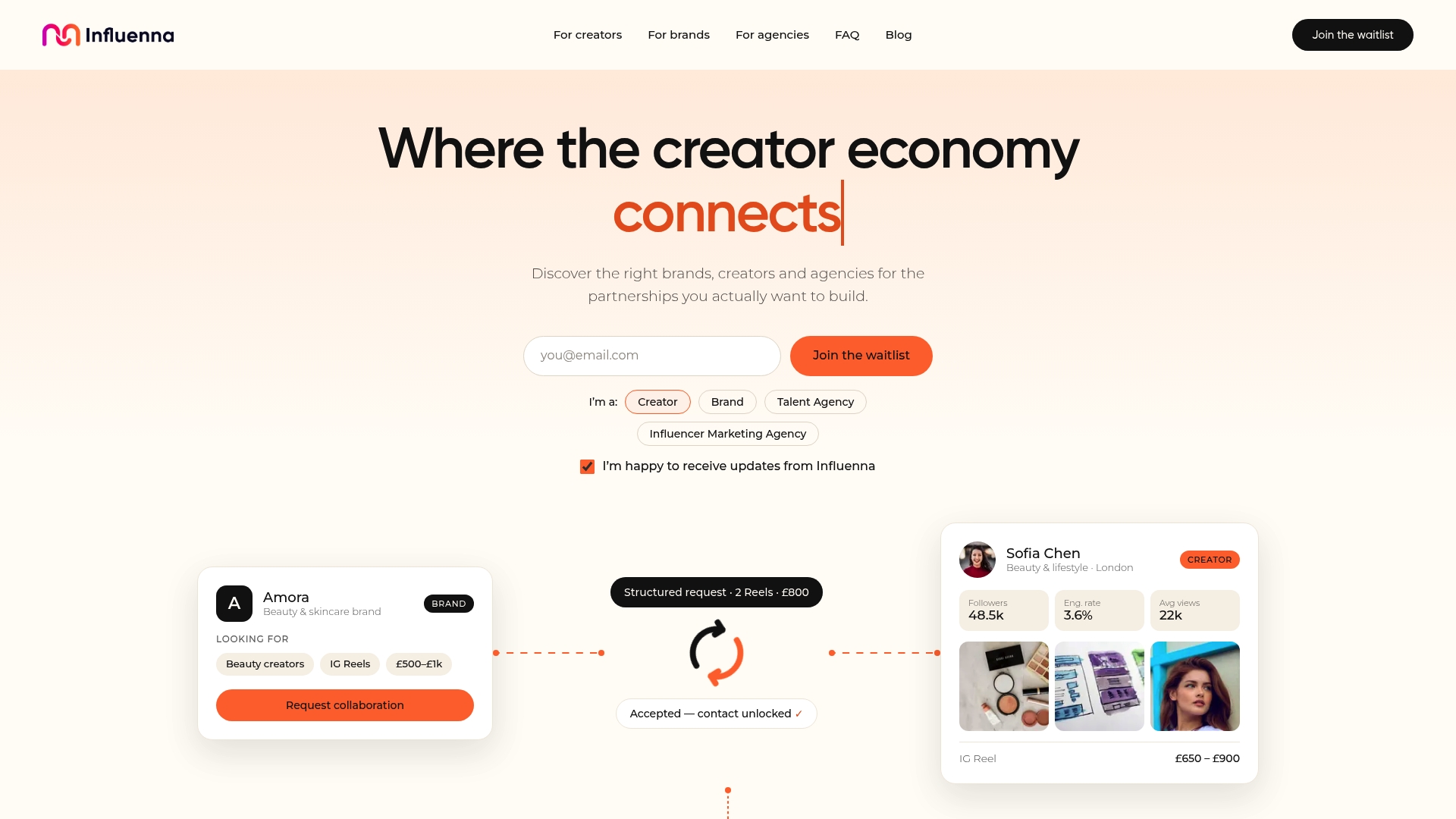
Instead of cold DMs and back-and-forth media kit requests, you send a structured collaboration request with your deliverable, budget range, and usage rights already spelled out. Contact details unlock only once both sides approve, which cuts out the negotiation cycles wasted on creators who were never a fit. Influenna is currently pre-launch, with the public site open as a waitlist. Join the Influenna waitlist to get early access when the marketplace opens to brands and agencies.
Sources
- TikTok Brand Deal Rates: What Brands Pay Creators for Sponsored Content in 2026 — InfluencerFee
- TikTok Brand Deals: How Much Do They Actually Pay? (2026 Rate Guide) — EarnTrackr
- TikTok Influencer Rate Card (2026) — CreatorScore
- Influencer Pricing: The Cost of Influencers in 2026 — Shopify
FAQ
How many TikTok views does it take to earn $1,000?
Using a mid-range CPV benchmark of roughly $0.05 per view, a video would need a certain number of views to reach $1,000 in sponsored fee value, though the exact figure shifts with niche and engagement rate.
What is a good rate for a TikTok influencer to charge?
A good rate depends on tier and engagement, but a common benchmark is $0.008 to $0.150 per median view, adjusted up 10 to 30% for engagement above 5% or down 15 to 30% for engagement below 2%.
How much are 10,000 views worth on TikTok?
At a mid-range CPV of $0.05, 10,000 views works out to roughly $500 in sponsored content value, though niche and audience geography can push that figure higher or lower.
How much does a TikTok creator with 1,000 followers charge?
Creators in the 1,000 to 10,000 follower nano tier typically charge $25 to $300 per in-feed video, with the final number depending more on engagement rate and niche than the follower count itself.
Should brands price TikTok deals off followers or views?
Views and engagement rate predict actual delivery far better than follower count, since TikTok's algorithm distributes content based on watch behavior rather than existing follower relationships.