TikTok Creator Rates: Benchmarks and How to Judge Any Quote
14 min read

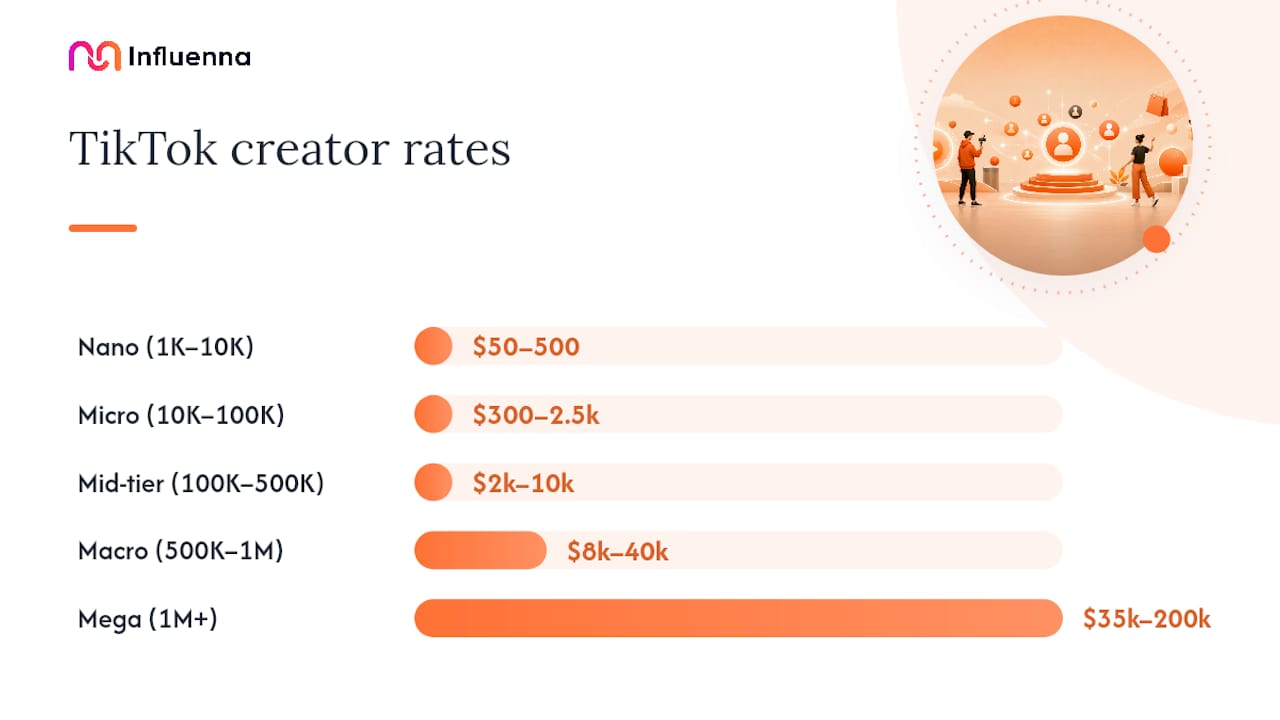
Nano creators (1,000 to 10,000 followers) typically charge $50 to $500 per sponsored video. Micro creators (10,000 to 100,000) run $300 to $2,500. Mid-tier creators (100,000 to 500,000) land between $2,000 and $10,000. Macro creators (500,000 to 1 million) charge $8,000 to $40,000, and mega creators above a million followers can command $35,000 to $200,000 or more per video, according to pricing data from Influencer Fee.
Those numbers are a starting point, not a verdict. The single most useful thing you can do before agreeing to any of them is calculate cost per view (CPV): the quoted rate divided by the creator's median views over their last 10 to 15 posts. A $2,000 quote from a creator who reliably pulls 400,000 views costs you half a cent per view. The same $2,000 from someone whose recent posts hover at 40,000 views costs you five cents per view, ten times more expensive for the same invoice.
Follower count tells you almost nothing about what you're actually buying. Engagement rate, average views, audience geography, and niche all move the real price far more than the number displayed on a profile.
- Nano (1K–10K followers): roughly low to moderate fees per video
- Micro (10K–100K): moderate fees
- Mid-tier (100K–500K): mid-level fees
- Macro (500K–1M): relatively high fees
- Mega (1M+): the highest fees per video
Pro Tip: Before you negotiate anything, ask for four numbers: median views over the last 10 to 15 posts, engagement rate, audience geography breakdown, and niche concentration. A rate quote without those four data points isn't a quote, it's a guess.
Budget for add-ons beyond the base fee too. Spark Ads authorization (letting your brand run paid promotion through the creator's account), extended usage rights, and exclusivity windows can add 50% to 200% on top of the headline number, per CreatorScore's rate card breakdown.
Key Takeaways
The most reliable way to compare TikTok creator quotes is cost per view, calculated from median recent views, not the headline rate or follower count alone.
| Point | Details |
|---|---|
| Use CPV, not followers | Divide the quoted rate by median views from the last 10 to 15 posts to get a comparable number. |
| Request four data points | Ask for median views, engagement rate, audience geography, and niche concentration before negotiating. |
| Budget for add-ons | Spark Ads authorization and usage rights can each add 50% to 200% on top of the base fee. |
| Target micro to mid-tier for ROI | Creators in the 50,000 to 200,000 follower range often deliver the lowest CPV for DTC conversion goals. |
| Put deliverables in writing | Specify revisions, usage duration, reporting deadlines, and payment splits before signing. |
Table of Contents
- TikTok Creator Rates by Tier: What the Ranges Actually Mean
- How to Evaluate Any Creator Quote Using CPV
- What Moves the Price: Rights, Exclusivity, and Production Complexity
- Building a Negotiation Checklist Before You Sign
- Worked Examples: Turning a Quote Into a Decision
- Tools and Media Kit Checklist for Rate Verification
- Why Sourcing Structure Changes Pricing Clarity
- What the Rate Data Actually Tells Brands
- Sources
- FAQ
TikTok Creator Rates by Tier: What the Ranges Actually Mean
The ranges above hold up across most industry sources, though the exact bands shift depending on who's counting. Hootsuite's 2026 benchmarks put nano creators at $20 to $500, micro at $500 to $2,000, mid-tier at $2,000 to $5,000, macro at $5,000 to $20,000, and mega above $20,000. The spread between sources exists because "rate" means different things to different creators: some quote a bare video with no usage rights, others bundle in a Spark Ads window or a Instagram Story crosspost.
Treat any published range as a sanity check, not a price tag. The real number for a specific creator depends on three things that follower count doesn't capture.
Average views matter more than followers. A creator with 200,000 followers but a recent posting slump averaging 15,000 views is not a mid-tier buy anymore, whatever their bio says. Ask for median views across their last 10 to 15 organic posts, not their best-performing video ever. One viral post from eight months ago tells you nothing about what you'll get next week.
Engagement rate predicts conversion better than reach. Creators with verified engagement above the norm for their tier can reasonably charge a premium, and Hootsuite's research notes that engagement is a stronger predictor of downstream conversion on TikTok than raw follower count. If you're running a performance campaign, weight engagement rate over audience size when comparing two similarly priced creators.
Niche and audience geography set the ceiling. A finance or B2B software creator can charge more per view than an entertainment creator with triple the audience, because the buyer intent behind that audience is worth more. Audience concentrated in the US, UK, Canada, or Australia commands a premium over audiences skewed toward lower ad-spend markets, a pattern consistent with the broader influencer marketing data Statista tracks.
Deliverable type changes the math too:
- In-Feed sponsored video is the baseline rate most tier ranges describe: a standard organic-style post under 60 seconds with a brand mention or demo.
- TikTok LIVE integrations are usually priced separately, often as an hourly or flat per-stream fee, and carry less standardized benchmarks since delivery is harder to guarantee.
- Spark Ads authorization adds cost on top of the base video because you're licensing the creator's handle and engagement history to run as a paid unit.
- White-label or UGC content (footage without the creator's face or handle, meant purely as ad creative) often prices lower than a branded post since it carries none of the creator's audience or algorithmic reach, just the content itself.
How to Evaluate Any Creator Quote Using CPV
Every quote you receive should get run through the same math before you say yes. Here's the process.
- Request median views, not lifetime average. Ask the creator (or their agency) for view counts on their last 10 to 15 organic posts, and calculate the median rather than the mean so one viral outlier doesn't skew your read.
- Divide the quoted rate by median views. A $5,000 quote against 250,000 median views produces a CPV of $0.02. That's your comparable number across every creator you evaluate, regardless of tier or follower count.
- Check that CPV against niche benchmarks. Category matters enormously here. Entertainment content tends to run $0.008 to $0.020 per view, beauty and fashion $0.015 to $0.030, tech and software $0.020 to $0.045, and finance content, thanks to high buyer intent and advertiser competition, can justify $0.050 to $0.150 per view, according to Influencer Fee's category breakdown.
- Weight the result by the other three numbers. A CPV that looks great on paper still needs to hold up against engagement rate, audience geography, and niche concentration. A finance creator with 90% US audience and 8% engagement at $0.09 CPV is a stronger buy than a lifestyle creator at $0.03 CPV with 40% audience overlap in markets you don't sell into.
The four essential numbers to request from any creator before you negotiate: median recent views, engagement rate, audience geography percentage, and niche concentration (how consistently they post in your category versus general lifestyle content). Skip any of the four and you're negotiating blind.
A quote that beats the category CPV benchmark isn't automatically a bargain, and one that exceeds it isn't automatically overpriced. A finance or B2B creator charging above the entertainment-tier CPV is often pricing in the higher intent of their audience correctly. Context beats the raw number every time.
What Moves the Price: Rights, Exclusivity, and Production Complexity
The headline rate is the floor, not the full invoice. Several line items routinely add to the base fee, and brands that don't ask about them upfront end up with change orders mid-campaign.
- Spark Ads authorization typically adds 50% to 200% on top of the base rate depending on the duration (commonly sold in 30, 60, or 90-day windows) and territorial scope of the paid usage license, per Influencer Marketing Hub's cost guide.
- Usage rights and whitelabeling (using the content in your own paid ads or on other channels without the creator's handle attached) scale cost similarly, often in the same 50% to 200% range depending on how broadly you want to use the footage and for how long.
- Exclusivity windows, where the creator agrees not to work with competing brands for a set period, add a separate premium on top of usage rights, and the premium usually scales with the length of the exclusivity term.
- Production complexity (multi-location shoots, wardrobe changes, scripted dialogue versus casual demo) pushes rates up because it eats into the creator's time beyond a typical single-take TikTok video.
- Rush timelines and seasonal demand (Q4 retail, back-to-school, major shopping events) can add a premium simply because creator calendars fill up fast during those windows.
Pro Tip: Ask every creator to itemize their quote into base content fee, Spark Ads add-on, and usage rights separately. A single lump-sum number hides which line item you're actually overpaying for, and makes it impossible to negotiate any one piece down.
Viral potential complicates pricing further. CreatorScore's rate card analysis notes that a genuine viral moment can justify a temporary 2x to 3x rate bump on a creator's next few bookings. If a creator's price jumped sharply after one breakout video, ask whether that video reflects their typical delivery or an outlier you shouldn't expect to repeat.

Building a Negotiation Checklist Before You Sign
Get the following in order before a contract goes out, not after.
- Collect performance data first. Request median views, engagement rate, audience geography, and examples of past branded content with actual view counts, not just screenshots of the finished post.
- Verify the numbers where you can. Cross-check follower and view counts against what's publicly visible on the creator's profile; a mismatch between claimed and visible performance is your first red flag.
- Spell out deliverables precisely. Number of videos, length, whether it's In-Feed or LIVE, how many revision rounds are included, and the posting deadline all belong in writing.
- Lock in usage rights and duration. Specify exactly where you can use the content, for how long, and whether Spark Ads authorization is included or billed separately.
- Set the payment structure. A 50/50 split (half on signing, half on delivery) is common; for performance-driven campaigns, consider a smaller upfront fee plus a bonus tied to view count or conversion thresholds.
- Define reporting requirements. Require a screenshot of native analytics within 48 to 72 hours of posting, not just a link to the live video.
- Include cancellation terms. Specify what happens, and what's owed, if either side needs to back out after signing but before delivery.
Watch for creators who resist sharing analytics screenshots, who only provide follower counts with no view or engagement data, or whose past "branded content" examples show suspiciously flat engagement. Those are signs to slow down, not sign faster.
Worked Examples: Turning a Quote Into a Decision
Say a micro creator with 60,000 followers quotes $800 for a sponsored video, and their last 12 posts show median views of 55,000. That's a CPV of roughly $0.0145, solidly inside the entertainment and lifestyle benchmark range. If your goal is broad awareness, that's a reasonable buy.
Now say a mid-tier creator with 300,000 followers quotes $6,000 including a 60-day Spark Ads license, with median organic views of 180,000. Base CPV on the organic post alone is $0.033, but factoring in the paid amplification the effective view volume climbs substantially, which usually lowers your blended CPV if the ads perform even moderately well. For a conversion-focused campaign, that Spark Ads add-on is often worth the premium specifically because it extends reach past the creator's organic audience.
As a rule of thumb, industry data suggests that micro and lower mid-tier creators, roughly 50,000 to 200,000 followers, tend to deliver the strongest ROI for direct-to-consumer brands. Their engagement rates run higher than macro or mega creators, and their CPV is typically lower. Save mega-tier spending for brand-awareness pushes where sheer reach matters more than conversion efficiency.
Tools and Media Kit Checklist for Rate Verification
A CPV calculator only works with three real inputs: median views, engagement rate, and audience geography breakdown. Plug in guesses and you get a guess back.
Before you accept any media kit at face value, check it against this list:
- Median views across recent posts (not just top performers)
- Engagement rate, labeled as verified, estimated, or self-reported
- Audience geography by country percentage
- Niche concentration or content category consistency
- Past branded content performance with actual screenshots
Third-party tools generally fall into three categories: audience verification services that flag bot followers, view-history exporters that pull a creator's actual posting data, and affiliate or Shop performance trackers for creators running TikTok Shop links. None of these replace asking the creator directly, but they're useful for spot-checking numbers that seem inflated.
Why Sourcing Structure Changes Pricing Clarity
Most rate confusion doesn't come from creators lying about their numbers. It comes from brands never asking the right four questions in the first place, and creators quoting a fair price for one deliverable while the brand assumed a different one.
Influenna's marketplace addresses that gap structurally rather than through guesswork. Every account, creator, brand, agency, is reviewed by a person before joining, and collaboration requests are structured from the start, meaning rate expectations and deliverables get stated upfront instead of buried in a cold DM thread. Contact details unlock only after both sides approve, which means the negotiation that follows starts from clearer footing on both ends.
What the Rate Data Actually Tells Brands
The conventional advice, budget by follower tier, isn't wrong so much as incomplete. It gets you into the right neighborhood and then abandons you there. The real skill in buying creator content on TikTok is knowing that two creators in the same tier can carry a tenfold difference in real cost once you account for what their audience actually does after watching.
What gets underestimated most is engagement rate's predictive power. Brands fixate on follower count because it's the number displayed most prominently, but it's the least useful one for judging whether a partnership will perform. CPV forces a discipline that follower-based budgeting doesn't: it makes you ask what you're actually buying before you agree to pay for it.
If you take one thing from this guide, make it the habit of requesting those four numbers, median views, engagement rate, audience geography, niche concentration, before you ever discuss price. Everything else in a negotiation gets easier once both sides are working from the same real data instead of a follower count on a profile page.
Sources
- TikTok Influencer Rates 2026: Complete Pricing Guide by Tier & Format
- Influencer rates: How to maximize your budget in 2026
- TikTok Influencer Rate Card (2026) | CreatorScore
- TikTok influencer rates in 2026: A complete cost guide for brands | Influencer Marketing Hub
FAQ
How many TikTok views does it take to earn $1,000?
Through the TikTok Creator Rewards Program alone, creators generally need several million views to earn $1,000, since payout rates per view are small; the far more reliable path to that kind of money is a single branded partnership, where even a nano or micro creator can charge $500 to $1,000 or more per sponsored video.
How much is 10,000 views worth on TikTok?
Through platform ad-revenue payouts, 10,000 views typically earns only a few dollars at most, since per-view rates are fractions of a cent. Brand deals are priced separately from platform payouts and are based on the creator's overall rate, not a per-view platform payment.
How much can a creator with 7 million followers charge?
Mega-tier creators above 1 million followers typically charge $35,000 to $200,000 or more per sponsored video, with the exact figure depending heavily on engagement rate, niche, and add-ons like Spark Ads or exclusivity, according to industry benchmarks.
What does it cost to work with a creator who has 1,000 followers?
Nano creators with around 1,000 followers typically charge $50 to $500 per sponsored video, though many at this size are open to product-only collaborations rather than a paid fee.