Influencer Payment Terms: Standard Rates & Clauses
13 min read

Standard influencer payment terms fall into three patterns: a 50/50 deposit split for direct creator deals, Net-30 for agency-mediated contracts, and milestone or hybrid schedules (base pay plus performance bonus) for larger productions. If you take one action from this article, take this one: always request a deposit or escrow before you start work, and send an invoice the moment content is delivered or published, whichever your contract defines as the trigger.
A few numbers anchor this before we go further:
- 50/50 split (deposit at signing, balance on publish) is the default for direct brand deals
- Net-30 is standard once an agency sits between you and the brand
- Escrow becomes worth the paperwork on deals above $25,000
- U.S. creators cross the 1099-NEC reporting threshold at relatively low annual payments from a single client
Everyone in the creator economy uses the phrase "payment terms" loosely, but the industry-standard version of it covers four things: when you get paid, how much upfront, what usage rights the payment buys, and what happens if the brand is late. Contracts that spell out all four cause far fewer disputes than ones that only mention a flat fee.
Key Takeaways
Influencer payment terms work best when the schedule, usage rights, and remedies are all defined in writing with specific dates, percentages, and triggers rather than general language.
| Point | Details |
|---|---|
| Default schedule | Use a 50/50 split for direct deals and Net-30 for agency-mediated contracts. |
| Price usage separately | Charge around 25% of base rate per month for paid social or whitelisting on top of the posting fee. |
| Perpetual rights cost more | Price perpetual usage at 200 to 300% of the base rate, never as a free add-on. |
| Protect against late payment | Add a late-fee clause, a kill-fee, and escrow for deals above $25,000. |
| Invoice on a trigger | Send invoices within days of publish or delivery, and start Net terms from the invoice date. |
Table of Contents
- Payment Terms Influencers Should Expect by Deal Type
- How Should Influencers Invoice for Sponsored Content?
- What Should You Charge for Usage Rights?
- Red Flags in Influencer Marketing Contracts
- Negotiation Checklist and Sample Clauses
- From Brief to Paid: The Full Timeline
- What the Push for Standard Payment Terms Really Means
- Sources
- FAQ
Payment Terms Influencers Should Expect by Deal Type
Three structures cover most influencer marketing contracts, and which one you get usually depends on deal size and whether an agency is involved.
50/50 split. Half the fee at signing, half on publish. This is the working default for direct creator-to-brand deals because it protects your cash flow if you're fronting production costs (props, editing, a second shooter) while still giving the brand a reason to believe you'll deliver. It's the model most consultants recommend as a starting point for new relationships with no payment history.
Net-30 (and Net-45 or Net-60). Common once an agency handles the brand relationship, because agencies run on accounts-payable cycles that rarely move faster than 30 days. Net-30 is worth a small premium on your rate since you're carrying the float risk, not the brand.
Milestone-based and retainers. Multi-deliverable campaigns (a video series, a multi-platform push) get split into payments tied to specific deliverables rather than a single publish date. Ongoing ambassador deals often run as monthly retainers instead.
A rough guide by deal size:
- Under $2,000: 50/50 split, net terms rarely necessary
- $2,000 to $25,000: 50/50 or Net-30 depending on whether an agency is involved
- Above $25,000: milestone payments with escrow, released in stages as deliverables are confirmed
Hybrid deals, base pay plus a performance bonus tied to views or conversions, have become common enough that more than half of new creator contracts now include some performance-tied element.
How Should Influencers Invoice for Sponsored Content?
A clean invoice removes most of the excuses a brand's finance team uses to delay payment. Every invoice should include:
- Your legal name and the brand's legal entity name (not just the marketing team contact)
- A unique invoice number and issue date
- A description of the deliverable tied to the contract (platform, format, publish date)
- Payment terms in writing (Net-30, due on receipt, etc.)
- Accepted payment methods and your account details
Send the invoice the moment your contract's trigger fires, and define that trigger clearly beforehand: "invoice on publish" and "invoice on delivery" are different dates, and Net-30 clocks usually start from the invoice date, not the day you finished the work.
A workable follow-up cadence: a friendly reminder at 7 days past due, a formal written notice on the due date itself if nothing's moved, then a late fee trigger and escalation language if the brand goes silent past that.

On payment methods: ACH or wire transfers settle in 1 to 3 business days domestically and work best for larger sums. PayPal and Stripe are convenient for smaller payments but carry a fee around 2.9% plus $0.30 per transaction. Wise tends to beat both on fees for international clients.
Pro Tip: If a brand pays through PayPal, always request "Goods and Services," not "Friends and Family." The latter offers you zero buyer protection if the payment gets reversed.
What Should You Charge for Usage Rights?
Your posting fee and your licensing fee are two different line items, and treating them as one is the single most common way creators leave money on the table. A usage grant has four variables you control: channel (where the brand can run it), duration (how long), territory (which markets), and exclusivity (can competitors use similar content). Price each separately.
| Usage channel | Typical fee (% of base rate) | Common duration |
|---|---|---|
| Organic social repost | Often bundled into base fee | Up to 3 months |
| Paid social (boosted ads) | 25% per month | 3–6 months |
| Whitelisting / Spark Ads | 25% per month | 3–6 months |
| Email or website placement | 25–30% per month | Up to 12 months |
| OOH / print / broadcast | 30–50% flat, or custom quote | Negotiated per placement |
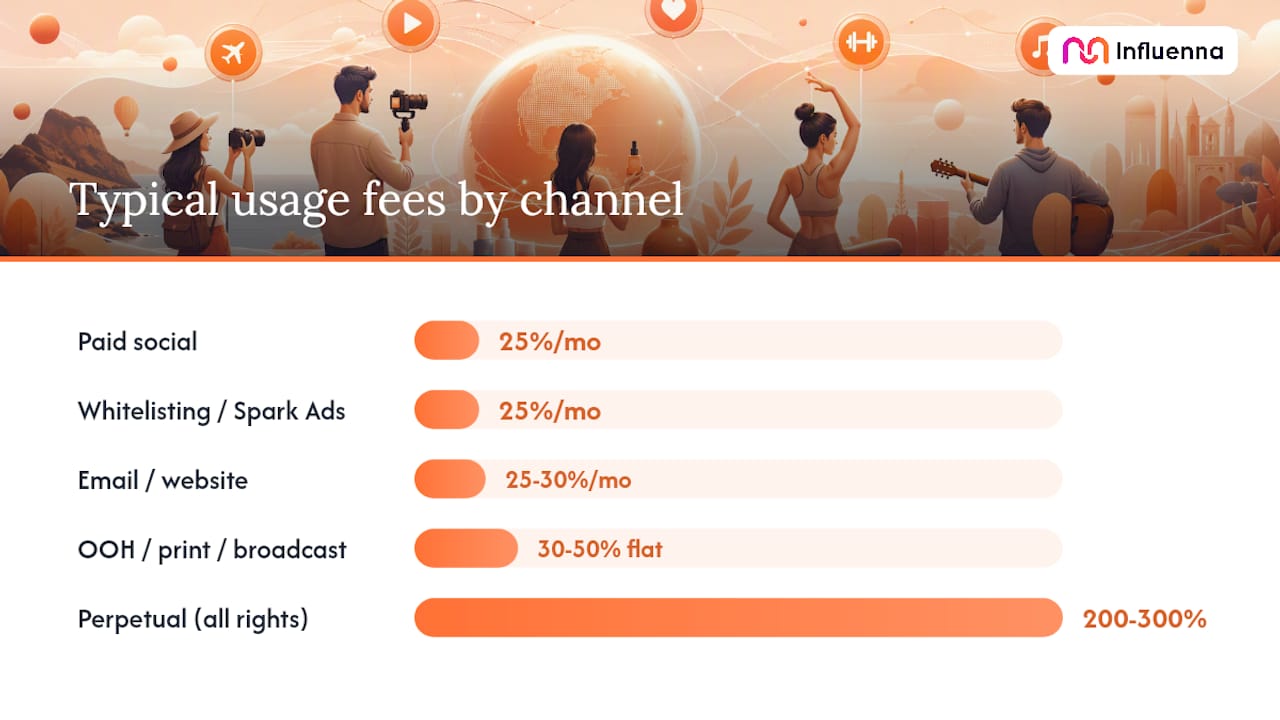
These ranges come from industry usage-rights benchmarking and from agency licensing guidance that recommends 3 to 6 months for paid social placements and up to 12 months for website or email use.
Perpetual usage, meaning the brand can use your content forever with no renewal, should never be free. Price it as a flat multiplier, typically 200 to 300% of your base rate, or as the equivalent of 6 to 12 months of monthly licensing fees paid upfront. If a brand asks for "all rights, in perpetuity" in the first draft of a contract, that line item alone should double your quote.
Pro Tip: Build a usage appendix as a separate schedule attached to the main contract. List channel, duration, territory, exclusivity, and fee per period in a table. It turns a vague negotiation into a line-item conversation, and it's far easier to renew or renegotiate a single row than to reopen the whole agreement.
For ongoing licenses, add an audit or usage-reporting clause that lets you request proof of where and how long your content ran, and bill monthly for term licenses instead of accepting one flat number for open-ended use.
Red Flags in Influencer Marketing Contracts
Most payment disputes trace back to the same handful of vague clauses. Watch for these before you sign anything:
- Payment "upon completion" with no defined date for what "completion" means
- Perpetual usage rights bundled into the base fee with no separate licensing line
- No mention of invoicing requirements, tax forms, or a W-9/W-8BEN request
- No kill-fee if the brand cancels mid-production
- "Reasonable revisions" with no cap on how many rounds that actually means
The gap between a professional contract and a risky one usually isn't length. It's whether payment triggers, usage scope, and revision limits are defined in numbers and dates instead of adjectives like "reasonable" or "timely."
The fix for most of these is specificity, not more paragraphs. Cap revisions at two rounds. Define "publish" as a calendar date, not a vague window. Add a kill-fee (commonly 50% of the total fee) if the brand cancels after you've started production. For deals over roughly $25,000, ask for escrow: the brand deposits 50% at signing, you confirm deliverables, the remainder releases on publish after a short audit hold. That structure protects both sides equally, which is usually the fastest way to get a brand's legal team to agree to it.
Negotiation Checklist and Sample Clauses
Before you sign, run through this checklist:
- Are deliverables defined by format, platform, and exact date, not vague terms like "a post"?
- Is the payment schedule spelled out (deposit percentage, due dates, Net terms)?
- Is usage scope separated from the base fee, with channel, duration, and territory listed?
- Has the brand requested (or will you provide) a W-9 or equivalent tax form?
- Is the payment method and currency confirmed in writing?
Clause language you can adapt directly:
- Deposit: "Creator shall receive 50% of the total fee upon contract execution, with the remaining 50% due within 5 business days of publish."
- Net-30 trigger: "Payment is due within 30 days of invoice date. Invoice shall be sent within 3 business days of content publication."
- Fixed-term license: "Brand is granted a non-exclusive license to use the Content on [channel] for [duration], beginning on the publish date."
- Whitelisting fee line: "Brand may run the Content as paid social advertising for an additional fee of [X]% of the base rate per month, payable monthly in advance."
- Perpetual-use premium: "Perpetual usage rights require a one-time fee equal to 250% of the base rate, payable prior to any use beyond the fixed term."
- Kill-fee: "If Brand cancels after production has begun, Creator retains 50% of the total fee as a cancellation payment."
- Audit/reporting: "Creator may request, no more than once per quarter, a usage report confirming placement and duration of licensed Content."
A contract that names its own remedies in advance, a kill-fee, a late-payment interest rate, a defined revision cap, gets far less pushback in negotiation than one that leaves those questions open, because neither side has to guess what happens if things go wrong.
Attach these as a signed usage-rights schedule rather than burying them in the main body. It's easier for a brand's legal team to approve a labeled appendix than to redline a wall of text, and it makes future renewals a matter of updating one page.
From Brief to Paid: The Full Timeline
A typical influencer contract moves through eight checkpoints, and delays almost always happen at the same two or three of them.
- Brief approved
- Content produced
- Draft delivered to brand
- Brand approval window (commonly 3 to 5 business days)
- Content goes live
- Invoice sent (within 3 business days of publish, per the trigger defined in your contract)
- Payment due (per Net terms)
- Reminders and escalation if payment is late
Set an SLA for step 4 in the contract itself. Brands that take two weeks to approve a draft with no deadline are the single biggest source of schedule slippage. If payment is late past the due date in step 7, escalate in order: a written reminder, a formal notice citing the late-fee clause, suspension of usage rights until payment clears, and only then mediation or a collections referral. Most disputes resolve before reaching that last step, but having it written into the contract changes how brands behave at step 4.
What the Push for Standard Payment Terms Really Means
The loudest complaint in the creator economy right now isn't about rates, it's about predictability. Reporting on the booming influencer economy points to a market where creators are actively pushing for standardized terms because so many contracts still treat payment schedules as an afterthought bolted onto a creative brief.
Here's what the conventional advice gets wrong: it treats "get everything in writing" as the finish line. It isn't. A contract that specifies Net-30 but leaves usage rights vague has just moved the ambiguity from one clause to another. The real fix is treating usage rights as their own budget line, priced by channel and duration, the same way you'd price a deposit or a kill-fee. Creators who negotiate the fee but skip the usage appendix routinely give away six figures of ad-spend value in whitelisting rights for free.
If you only fix one habit after reading this, fix the invoicing trigger. Ambiguity about when the clock starts on Net-30 causes more payment delays than actual brand bad faith. Define it, put it in writing, and half your collection headaches disappear before they start. Finding brands and agencies that already operate this way, through a vetted creator marketplace rather than cold outreach, tends to filter out the worst offenders before a contract ever gets drafted.
Sources
For deeper detail on the numbers in this guide, consult the influencer usage-rights clause library for copy-paste licensing language, and the agency licensing guide for duration and stacking examples across paid social, whitelisting, and OOH placements.
- What Are Standard Influencer Payment Terms in 2026
- Influencer Usage-Rights Clause Library: 9 Copy-Paste Options for Marketers
- Influencer Payment Terms Decoded: Net-30, 50% Upfront, and Milestone Payments | Gigapay Blog
- Influencer Payment Terms: Net 30, Deposits, and Creator Payment Best Practices
- Influencer Content Usage Rights: Agency Licensing Guide 2026
FAQ
How do influencers actually receive payments?
Most creators get paid via direct bank transfer (ACH or wire), PayPal, or Stripe, with the method usually specified in the contract alongside the payment schedule. Wire transfers settle faster for large domestic sums, while Wise typically offers lower fees for international payments.
How much does an influencer with 100,000 followers typically charge?
Rates vary enormously by platform, niche, and engagement rather than follower count alone, so there's no single fixed rate. Pricing should be built around your base rate plus separate usage-rights fees for any paid social or whitelisting use, not follower count as a standalone multiplier.
What should I charge for a creator with roughly 480,000 followers?
Base rates at that audience size vary widely by platform and engagement, so quote from your own performance history and production costs rather than a follower-based formula. Add usage licensing on top of the base fee if the brand wants paid social or whitelisting rights.
What payment terms should I request as a new creator?
Start with a 50/50 deposit split for direct brand deals, or Net-30 if an agency is involved, and always separate your usage-rights fee from your posting fee. For any deal above $25,000, request escrow rather than relying on trust alone.