How to Spot Fake Followers Before You Pay for a Partnership
11 min read
You can spot most fake followers with three checks: calculate the account's engagement rate, sample 20 to 30 followers by hand, and run a free fake-follower checker. Do the math first. Take likes and comments from the last three posts, divide by follower count, and multiply by 100. Anything suspiciously low on a mid-size account deserves a closer look. These three checks together catch the overwhelming majority of fake-follower patterns because bots, purchased accounts, and inactive users each leave a different fingerprint, and no single one hides from all three.
Key Takeaways
Spotting fake followers reliably requires combining a manual sample, an engagement-rate calculation, and at least one automated checker report before you make a hiring decision.
| Point | Details |
|---|---|
| Run three checks together | Engagement rate, a 20 to 30 follower sample, and one tool report catch most fake-follower patterns. |
| Watch for clustered red flags | Three or more signs (empty profiles, spikes, generic comments) together raise real suspicion. |
| Treat tool scores as probabilistic | A fake-follower percentage is an estimate to confirm with manual review, not a final verdict. |
| Protect ad spend contractually | Use performance milestones or payment holdbacks until audience quality is verified. |
| Start from a reviewed pool | Influenna's human-reviewed marketplace filters bot-run accounts before discovery even starts. |
Table of Contents
- How to Spot Fake Followers Manually in Under 10 Minutes
- How Do Fake-Follower Checker Tools Actually Work?
- Running a 10 to 20 Minute Fake-Follower Audit
- What to Do With Your Audit Results
- Why Human Review Beats Raw Follower Lists
- How We Evaluated These Fake-Follower Checkers
- When Manual Checks Stop Being Enough
- A Curated Marketplace Cuts Your Audit Time in Half
- Sources
- FAQ
How to Spot Fake Followers Manually in Under 10 Minutes
Before opening any tool, look at the account itself. A handful of visible signs give away a padded follower count almost every time:
- Engagement that doesn't match the audience size. An account with 50,000 followers pulling 80 likes per post is a red flag on its own.
- A follower spike with no cause. A jump of several thousand followers in a week, with no viral post or press mention behind it, usually means a purchase.
- Generic, repetitive comments. "Nice pic 🔥" and "Love this!!" from accounts with no other activity are classic bot behavior.
- Followers with no profile photo, no posts, or a string of numbers for a username. One or two of these mean nothing. A cluster means something.
- Follower:following ratios that don't add up, like an account following 7,000 people while being followed by only 40.
- A geographic mismatch, such as a "local Chicago boutique" account whose audience is 60% based in a country with no obvious tie to the brand.
None of these signs alone proves fraud. Real accounts can have quiet followers, and small creators sometimes get a legitimate viral bump. But when three or more of these signs show up together, the probability that you're looking at a fake-follower problem climbs fast, according to pattern-based detection guidance.
To sample properly, pull 20 to 30 followers at random and check each one's photo, post history, and follower count. Don't just click the most recent followers.
Pro Tip: Sample from the top, middle, and end of the follower list, not just the newest additions. Platforms sometimes sort by activity, and checking only recent followers skews your sample toward whichever bot batch was last purchased.
How Do Fake-Follower Checker Tools Actually Work?
Automated checkers look at signals no human can scan manually across thousands of accounts: profile completeness, growth-curve shape, engagement-to-follower ratio, comment-text patterns, geographic clustering, and sometimes network analysis that flags coordinated "pod" behavior between accounts. Academic work on bot detection increasingly relies on exactly these behavioral and network-level features rather than any single metric.

Most reports return a similar set of fields, though tools differ in how they weigh them. Perkifi, for instance, blends five separate signals (empty-profile ratio, growth spikes, bot comments, geographic mismatch, and engagement-to-reach) into one authenticity score, while CreatorScore folds pod clustering and growth velocity into its broader 1 to 100 creator rating.
| Report field | What it means | How to treat it |
|---|---|---|
| Fake-follower % | Probabilistic estimate, not a hard count | Use with a manual sample, don't treat as gospel |
| Engagement rate | Likes/comments relative to followers | Compare against account size, not a flat number |
| Audience demographics | Estimated location, age, gender split | Check for mismatches with the creator's claimed niche |
| Growth history | Follower count over time | Look for unexplained spikes or cliffs |
| Sample of flagged accounts | Specific followers the tool suspects | Spot-check a few manually to confirm |
Treat every automated score as a starting point for review, not a verdict. That's exactly why the better tools surface the underlying flagged accounts instead of just a single number.
Running a 10 to 20 Minute Fake-Follower Audit
You don't need a full afternoon to vet an account. A short, structured audit gets you a defensible answer fast:
- Calculate engagement rate (2 to 4 minutes). Average likes and comments across three recent posts, divide by follower count, multiply by 100. Below 1% on a mid-tier account is a warning sign; below 0.5% is a serious one.
- Sample 20 to 30 followers (4 to 6 minutes). Log which ones have no photo, no posts, or nonsensical usernames. Note the pattern, not just the count.
- Run a free checker (2 to 5 minutes). Use one of the tools below and screenshot or export the report before it changes.
- Compare tool output to your manual notes (2 to 5 minutes). If the tool's fake-follower estimate lines up with what you saw by hand, you have a reliable read. If they conflict sharply, sample again before deciding.
Pro Tip: *Build a performance-based clause into any creator contract before you pay a deposit.
What to Do With Your Audit Results
A low fake-follower rate is normal noise on almost any account and rarely worth acting on. Moderate levels warrant questions. High rates, or paired with very low engagement, signal a renegotiate-or-walk situation.
Ask the creator or their manager for:
- Recent Story view rates and swipe-up or link-click conversion numbers.
- Screenshots of audience demographics from their own native analytics.
- A third-party report if they've already run one, so you can compare against yours.
On the contract side, structure payment around performance milestones rather than a flat upfront fee, and consider a holdback until you've verified audience quality post-campaign. The real risks of skipping this step aren't just wasted ad spend. They include reputational damage when a campaign visibly underperforms and attribution noise that makes your next campaign's data harder to trust.
Why Human Review Beats Raw Follower Lists
Automated detection catches patterns, but it can't catch what never should have been listed in the first place. A marketplace that manually reviews every creator before they can be discovered filters out synthetic and bot-run accounts before a brand ever has to run a check.
The difference between a curated marketplace and a scraped list isn't polish. It's that someone looked at the account before you had to.
Raw, keyword-searchable creator lists surface anyone, verified or not. A curated model built on human review before onboarding shifts some of that vetting burden upstream, before you ever open a report.
Pro Tip: Look for a stated human-review policy on any platform you use to discover creators. It's a trust signal in the same way a "how we tested" methodology page is for a review site.
How We Evaluated These Fake-Follower Checkers
Evaluating a fake-follower checker comes down to four questions: what signals does it use, how deep is the report, what does it cost to access, and how much of your data does it ask for in return. For detection approach, tools that combine multiple signals (profile quality, growth curves, engagement ratios, comment patterns) tend to produce more defensible results than any single-metric check, consistent with the multi-signal logic behind Perkifi's scoring model and CreatorScore's authenticity agent.
Access matters just as much as accuracy. A tool that requires no sign-up for a basic scan is more useful for a fast triage than one that gates every result behind a paid plan, even if the paid version is more thorough. Report depth separates the tools worth bookmarking from the ones you'll use once: does it show you which specific accounts were flagged, or just a single percentage with no way to verify it?
Privacy is the criterion most people skip and shouldn't. Independent research on follower-audit and unfollower apps found meaningfully different data access models across similar tools, some requesting far more account permissions than the task requires. A checker that needs your login credentials to scan public follower data is asking for more than it needs.
None of this replaces a manual sample. Every evaluation criterion here assumes you're using the tool's output as one input, not the final word, on whether an account's audience is real.
When Manual Checks Stop Being Enough
Manual review works for vetting a handful of creators. Past a certain volume, it breaks down. If you're screening thousands of accounts for a campaign, automated screening isn't optional anymore. One caution worth repeating: a sudden follower drop can mean a platform-wide bot purge, not creator fraud.
A Curated Marketplace Cuts Your Audit Time in Half
Every check above still matters, but the fastest way to reduce fake-follower risk is to start your search somewhere accounts have already been screened once. Influenna is a human-reviewed creator marketplace: every creator, brand, and agency profile goes through a real person before it's discoverable, which means the synthetic and bot-run accounts that slip through open, scrapable lists get filtered out before you ever run a check.
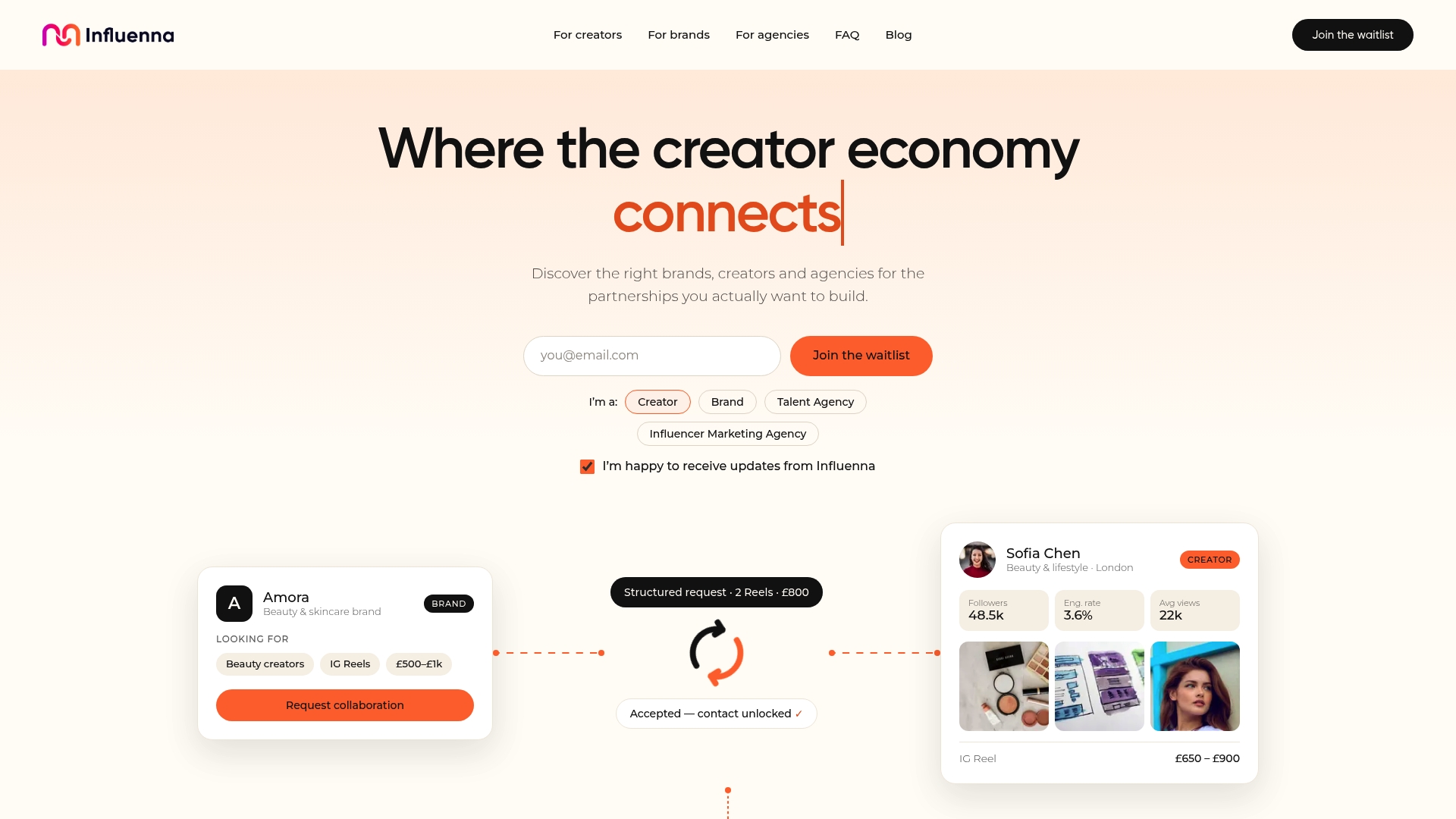
That doesn't replace your own audit. It changes what you're auditing. Instead of vetting a name pulled from a hashtag search or a cold DM, you're reviewing a profile that already passed manual review, with audience metrics labeled by how they were sourced, verified, estimated, or self-reported, shown separately by platform instead of blended into one misleading number. Rates and preferences are set upfront, and contact details only unlock once both sides approve a structured collaboration request, so you're never guessing who you're really talking to before you've done your homework. If you want to shrink the amount of manual vetting your team does per campaign, join the Influenna waitlist and start discovery from a pool that's already been checked once.
Sources
FAQ
Is there an app that can identify fake followers?
Yes. Tools like Collabstr, Modash, SocialAuditor, Perkifi, and CreatorScore all offer some form of free or paid fake-follower check, each weighing signals like engagement, growth history, and profile quality differently.
Is it possible to get fake followers?
Yes, followers can be purchased in bulk from bot farms or click farms, which is exactly why sudden, unexplained follower spikes are one of the clearest manual red flags to check for.
How can I check if an Instagram follower is real or fake?
Look at the profile photo, post history, and follower:following ratio. An account with no photo, no posts, and thousands of following with almost no followers back is a strong fake-follower signal.
How do I spot fake followers on a Facebook page?
The same core signals apply: check for low engagement relative to page likes, generic comments, and accounts with incomplete profiles, then confirm with a free checker where available.