Brands and Agencies: Choose the Best Influencer Platforms by Objective
23 min read

For most brands and agencies, the right starting point breaks into three lanes: curated discovery marketplaces, enterprise relationship platforms, and ecommerce-native attribution tools. Influenna operates in the discovery space, with a matching model designed for structured, spam-free introductions. CreatorIQ and Sprout Social's influencer suite (formerly Tagger) lead enterprise management, while Shopify Collabs owns ecommerce attribution for merchants already on that stack. The right pick depends less on brand reputation and more on what your program actually needs to do this quarter.
TL;DR:
- Curated marketplaces like Influenna focus on structured, mutual-approved introductions, reducing outreach noise but do not handle campaign management or payments.
- Enterprise solutions such as CreatorIQ and Sprout Social are designed for high-volume, multi-market programs, offering advanced relationship management, security, and integrated workflows.
- Ecommerce attribution platforms like Shopify Collabs and Upfluence directly connect campaign results to sales, making them ideal for brands with a storefront, but less useful for brand-awareness campaigns.
- Entry-level and free tools like Afluencer and Heepsy provide quick, low-cost access but lack comprehensive audience verification, attribution, and campaign management features.
- Platform choice must align with program scope and objectives, prioritizing discovery, management, or attribution, rather than feature count or brand reputation.
Table of Contents
- What Are the Best Influencer Platforms Right Now?
- How Do These Platforms Compare Side by Side?
- Platform Profiles: What Each One Actually Does
- How to Choose the Right Platform for Your Program
- Why Curated Discovery Changes the Vetting Equation
- How Does Campaign Management Actually Work Across These Tools?
- What Kind of Support and Onboarding Should You Expect?
- How Do These Platforms Handle Security and Fraud Prevention?
- What Do User Reviews and Case Studies Actually Tell You?
- Is the Platform Actually Easy to Use?
- What Contract and Legal Management Features Should You Expect?
- The Real Lesson Buried in This Roundup
- Ready to Try a Curated Approach to Influencer Discovery?
- Sources
- FAQ
What Are the Best Influencer Platforms Right Now?
Every platform on this list solves a different problem, and picking the wrong one wastes months. The fastest way to narrow your options is to sort by what you're actually trying to accomplish, not by which name shows up most in roundups.
If your goal is curated discovery and clean introductions, Influenna is built for exactly that. It runs a manually reviewed, four-sided marketplace connecting creators, brands, talent agencies, and influencer marketing agencies, so instead of firing off cold DMs and hoping for a reply, you send a structured collaboration request and only exchange contact details once both sides say yes. That single design choice, private contact until mutual approval, cuts out a huge share of the noise that makes influencer outreach exhausting. It's a strong fit for brands and agencies that want relevant partners fast without building a vetting pipeline from scratch. It's not the fit if you need a heavy campaign management suite with automated payment disbursement baked in.
If your goal is enterprise-scale relationship management, CreatorIQ and Sprout Social's influencer tools are the names that come up again and again in industry roundups. CreatorIQ is built around a relationship CRM, security controls, and integrations meant for teams running dozens of campaigns across markets. Sprout Social folds discovery and audience analytics into its broader social management suite, which matters if your team already lives inside Sprout for community management. Neither is the right starting point for a solo marketer running a first campaign. They're built for volume, and volume is what justifies the cost and the onboarding lift.
If your goal is ecommerce attribution and revenue tracking, Shopify Collabs is the obvious candidate for merchants already selling on Shopify. It sits natively in the Shopify admin, so discovery and checkout attribution happen without a separate integration project, which is exactly why Shopify's own influencer guide positions it as the default for stores on that ecosystem. Upfluence plays a similar role for brands that need attribution but aren't Shopify-exclusive, connecting to a wider set of commerce and analytics stacks. Skip both if you don't sell products directly through a storefront. Affiliate-style attribution tools solve a revenue-tracking problem that brand-awareness campaigns simply don't have.
If your goal is testing the waters on a small budget, Afluencer and Heepsy offer low-cost or free entry points that don't demand a long onboarding process. They're reasonable for a first campaign or a one-off product seeding push. The tradeoff is depth: don't expect the audience verification, contract tooling, or attribution reporting that the bigger platforms build in. Once your program scales past a handful of campaigns a quarter, you'll likely outgrow them.
The pattern across all four lanes: the "best" platform is the one that matches your program's actual objective, not the one with the longest feature list. Hootsuite's platform comparison makes the same point directly, tying platform choice to budget, scale, and the specific integrations a program needs.
How Do These Platforms Compare Side by Side?
Read this table by priority, not by row order. If your program lives or dies on revenue attribution, weight the integrations column heaviest and treat everything else as secondary. If you're running a brand-awareness push with no direct-response goal, the channel support and standout capability columns matter more than integrations ever will.
A few things worth flagging before you take any cell at face value:
- Metric provenance varies by platform. Some tools show audience numbers as verified, others as estimated, and others as self-reported by the creator. Confirming which category applies before you sign a contract prevents an ugly surprise three campaigns in.
- Integrations mean different things across vendors. "Shopify integration" can mean a full checkout-attribution pipeline or a basic data export. Ask for specifics, not the word itself.
- Pricing shape is directional, not a quote. Treat every price description in this table as a starting signal, then confirm exact numbers directly with the vendor before budgeting.
- Enterprise integrations require enterprise implementation support. A platform with dozens of connectors is worthless if your team has no one to configure them.
Platform Profiles: What Each One Actually Does
-
Influenna. A curated, four-sided marketplace where creators, brands, talent agencies, and influencer marketing agencies apply and get manually reviewed before gaining access. Best for teams that want relevant partners fast without wading through cold outreach. Its standout is the structured request-and-approval flow: collaboration requests replace cold messaging, and contact information stays private until both sides accept. The constraint worth knowing up front: it's an introduction layer, not a campaign management or payment system, and the platform is not yet publicly available.
-
Sprout Social Influencer Marketing (formerly Tagger). Built around audience analytics and brand-fit discovery, folded directly into Sprout's broader social management suite. Best for teams that already run community management and reporting through Sprout and want influencer discovery in the same login. The caveat: you're buying into Sprout's ecosystem, so the value drops if you're not already a Sprout customer for other functions.
-
Brandwatch. A consumer intelligence platform that layers influencer identification on top of its social listening core. Best for brands that need to understand broader conversation trends alongside creator discovery, like tracking sentiment shifts around a launch while finding creators already talking about the category. The tradeoff is that it's built primarily as a listening tool first, influencer tool second, so dedicated campaign workflow features are lighter than purpose-built platforms.
-
Upfluence. An end-to-end platform pairing discovery with campaign management and direct integration options into commerce and payment stacks. Best for ecommerce brands and agencies that need attribution tied to actual purchases, not just impressions. The catch: the integration depth that makes it valuable also means a longer setup process than a lightweight discovery tool.
-
Afluencer. A marketplace-style platform with free or low-cost access, aimed at brands testing influencer marketing for the first time. Best for small budgets and first campaigns where the goal is learning the process, not running a sophisticated multi-market rollout. The limitation is depth: don't expect heavy audience verification or advanced reporting at this price point.
-
Shopify Collabs. Shopify's native collaborator marketplace, accessible right inside the Shopify admin panel. Best for merchants who want discovery and checkout attribution without adding a separate vendor integration, a point Shopify's own product page leans on directly. It only makes sense if you're actually selling through Shopify. Outside that ecosystem, it's not an option.
-
Meltwater. A media intelligence platform that added influencer marketing capabilities on top of its PR and monitoring core. Best for teams that already track media coverage and want influencer discovery in the same dashboard, particularly useful when a campaign spans earned media and creator content together. The limitation mirrors Brandwatch's: influencer tooling here is an add-on to a media monitoring product, not a from-scratch influencer platform.
-
CreatorIQ. An enterprise-grade platform built around relationship management, security controls, and integrations that scale across large, multi-market programs. Best for enterprise teams running high campaign volume with cross-channel complexity and compliance requirements. The constraint is proportional: the feature depth and quote-based pricing only make sense once program volume justifies the investment, which rules it out for a first campaign or a lean marketing team.
-
GRIN. An ecommerce-first creator management platform built for brands running ongoing, high-volume creator programs tied to product sales. Best for direct-to-consumer brands that treat influencer marketing as an extension of their commerce operation rather than a standalone campaign function. It's less suited to service businesses or brand-awareness-only programs with no ecommerce component.
-
LTK. A platform centered on shoppable creator storefronts, historically strongest in fashion, beauty, and lifestyle categories. Best for brands in those verticals that want affiliate-style, shoppable content baked directly into the creator relationship. Outside those categories, the platform's core audience and creator base is a weaker match.
-
Influencity. A discovery and analytics platform focused on audience demographic breakdowns and fraud detection. Best for brands that want data-heavy vetting before committing budget to a creator, especially when brand safety is a top concern. It leans analytical rather than workflow-heavy, so heavier campaign management needs may require pairing it with another tool.
-
Later Influence. Combines content calendar planning with influencer discovery, useful for teams that already schedule organic content through Later. Best for small to mid-size teams that want influencer sourcing without leaving their existing content planning workflow. It's a lighter fit for enterprise programs running complex, multi-approval campaigns.
-
Modash. A search-focused discovery tool built around a large, searchable creator database and API access. Best for lean teams that need fast, filterable search over deep campaign management features. The tradeoff is that it leans toward discovery over full-cycle campaign and payment workflows.
-
YouTube BrandConnect. A native marketplace giving direct access to YouTube's creator pool, which reduces discovery overhead for campaigns centered on long-form video. Best for brands specifically prioritizing YouTube reach over a multi-platform strategy. It's not built for cross-channel campaigns spanning Instagram and TikTok in the same workflow.
-
Skeepers. Combines user-generated content sourcing with influencer collaboration tools in a single platform. Best for brands that want both organic UGC and paid creator content managed through one system, particularly retail and consumer goods brands. It's a narrower fit for teams that only need one of those two functions.
-
Heepsy. A straightforward search and filter tool for creator discovery with free and tiered access. Best for budget-conscious teams that need basic search capability without a long procurement process. The limitation is scope: it's a discovery search tool first, and heavier campaign or payment management will require a separate system.
How to Choose the Right Platform for Your Program
Start with the objective, not the feature list, and explore detailed AI Use Cases by Role and Industry to see how technology can scale outreach and discovery workflows. A platform chosen because it looked impressive in a demo and not because it matched your actual campaign goal is the single most common expensive mistake teams make, and it's an easy trap to fall into when every vendor page reads roughly the same.
Run through this checklist before you request a single demo:
- Program objective. Is this discovery and relationship building, enterprise-scale management, or affiliate/ecommerce attribution? Each points to a different lane of platform.
- Program scale. How many campaigns, creators, and markets are you actually running this year, not what you hope to run in three years?
- Integration requirements. Do you need a direct pipeline into Shopify, Klaviyo, or a payment processor, or is a manual export good enough for now?
- Metrics and attribution needs. Do you need revenue-linked attribution, or are impressions and engagement enough for your reporting?
- Payment workflows. Does the platform need to handle creator payments directly, or does that happen outside the tool?
- Staffing. Who on your team will actually run the platform day to day, and do they have time to learn a complex enterprise system?
Once you've answered those, bring a shorter, sharper list of questions to any vendor conversation:
- How deep is the integration, exactly, a full data pipeline or a basic export?
- Are audience metrics verified, estimated, or self-reported, and can you get raw exportable data to check them against your own analytics?
- What are the contract terms, and is there a lock-in period or auto-renewal clause buried in the fine print?
- Who owns content rights after a campaign ends?
- When do creators actually get paid, and does the platform handle it or just track it?
Watch for a few red flags that tend to surface after the contract is signed, not before: opaque metric labeling with no verified/estimated/self-reported distinction, a platform that claims broad integrations but can't name specific systems it connects to, forced data exports required just to generate a billing report, and an enterprise feature set sold with no implementation support included. Any one of those should slow down a purchase decision.
Pro Tip: Match platform complexity to your program size, not your ambitions for it. A lean team running four campaigns a quarter gains nothing from an enterprise CRM built for hundreds of creator relationships, and a team scaling past fifty active creators will drown trying to run everything through spreadsheets and a discovery-only tool.
Why Curated Discovery Changes the Vetting Equation
Most of the time lost in influencer marketing doesn't happen during the campaign. It happens before it, sorting through creators who never respond, verifying audiences that turn out to be inflated, and chasing agencies that ghost after the first email. A platform's real value shows up in how much of that friction it removes before a brand ever reaches the negotiation stage.
That's the core argument for a manually reviewed marketplace. When every account, creator, brand, agency, has already passed a human review before it's visible, the baseline quality of who you're talking to goes up before a single message is sent. Its mutual-approval contact flow means contact details are shared only after both sides agree there's a fit, reducing guesswork in outreach.
For fast campaign starts, especially for lean teams without a dedicated influencer vetting function, that structure matters more than a long feature list. A brand launching a seasonal push doesn't need a relationship CRM. It needs three or four legitimate, responsive partners lined up in a week, not a month, without discovering after the fact that half the "engaged" audience was fake.
How Does Campaign Management Actually Work Across These Tools?
Campaign management breaks into three stages, brief creation, approval workflows, and payment, and platforms handle each with wildly different levels of depth. Enterprise tools like CreatorIQ and Meltwater build structured brief templates, multi-stage approval chains, and integrated payment tracking directly into the platform, which matters when a campaign involves legal review, brand safety sign-off, and finance approval before a single dollar moves.
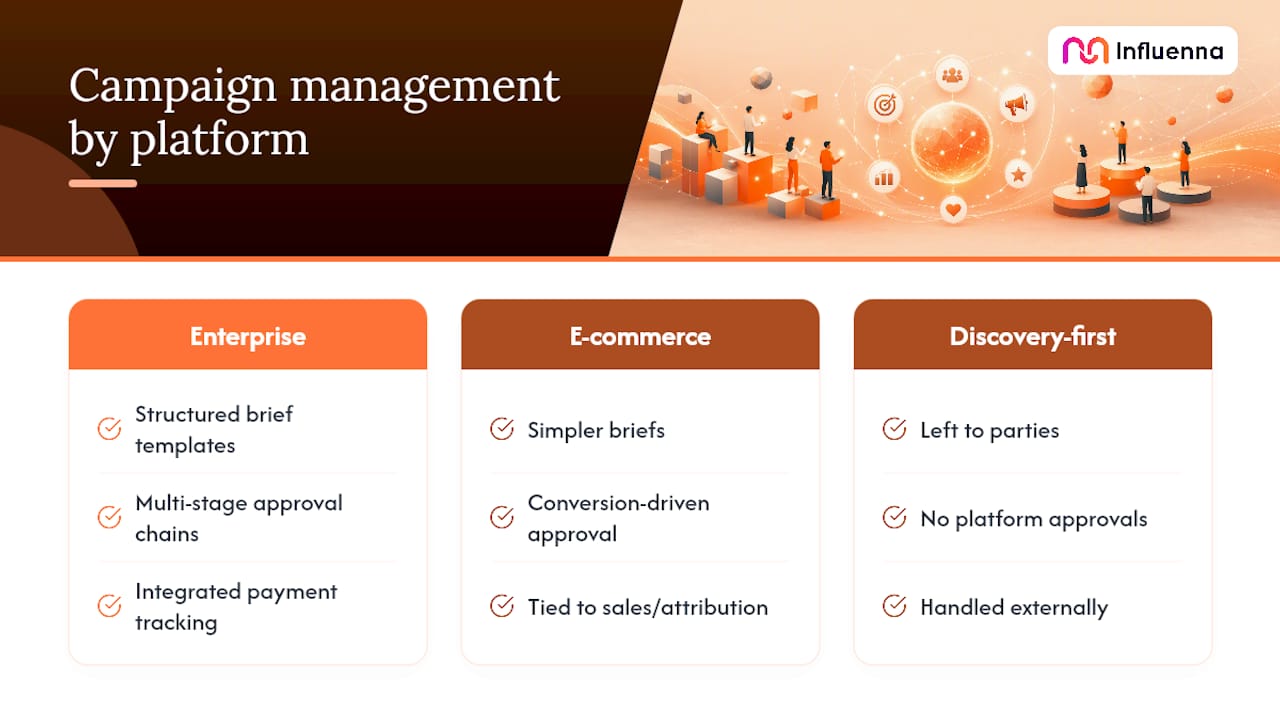
Ecommerce-native tools like Shopify Collabs and Upfluence lean the other direction: briefs tend to be simpler, but payment and attribution are tied directly to actual sales, so the "approval" that matters most is whether the creator's content actually converts. GRIN and LTK sit somewhere in between, with structured campaign tracking but a stronger focus on product seeding and affiliate-style commission payment rather than flat fees.
Discovery-first platforms generally leave campaign management, briefs, approvals, and payment terms to the two parties once an introduction happens. That's a deliberate tradeoff: less built-in structure, but also less overhead for teams that already have their own contract and payment process and just need to find the right partner faster. If your team already runs briefs and payments through existing project management and finance tools, that gap matters far less than it would for a team hoping the platform will handle everything end to end.
What Kind of Support and Onboarding Should You Expect?
Onboarding quality tends to track directly with pricing tier, and that's not a coincidence. Enterprise platforms like CreatorIQ, Meltwater, and Brandwatch typically assign dedicated account management and structured onboarding programs, because the integration work and internal training required to get a large team using the system properly justifies that investment on both sides.
Mid-tier tools like Upfluence, Sprout Social's influencer suite, and Influencity generally offer a mix of self-serve documentation and email or chat support, with onboarding calls available but less hands-on than the enterprise tier. That's usually the right balance for a mid-size team that needs guidance but doesn't need a dedicated success manager checking in weekly.
Entry-level and free-tier tools like Afluencer and Heepsy tend to rely more heavily on self-serve help centers and community resources, which works fine for a small team comfortable figuring things out, but can leave a first-time user stuck without a clear next step.
Curated marketplaces built around structured introductions shift the support question somewhat. The key onboarding happens at the application stage with account review and approval, rather than extensive training afterward.
How Do These Platforms Handle Security and Fraud Prevention?
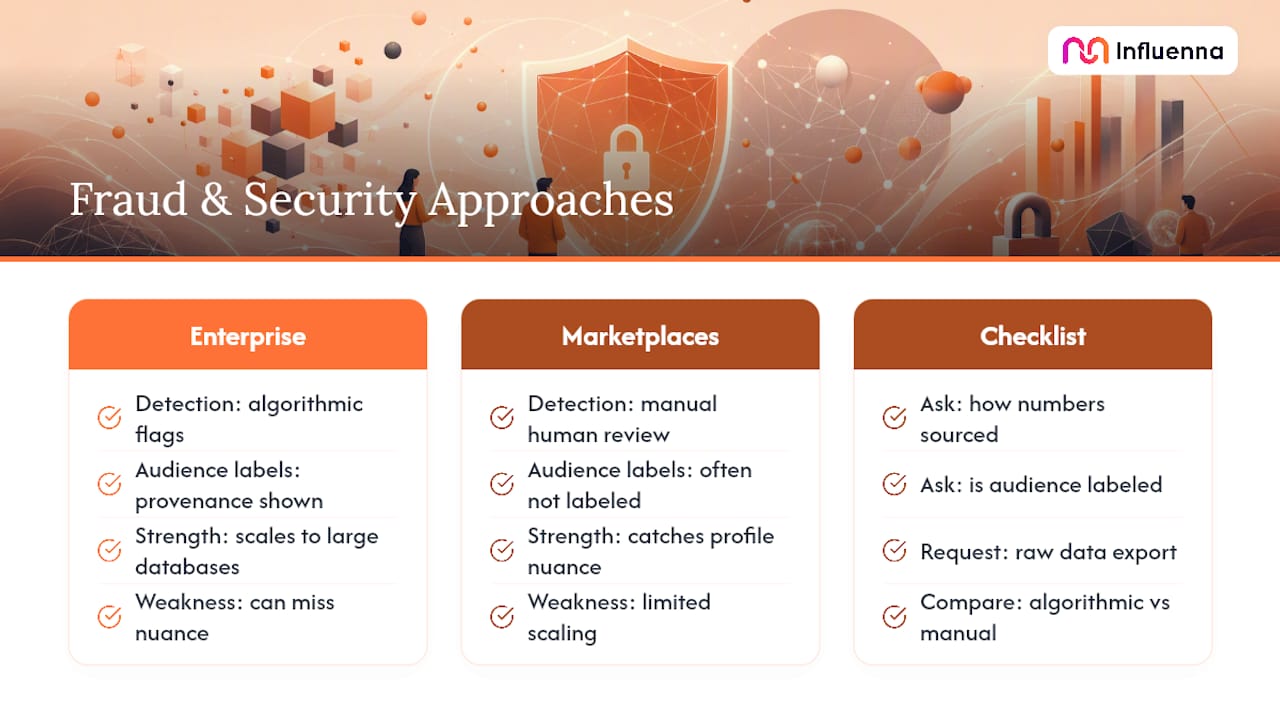
Fraud in influencer marketing usually shows up as inflated follower counts, purchased engagement, or bot-driven views, and platforms address it with very different levels of rigor. The strongest signal to look for is whether a platform explicitly labels audience data by provenance, verified, estimated, or self-reported, rather than presenting every number with equal confidence.
Enterprise platforms like CreatorIQ and Brandwatch build fraud detection into their audience analytics, flagging suspicious follower growth patterns or engagement anomalies automatically. Influencity leans specifically on audience demographic and fraud analysis as a core feature, which makes it a reasonable pick for brands where brand safety is the top procurement concern.
Curated marketplaces address the fraud problem differently, at the entry point rather than through ongoing algorithmic detection. Some platforms use manual human review before granting marketplace access to filter out fake or low-quality profiles before discovery, as an alternative to data analysis fraud detection. Neither approach is strictly superior; algorithmic detection scales better across huge creator databases, while manual review tends to catch nuance that automated systems miss. Whichever platform you choose, ask directly how audience numbers are sourced and whether raw data is exportable for your own reconciliation.
What Do User Reviews and Case Studies Actually Tell You?
Review volume is a weak signal on its own. A platform with a thousand reviews and a platform with fifty can both be the right choice, or the wrong one, depending entirely on what those reviewers were trying to accomplish. The more useful question is whether the reviews and case studies describe a use case that matches yours.
Enterprise platforms like CreatorIQ and Meltwater tend to publish detailed case studies from large brand and agency clients, useful if you're evaluating for a similarly large program, but not particularly predictive of how the platform performs for a five-person marketing team. Ecommerce-focused tools like Upfluence and GRIN often highlight revenue-attribution case studies, which matter if that's your primary goal and mean far less if you're running a pure brand-awareness campaign.
For a newer, curated model like Influenna's, the more relevant evaluation criteria aren't star ratings but structural ones: does the review process actually filter for quality, does the mutual-approval flow reduce wasted outreach, does the match rate on structured requests beat what you were getting from cold DMs. Those are the practical measures worth asking about directly, rather than treating a review count as a stand-in for fit.
Is the Platform Actually Easy to Use?
Ease of use splits along the same enterprise-versus-lean line as everything else on this list. CreatorIQ, Meltwater, and Brandwatch pack in enough functionality that new users typically need real training before they're productive, a fair tradeoff for the depth they offer, but a genuine cost if your team doesn't have time to invest in that ramp-up.
Discovery-focused tools tend to be simpler by design. Modash and Heepsy both lean on straightforward search and filter interfaces that a new user can navigate within a session. Later Influence benefits from sitting inside Later's existing content calendar interface, so teams already familiar with that scheduling tool have almost no learning curve.
Influenna's structure, apply, discover, send a structured request, get matched, is built to be understood in one pass: there's no dashboard to master, just a clear sequence from application to introduction. For a marketing professional juggling five other tools already, that simplicity is often worth more than a feature-dense interface that takes weeks to learn properly.
What Contract and Legal Management Features Should You Expect?
Contract and rights management is one of the widest gaps between platform types on this list. Enterprise tools like CreatorIQ typically include built-in contract templates, content usage rights tracking, and compliance workflows designed for legal teams reviewing dozens of agreements a month. That depth is genuinely valuable at scale and genuinely unnecessary for a brand running two campaigns a year.
Ecommerce and affiliate-focused platforms like Upfluence and LTK usually build commission terms and usage rights directly into their payment and attribution systems, since the contract terms there are closely tied to how creators get paid. Smaller and entry-level tools, Afluencer and Heepsy among them, generally leave contract and legal terms to be handled outside the platform entirely.
Discovery marketplaces like Influenna sit in that same outside-the-platform category by design. Once a brand and creator match and exchange contact details, the contract, deliverables, usage rights, and payment terms get negotiated directly between the two parties, not templated by the platform. That's a meaningful distinction to raise with any vendor claiming "contract management" as a feature: ask whether that means a real legal template library or just a place to upload a signed PDF after the fact.
The Real Lesson Buried in This Roundup
Most influencer platform roundups rank tools by feature count, which is exactly backward. A platform with forty features you'll never touch isn't better than one with four features you'll use every week. The research behind this comparison keeps circling back to the same point: platform choice should follow program objective, not brand recognition or feature density.
The conventional advice, "pick the platform with the most integrations and the biggest creator database," quietly assumes every team is running an enterprise-scale program. Most aren't. A five-person marketing team launching its third influencer campaign this year doesn't need CreatorIQ's relationship CRM. It needs a fast, trustworthy way to find two or three real partners without wading through fake accounts and unanswered DMs, which is precisely the gap a curated marketplace closes.
If there's one thing worth prioritizing above everything else, it's this: figure out whether your program's bottleneck is discovery, management, or attribution before you compare a single feature list. Match the tool to that bottleneck, not to whichever platform showed up first in a search.
— Igor
Ready to Try a Curated Approach to Influencer Discovery?
If cold DMs and unresponsive creator lists are the actual bottleneck slowing your campaigns down, Some platforms address challenges in influencer outreach by reviewing accounts before marketplace access and unlocking contact details only after mutual approval of collaboration requests. No cold outreach, no scraped contact lists, no guessing whether a creator's audience is real before you've already sent a pitch.
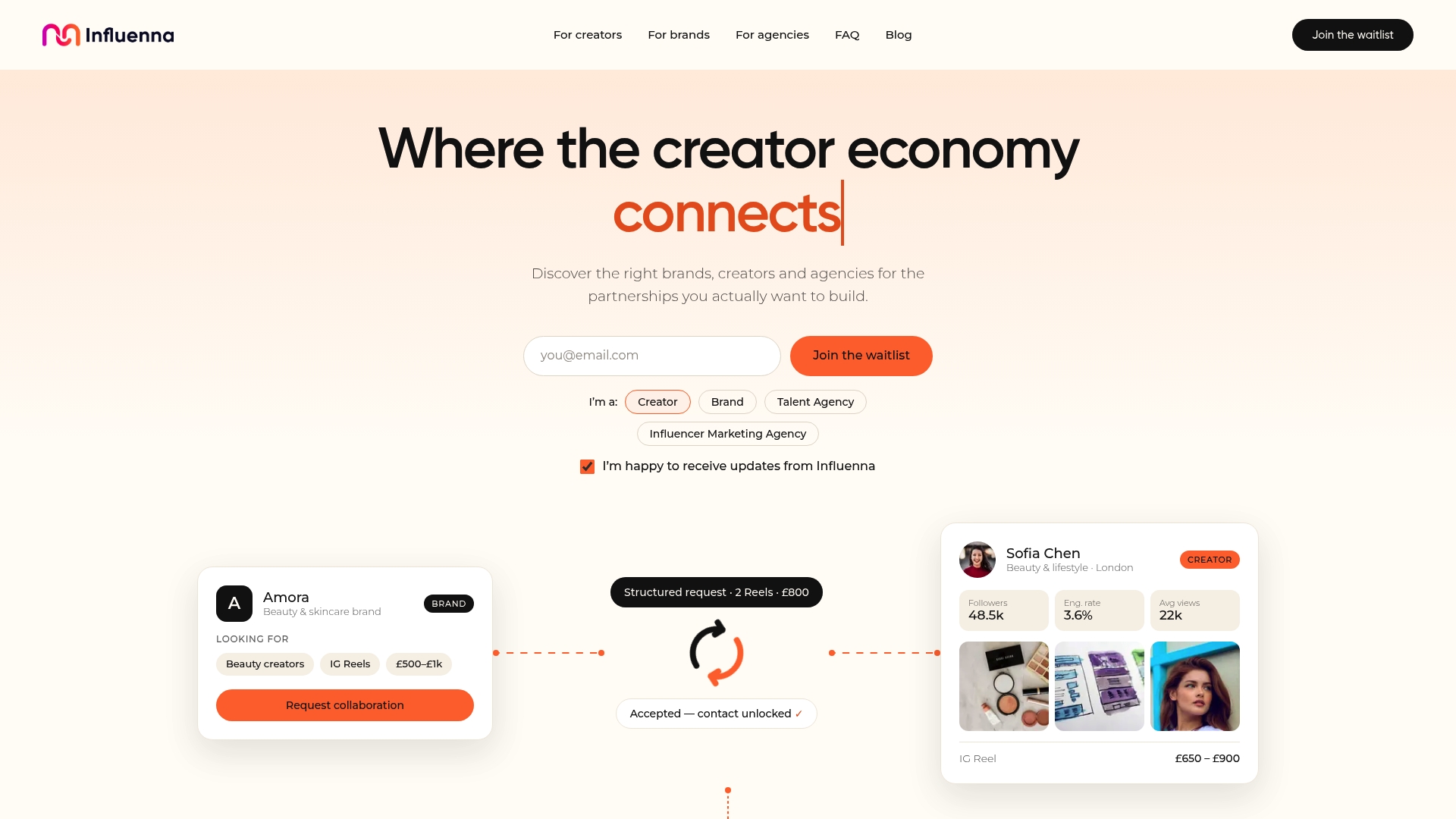
That structure matters most for brands and agencies running lean: you get relevant, vetted partners without building a vetting process from scratch, and without paying for enterprise features designed for a program ten times your size. Influenna is currently pre-launch, with the public site running as a waitlist, so there's no live browsing or pricing to compare yet. What you can do right now is join the Influenna waitlist to get access as soon as the marketplace opens, and start planning which structured requests you'll send first once it does.
FAQ
Which platform is best for influencers themselves, not brands?
Creators generally do best on platforms that let them control their own rates and preferences rather than being scraped for cold outreach. Influenna is built specifically around that model, letting creators set terms and only respond to structured requests, while LTK works well for creators focused on shoppable, affiliate-style content.
What is the most popular social media platform for influencer marketing?
Instagram remains the most widely supported channel across nearly every platform on this list, including Influenna, Sprout Social's influencer tools, and CreatorIQ. TikTok has grown fastest for engagement-driven campaigns, while YouTube leads specifically for long-form video partnerships through tools like YouTube BrandConnect.
How do I choose between a discovery marketplace and an enterprise platform?
Match the choice to program volume and complexity: a marketplace like Influenna works well for teams that need fast, vetted introductions without heavy campaign infrastructure, while enterprise tools like CreatorIQ suit large teams running dozens of campaigns with compliance and reporting requirements attached.
Are free influencer platforms worth using for a first campaign?
Free or entry-level tools like Afluencer and Heepsy work fine for testing the process on a small budget, but expect lighter audience verification and reporting than paid enterprise tools offer.
How can I verify a creator's audience numbers before a campaign?
Ask any platform whether audience metrics are labeled verified, estimated, or self-reported, and request exportable raw data to cross-check against your own analytics before committing budget.