Micro vs Macro Influencers: How to Choose for Your Campaign
17 min read

Choose micro influencers when your goal is conversions from a defined niche audience. Choose macro influencers when you need fast, broad awareness at scale. That's the short answer — and for most campaigns, the right move is actually both, sequenced deliberately.
Here's how the tiers map to common campaign goals:
- Drive conversions or trial: Micro influencers deliver higher engagement rates and stronger audience trust, which translates more directly into clicks, sign-ups, and purchases.
- Launch a product to a mass audience quickly: Macro influencers give you reach that a handful of micro creators simply can't match in a short window.
- Sustain a program over time: A portfolio of micro creators keeps content fresh, niche-specific, and cost-efficient across months.
The rest of this guide unpacks the trade-offs in detail — follower ranges, pricing, measurement, and how to vet creators before you commit budget.
Key Takeaways
The most effective influencer strategy treats micro and macro creators as complementary tools: macro for reach, micro for conversion, sequenced deliberately around your campaign funnel.
| Point | Details |
|---|---|
| Tier selection follows campaign goal | Use macro for fast awareness, micro for conversions and niche targeting — not interchangeably. |
| Engagement rate needs context | Always convert engagement percentages to absolute interaction counts before comparing tiers or setting KPIs. |
| Pricing varies by format and rights | Video and whitelisting fees can triple a creator's base rate; budget for usage rights from the start. |
| Vet before you commit | Check audience demographics, comment quality, and follower authenticity before signing any creator above $500 in fees. |
| Influenna reduces discovery friction | Influenna's curated marketplace connects brands with verified creators through structured requests, replacing cold outreach for multi-micro campaigns. |
Table of Contents
- What the influencer tiers actually mean (and why the labels vary)
- Micro vs macro influencers: the side-by-side comparison
- When to use micro, macro, or a hybrid strategy
- What influencer partnerships actually cost
- How to vet and choose the right influencer
- How to measure ROI across micro and macro campaigns
- Why micro influencers often convert better: the psychology behind it
- The portfolio approach is the right default
- Influenna makes multi-creator campaigns easier to run
- Sources
What the influencer tiers actually mean (and why the labels vary)
The industry hasn't standardized these labels, which causes real confusion when you're briefing a media plan. Here are the ranges most practitioners and platforms use:
| Tier | Follower Range | What They're Known For |
|---|---|---|
| Nano | Small follower base | Hyper-local, very high trust, minimal production polish |
| Micro | Moderate follower base | Niche authority, strong engagement, accessible rates |
| Mid-tier | Larger follower base | Broader reach, more professional content, moderate cost |
| Macro | Large follower base | Mass awareness, polished content, higher fees |
| Mega / Celebrity | Very large follower base | Maximum reach, brand-safe risk, premium pricing |
Shopify's guide to micro influencers places the micro tier at roughly 10K–100K followers, which aligns with how most U.S. agencies brief campaigns. Neal Schaffer's breakdown of macro influencers puts the macro range at 100K–1M, though some practitioners split that into mid-tier and macro at 500K.
Platform context matters. A creator with 80K followers on YouTube commands a very different audience relationship than one with 80K on TikTok. YouTube audiences tend to be more intentional — subscribers chose to follow long-form content. TikTok's algorithm can push a micro creator's video to millions of non-followers overnight, which means follower count is an even weaker proxy for reach on that platform. Sprout Social's research on micro-influencer marketing notes that algorithmic distribution, especially on TikTok, means a creator's actual reach often exceeds their follower count significantly. Instagram sits between the two: follower count correlates more closely with reach than TikTok, but Reels still get meaningful algorithmic distribution.
Pro Tip: *Treat tier labels as starting filters, not final decisions.
Micro vs macro influencers: the side-by-side comparison
The decision comes down to six dimensions. Here's how the two tiers compare on each:
| Dimension | Micro (10K–100K) | Macro (100K–1M+) |
|---|---|---|
| Follower count / reach | Smaller but highly targeted | Broad, often cross-demographic |
| Engagement rate | Generally higher (varies by niche and platform) | Generally lower as a percentage |
| Authenticity / audience closeness | Perceived as peers; strong parasocial trust | More aspirational; some distance from audience |
| Cost per partnership | Lower per creator; higher if running many | Higher per creator; simpler to manage |
| Best for | Conversions, niche launches, sustained programs | Awareness, product launches, PR moments |
| Availability / responsiveness | Usually self-managed; faster to brief | Often agency-represented; longer lead times |
| Content production quality | Variable; authentic feel | More polished; closer to brand-standard |
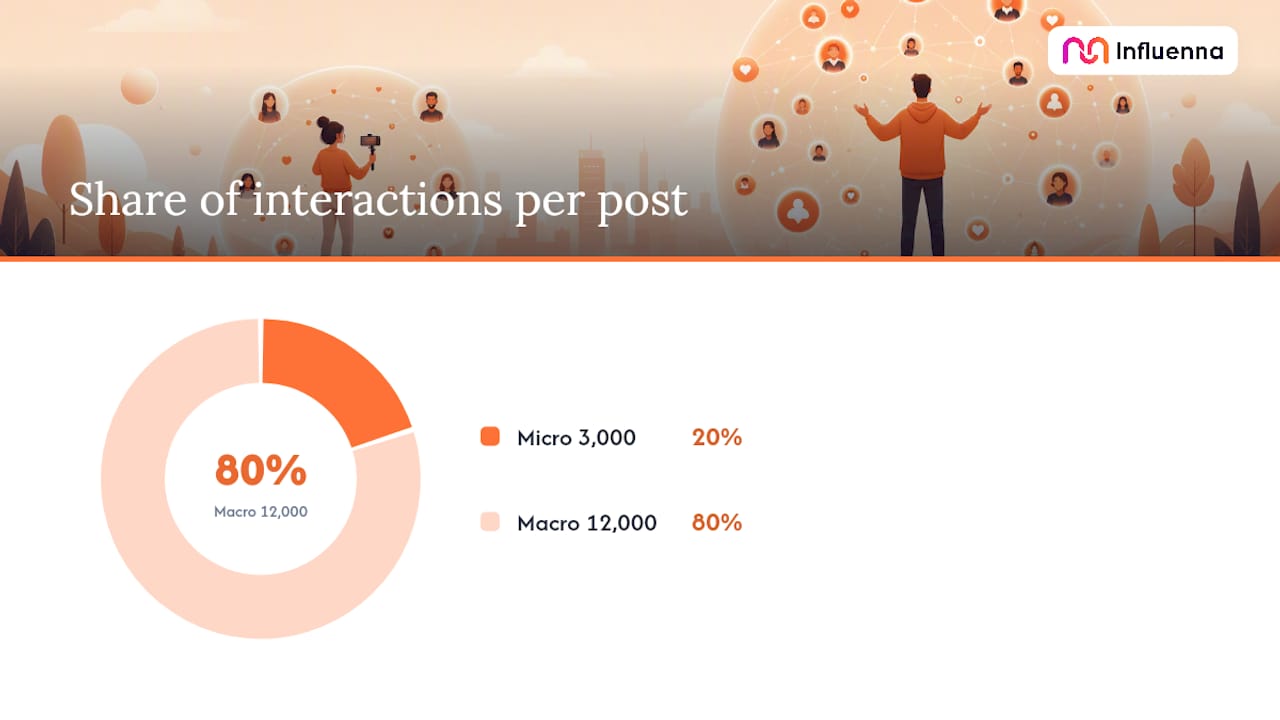
The engagement rate comparison deserves a closer look. Later's guide to micro-influencer marketing confirms that micro creators frequently outperform larger creators on engagement benchmarks and audience trust. But a higher percentage doesn't automatically mean more total interactions.
Here's the math that trips up a lot of marketers:
- A micro creator with 50K followers and a 6% engagement rate generates roughly 3,000 interactions per post.
- A macro creator with 800K followers and a 1.5% engagement rate generates roughly 12,000 interactions per post.
So if your KPI is raw interaction volume — comments, shares, saves — a single macro post can outperform several micro posts combined. Neal Schaffer's analysis makes this point directly: always convert engagement percentages into absolute interaction counts before comparing tiers. The percentage alone is misleading.
What this means for your planning:
- If you need volume of interactions for a contest, UGC campaign, or social proof: run the absolute-interaction math first.
- If you need conversion efficiency (cost per click, cost per acquisition): micro creators typically win.
- If brand safety and content polish are non-negotiable: macro creators deliver more consistently.
When to use micro, macro, or a hybrid strategy
The tier you choose should follow directly from your campaign goal. Here's how to map them:
Micro influencers are the right call when:
- You're targeting a specific niche (fitness, sustainable fashion, B2B SaaS, regional food).
- Your primary KPI is conversions, sign-ups, or trial downloads.
- You're running a local or regional activation where geographic precision matters.
- You want a sustained always-on program over 3–12 months with fresh content.
- Your budget is limited and you need cost-efficient reach within a defined audience.
Macro influencers make sense when:
- You're launching a new product and need fast, broad awareness in a short window.
- You're entering a new market and need credibility signals at scale.
- Your campaign is tied to a cultural moment (a season, a trend, an event) with a hard deadline.
- You need a single, high-production content asset that can be repurposed across paid channels.
Three campaign scenarios:
-
DTC skincare brand launching a new serum: Open with one macro creator (500K–800K beauty audience) for a launch-week awareness spike, then activate eight to ten micro creators in the skincare niche over the following six weeks to drive trial and reviews. The macro post builds the initial signal; the micro cohort converts it.
-
Regional restaurant chain: Skip macro entirely. Run ten to fifteen nano and micro creators in each target city, each posting about a specific menu item. Hyper-local content from people who actually live there converts better than a polished national post from someone who doesn't.
-
B2B software tool: Macro influencers rarely exist in most B2B niches. Build a micro cohort of LinkedIn and YouTube creators who cover your specific software category. Engagement rates in B2B tend to be lower overall, but the audience is far more qualified.
Pro Tip: The most effective hybrid sequence is macro first, micro second. Use the macro post to establish brand recognition and generate search volume, then let micro creators capture that demand with more personal, conversion-oriented content. Give yourself at least two weeks between the macro launch and the micro activation so the audience has time to encounter the brand before the peer recommendation lands.
What influencer partnerships actually cost
Pricing in influencer marketing is genuinely variable, which makes budgeting feel like guesswork. It doesn't have to be.
Common payment models:
- Flat fee per post: The most common structure. You pay a fixed amount for a defined deliverable (one Reel, one TikTok, one YouTube integration).
- Bundled packages: A rate for multiple deliverables (e.g., one feed post plus three Stories). Usually more cost-efficient than individual post rates.
- Product-for-post (gifting): Works at the nano and lower micro tier. Above 50K followers, most creators expect cash compensation.
- Usage and whitelisting fees: If you want to run a creator's content as a paid ad, expect an additional fee — often 20–50% on top of the organic post rate.
- Performance bonuses: Tied to clicks, sales, or promo code redemptions. Useful for conversion campaigns but harder to negotiate with larger creators.
Typical cost ranges by tier:
HubSpot's micro-influencer marketing guide cites a general pricing guideline based on follower counts for static posts., though video formats and usage rights push fees substantially higher. Treat these as rough starting points, not firm rates — niche, platform, and format all shift the number.
- Nano (1K–10K): Often gifting or $50–$200 per post
- Micro (10K–100K): Roughly $200–$1,500 per post depending on platform and format
- Mid-tier (100K–500K): $1,500–$5,000 per post
- Macro (500K–1M): $5,000–$20,000+ per post
- Mega / Celebrity: $20,000 to well into six figures
A concrete budgeting example:
Say you have $15,000 for an influencer campaign. You could spend it on one mid-tier creator at $12,000–$15,000 and get a single piece of content reaching a broad but undifferentiated audience. Or you could activate ten micro creators at $1,000–$1,500 each, covering ten distinct niches or geographies, generating ten pieces of content, and reaching ten different engaged communities. For most conversion-focused campaigns, the ten-micro approach produces more measurable results. Pricing varies far more by format and usage rights than by follower count alone — a video with whitelisting rights can cost three times a static post from the same creator.
How to vet and choose the right influencer
A structured vetting process saves you from expensive mistakes. Work through these steps before you commit to any creator:
-
Define your audience match first. Pull your customer data (age, gender, location, interests) and compare it against the creator's audience demographics. Most creators can share this from their platform analytics. If the overlap is below 60–70%, move on.
-
Check engagement quality, not just rate. Open the last 15–20 posts and read the comments. Generic comments ("Great post!" "Love this!") often signal purchased engagement. Real engagement looks like questions, personal stories, and back-and-forth conversation.
-
Audit follower authenticity. Tools like HypeAuditor or Modash can flag suspicious follower growth spikes, bot-heavy audiences, and engagement anomalies. This step is non-negotiable for any creator above $500 in fees.
-
Review content fit. Does the creator's existing content feel like a natural home for your product? If you're a premium brand and the creator's feed is cluttered with discount codes and unrelated sponsorships, that's a fit problem regardless of their numbers.
-
Clarify deliverables and usage rights upfront. Specify the exact deliverables (platform, format, number of posts, posting window), whether you need usage rights for paid amplification, and the exclusivity period. Vague briefs lead to disputes.
-
Check for exclusivity conflicts. Ask directly whether the creator has worked with or is currently contracted to a competitor. Many creators won't disclose this unless asked.
-
Confirm FTC disclosure compliance. Under FTC guidelines, any paid partnership must be clearly disclosed with language like "#ad" or "#sponsored" — not buried in a caption or hidden in a Stories swipe-up. Build this requirement into your contract, not just your brief.
Red flags to walk away from:
- Follower count grew by 20%+ in a single month with no obvious viral moment
- Engagement rate is under 0.5% on Instagram or under 1% on TikTok for a micro creator
- The creator has no rate card and no prior brand collaboration examples
- They resist providing audience demographic screenshots
- Their last three sponsored posts have fewer comments than their organic content by a wide margin
How to measure ROI across micro and macro campaigns
Comparing the ROI of a micro cohort against a single macro post requires a consistent measurement framework. Without one, you're comparing apples to oranges.
KPIs by campaign goal:
| Goal | Primary KPIs | Secondary KPIs |
|---|---|---|
| Awareness | Impressions, CPM, reach | Brand search lift, share of voice |
| Consideration | Engagement rate, video completion rate | Profile visits, saves, link clicks |
| Conversion | CTR, conversion rate, CPA | Promo code redemptions, revenue attributed |
| Retention / loyalty | Repeat purchase rate, UGC volume | Comment sentiment, DM volume |
Tracking checklist:
- Assign unique UTM parameters to every creator link — one UTM per creator, not one per campaign.
- Create unique landing pages or unique promo codes for each creator so you can attribute conversions without relying solely on last-click.
- If you're running paid amplification on creator content, set up pixel-based conversion events before the campaign goes live.
- For larger budgets, run an incrementality test: hold out a matched audience segment from seeing the influencer content and compare conversion rates against the exposed group.
Comparing ROI across tiers:
Don't compare engagement rate percentages between a micro and a macro campaign. Convert everything to absolute numbers, then compute cost per engaged user and cost per conversion for each tier. If your micro cohort of ten creators cost $12,000 total and drove 800 conversions, your CPA is $15. If your macro creator cost $12,000 and drove 200 conversions, your CPA is $60. That's the comparison that matters — not who had the higher engagement percentage.
Why micro influencers often convert better: the psychology behind it
The performance gap between micro and macro creators on conversion metrics isn't random. It has a clear psychological explanation: parasocial relationships.
Followers of micro creators tend to perceive them as peers rather than celebrities. They've watched the creator navigate real decisions, share genuine opinions, and respond to comments personally. When that creator recommends a product, it registers more like a trusted friend's suggestion than an advertisement.
Micro-influencers combine meaningful reach with the kind of audience trust that larger creators rarely sustain — their followers see them as accessible, relatable, and genuinely knowledgeable about their niche, which is precisely what makes their endorsements feel like peer recommendations rather than paid placements.
Shopify's influencer marketing playbook identifies this parasocial dynamic as the core driver of micro-influencer conversion efficiency. The same source warns that over-scripting destroys it: when brands hand creators a word-for-word script, the content loses the natural voice that built the audience's trust in the first place. Briefs that give creators a clear message but leave room for their own framing consistently outperform tightly controlled scripts in conversion-led programs.
Later's research reinforces this: micro creators outperform larger creators on authenticity and perceived similarity, two factors that directly predict purchase intent. The practical implication is straightforward. Write a brief that covers the key message, the required disclosures, and the deliverable specs — then let the creator tell the story in their own words.
Practical implications for campaign design:
- Share your product's genuine differentiator, not a marketing tagline. Creators translate real information into authentic content; they can't do the same with corporate copy.
- Allow creators to share their honest experience, including minor caveats. Audiences trust nuanced reviews more than uniformly positive ones.
- Give creators at least one week of product experience before they post. Content created without real product familiarity reads as hollow, and audiences notice.
The global influencer marketing industry has grown substantially — Statista's tracking of the global influencer market reflects the scale of investment brands are now committing to this channel. The brands getting the best returns are the ones treating micro creators as collaborators, not media placements.
The portfolio approach is the right default
Most marketers frame this as a binary choice: micro or macro. That framing is the wrong starting point. The question isn't which tier is better — it's which tier serves which phase of your funnel.
The brands that consistently outperform on influencer ROI treat their creator roster the way a media buyer treats a channel mix. Macro creators open reach. Micro and nano creators close conversions. Running both in sequence, with a clear handoff between awareness and consideration, produces better results than either tier alone.
The mistake I see most often isn't picking the wrong tier. It's picking one tier and expecting it to do everything. A macro creator can't replicate the trust a micro creator has built with a niche community over years. A micro creator can't match the raw reach of a macro post in a 48-hour launch window. They're different tools for different jobs.
If you're planning your next campaign and you're not sure where to start: run a four-week micro cohort test with five to eight creators in your core niche. Set a clear conversion KPI, give each creator a unique promo code, and measure CPA by creator. That test will tell you more about what works for your specific audience than any benchmark study.

Influenna makes multi-creator campaigns easier to run
Finding the right micro creators is where most campaigns stall. Brands spend weeks chasing media kits, sending cold DMs that go unanswered, and manually verifying whether a creator's audience actually matches their customer profile. That friction compounds when you're trying to coordinate eight or ten creators at once.
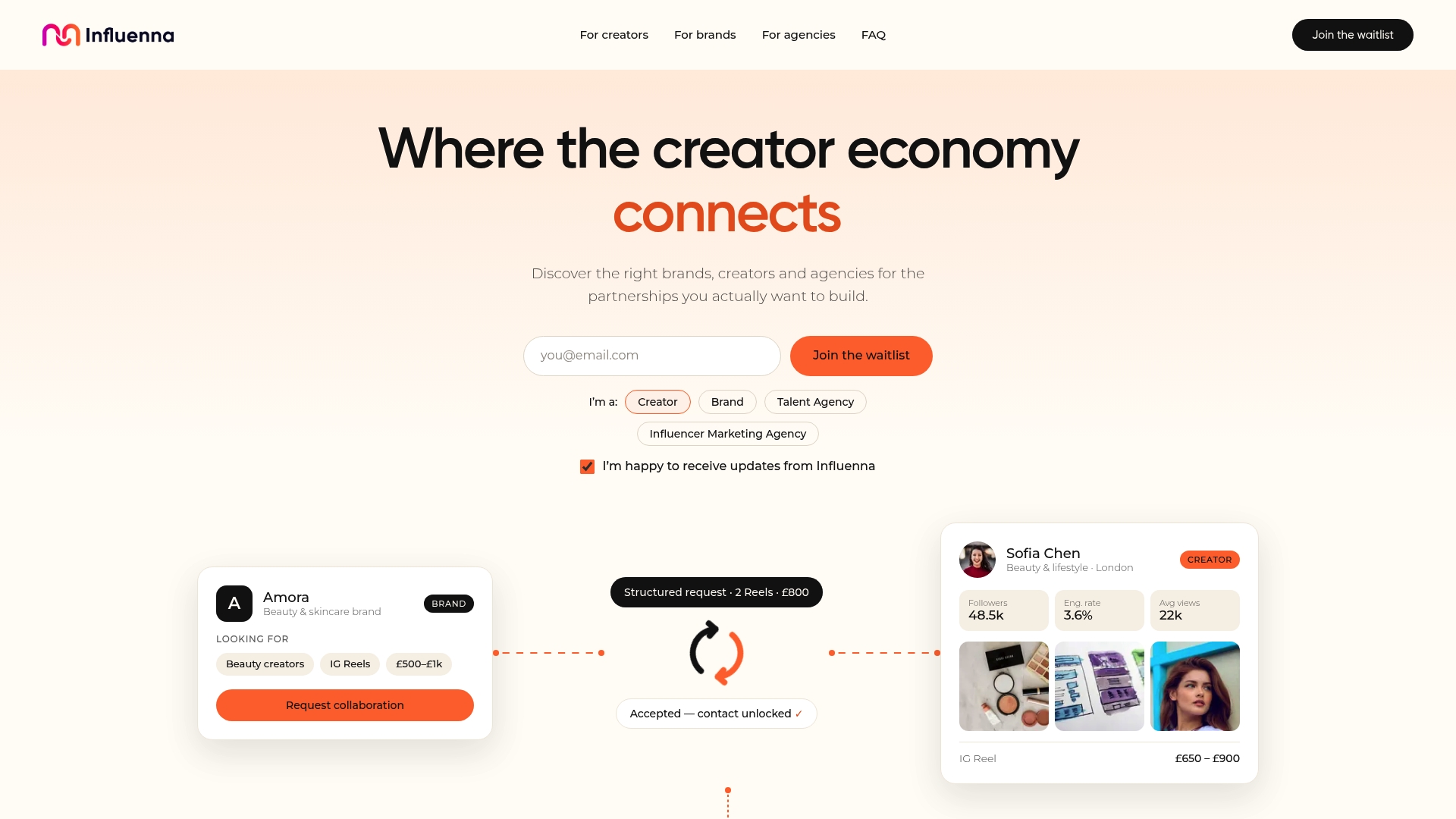
Influenna is a curated collaboration marketplace built for exactly this workflow. Every creator, brand, talent agency, and influencer marketing agency on the platform is reviewed by a person before getting access — so you're not sifting through a database of unverified accounts. You search and filter for creators by niche, platform, and fit, then send a structured collaboration request with your brief details upfront. Contact details are only exchanged after both sides approve the match, which means the conversations that do happen are already qualified.
For brands running multi-micro campaigns, that structure replaces the spreadsheet-and-cold-DM workflow with something that actually scales. Influenna is currently pre-launch. Join the waitlist at Influenna to get early access when it opens.
Sources
- Micro Influencers in 2026: Playbook for Cost, Compliance, and Conversion - Shopify
- Micro-Influencer Marketing: What It Is and How It Works
- Macro-Influencers Vs. Micro-Influencers: Which to Collab With?
- My Comprehensive Guide to Micro-Influencer Marketing - HubSpot
- Micro-influencer marketing - Sprout Social
- Statista