Influencer Marketing Budget: A 2026 Method for Teams
11 min read

That single ratio, drawn from practitioner budget templates, is the fastest way to sanity-check any number a stakeholder throws at you. A small pilot runs under $20,000 a quarter, a mid-size always-on program lands between $20,000 and $80,000 a year, and scaled programs clear $250,000 annually.
Three things to know before you build a deck:
- Expected split: roughly 60 to 70% creator fees, the remainder split across production, amplification, and tracking.
- Payback horizon: plan for fast returns. Nearly two-thirds of marketers now expect payback within one month, and almost half expect it within two weeks.
- Next step: calculate your target conversions first, then work backward into a creator-fee number. Also flag Form 1099-NEC reporting early. Paying creators directly triggers tax paperwork most teams forget to budget for until Q4.
Key Takeaways
| Point | Details |
|---|---|
| Start with the fee ratio | Allocate 60–70% of total budget to creator fees, the rest to production, amplification, and measurement. |
| Anchor to conversions | Calculate target CAC from LTV first, then size the creator-fee budget backward from conversion goals. |
| Plan for fast payback | Nearly two-thirds of teams expect payback within one month, so fund measurement before launch. |
| Reserve for rebooking | Set aside about 30% of next quarter's spend to re-sign creators who already proved they convert. |
| Budget for tax admin | Direct creator payments trigger Form 1099-NEC reporting, so allocate 1–2% of spend to contracting and tax admin. |
Table of Contents
- What Does an Influencer Marketing Budget Actually Cover?
- What Are the Rate Benchmarks by Creator Tier?
- How Do You Calculate a Defensible Influencer Marketing Budget?
- How Should You Allocate Budget by Objective and Channel?
- How Do You Measure ROI and Defend the Budget?
- In-House or Agency: What Does It Cost to Run the Program?
- What Do Sample Influencer Budgets Look Like at Each Stage?
- What 2026 Benchmarks Should Change Your Planning?
- What Should You Do in the First 30 Days?
- Sources
- FAQ
What Does an Influencer Marketing Budget Actually Cover?
A real influencer marketing budget is never just "what we pay the creator." It's a stack of line items, and missing one is how programs blow past forecast by 20 or 30%.
- Creator fees — the core payment for content and usage, typically 60 to 70% of total spend.
- Production costs — studio time, editing, or co-shoot support for creators who need it.
- Paid amplification/whitelisting — boosting organic posts through the creator's ad account or your own.
- Measurement and tools — tracking software, UTM management, reporting dashboards.
- Agency fees or in-house labor — whichever team runs sourcing, contracting, and relationship management.
- Content rights — usage licenses beyond the original post, especially for paid media or website use.
- Legal, tax, and contracting — contracts, compliance review, 1099 processing.
- Contingency — a buffer for rate negotiation or a creator dropping out mid-campaign.
Pro Tip: Content rights and a rebooking reserve are where budgets quietly fail. Teams price the first post, then get surprised when a creator asks for a separate fee to let you run their content in paid ads six months later. Bake usage rights into the original contract instead of renegotiating later.
What Are the Rate Benchmarks by Creator Tier?
Rates vary enormously by tier, platform, and how much usage you're buying, but you can plan around defensible medians.
| Tier | Followers | Typical per-post/package range | Best use case |
|---|---|---|---|
| Nano | 1K–10K | $50–$500 | Authenticity, UGC, testing new products |
| Micro | 10K–100K | $500–$2,500 | Community trust, niche conversion |
| Mid-tier | 100K–500K | $2,500–$10,000 | Balanced reach and engagement |
| Macro | 500K–1M | $10,000–$25,000 | Broad awareness campaigns |
| Celebrity | 1M+ | $25,000–$500,000+ | Mass-reach launches, cultural moments |
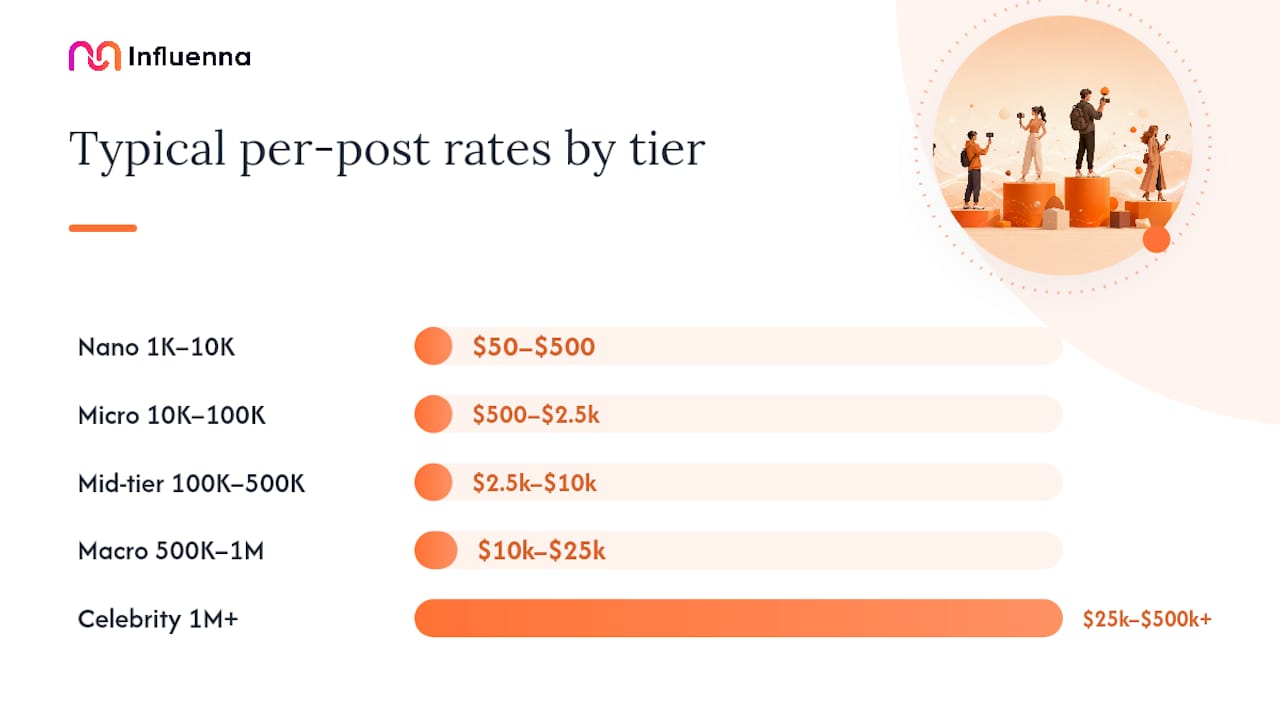
Mid-tier creators are a useful planning anchor: practitioners commonly use around $2,500 per integration as their baseline math for a single post. That figure shifts fast, though.
A few things worth flagging before you lock a tier mix:
- TikTok integrations often price lower per post than Instagram but decay in shelf life within days.
- YouTube integrations cost more per unit but hold relevance for months, changing your cost-per-impression math.
- Smaller creators frequently outperform bigger names on engagement and authenticity, which is why nano and micro tiers dominate 2026 budget allocations for repeatable testing.
How Do You Calculate a Defensible Influencer Marketing Budget?
Build the number from your business goal down, not from a vendor quote up. Here's the sequence that holds up in a budget review.
- Set your KPI and target conversion volume. Decide if you're optimizing for reach, sign-ups, or sales, and put a number on it (e.g., 500 trial sign-ups this quarter).
- Calculate your target CAC from LTV. If your average customer is worth $150 and your acceptable CAC is $40, that's your ceiling per acquired customer.
- Set the creator-fee budget to hit that volume. If you need 500 conversions at a $40 CAC, that's a $20,000 conversion budget. Divide by your expected conversion rate per creator post (say 2%) and average post reach (10,000) to estimate how many creators you need.
- Add production, measurement, amplification, and ops lines. Using the 60/70 rule, a $20,000 creator-fee budget implies a total program budget closer to $28,000–$33,000 once you add the rest.
- Reserve contingency and a rebooking fund. Set aside roughly 30% of next quarter's spend to re-book creators who performed, since re-signing a proven partner is cheaper than sourcing a new one from scratch.
For an awareness campaign, shift the math: instead of CAC, anchor on cost-per-thousand-impressions and weight spend toward macro or celebrity tiers. For direct-response campaigns, the CAC math above dominates, and nano/micro tiers usually win because their lower fees keep cost-per-conversion in range even at modest conversion rates.
How Should You Allocate Budget by Objective and Channel?
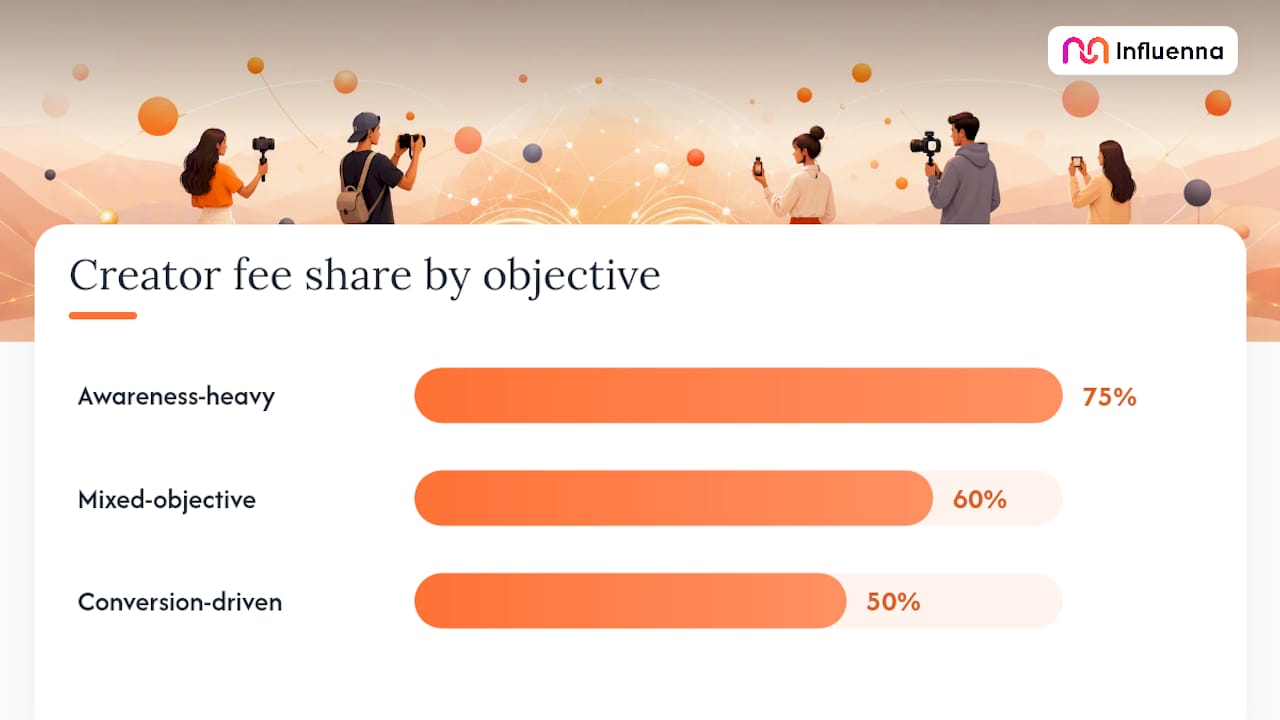
The split between media, amplification, measurement, and ops should shift with what you're actually trying to achieve.
- Awareness-heavy campaigns: roughly 75% creator fees, 15% amplification, 5% measurement, 5% ops. You're buying reach, so most of the money goes to talent.
- Mixed-objective campaigns: around 60% creator fees, 20% amplification, 10% measurement, 10% ops. This is the default for most always-on programs.
- Conversion-driven campaigns: closer to 50% creator fees, 25% amplification, 15% measurement, 10% ops. Amplification and tracking earn a bigger share because you need to prove attribution.
Channel choice changes the math too. TikTok integrations tend to run cheaper per post but expire fast in relevance, so they suit high-frequency testing budgets. YouTube favors fewer, larger integrations because a single video can stay discoverable for months, changing your cost-per-view calculation entirely.
Programs that skip this line end up locked into last year's channel mix even when the audience has moved on.*
How Do You Measure ROI and Defend the Budget?
The gap between planned budget growth and measurement maturity is the single biggest reason influencer budgets get cut mid-year. Brands that plan to spend more aren't always the ones building better tracking to prove it worked, and that mismatch shows up the moment a CFO asks for numbers.
Use metrics matched to what you can actually attribute:
- UTM-tagged links for direct traffic and conversion tracking on owned channels.
- Unique promo codes when creators drive purchases you can trace to a specific partner.
- Affiliate links for ongoing, performance-based relationships.
- Lift surveys for brand awareness campaigns where clicks aren't the point.
A reporting checklist that survives leadership review needs four things: a pre-campaign baseline, a fixed reporting cadence (weekly during flight, monthly after), named data sources for each metric, and a clear payback horizon stated up front.
65.9% of marketing teams now expect payback within one month, and nearly half expect it within two weeks, according to the Influencer Marketing Benchmark Report. Set that expectation with leadership before launch, not after the first report lands short.
In-House or Agency: What Does It Cost to Run the Program?
Running influencer programs in-house or through an agency changes your cost structure more than it changes your creative output.
- In-house: salary or FTE time for a manager, tool subscriptions (discovery, reporting), and direct 1099 processing for every creator you pay.
- Agency: a management fee layered on top of media spend, usually 15 to 25% of program budget, but less internal headcount and admin burden.
- Hidden costs either way: contract review time, revision rounds with creators, and the tax/reporting overhead of Form 1099-NEC filings once you're paying more than a handful of creators directly.
| Model | Typical cost component | Best for |
|---|---|---|
| In-house | Salary/FTE + tools + direct tax admin | Programs running 20+ creators per quarter with steady volume |
| Agency | 15–25% management fee on top of media | Teams without bandwidth for sourcing and contracting |
It's a small line, but skipping it is how a team ends up scrambling before tax season.
What Do Sample Influencer Budgets Look Like at Each Stage?
Three scenarios you can lift into a planning doc, adjusted to your own tiers and objectives.
- Small pilot (under $20,000/quarter): $13,000 creator fees across 8-10 nano and micro creators, $2,000 production, $2,000 measurement/tools, $3,000 contingency and ops.
- Mid program ($20,000–$80,000/year): $50,000 creator fees mixing micro and mid-tier talent, $10,000 amplification, $8,000 measurement and tooling, $12,000 ops and contingency, with a rebooking reserve built into next quarter's plan.
- Scaled/enterprise ($250,000+/year): $160,000 creator fees spanning all tiers, $40,000 paid amplification, $25,000 measurement/attribution infrastructure, $25,000 agency or in-house management costs.
Ramp spend quarter to quarter rather than committing the full annual number upfront. Move from pilot to scale only once you've hit a measurement milestone, such as three consecutive months of tracked conversions within your target CAC. A detailed line-item structure like the ones used in comprehensive campaign budget templates works well as a starting framework, even outside political advocacy contexts.
What 2026 Benchmarks Should Change Your Planning?
A few 2026 signals are worth putting directly in your budget deck, because they explain why leadership expects faster answers than they used to.
- 72.22% of surveyed teams plan to increase influencer budgets by 50% or more, per the Influencer Marketing Benchmark Report, which is pushing up rates across every tier as demand for creators rises faster than supply.
- Payback expectations have compressed. Teams increasingly want proof within weeks, not quarters, which means your measurement line needs to be funded before launch, not added afterward.
- Nano and micro creators are getting a larger share of 2026 budgets because they're cheaper to test at volume and produce usable content faster than fewer, bigger integrations.
When you set contingency, size it for rate inflation. If demand keeps outpacing creator supply, your mid-tier median from last quarter may already be low by the time you sign contracts.
What Should You Do in the First 30 Days?
Run one focused pilot tied to tracked conversions before committing to a full-year number. Pick a single KPI, book five to eight creators, and set your measurement baseline before the first post goes live.
The mistake I see most: teams chase 2026's platform trends and tier shifts without measurement maturity to match. A bigger budget on an untracked program just means a bigger number you can't defend next quarter.
Sources
- Influencer Marketing Benchmark Report
- Influencer Marketing Budget in 2026, What to Spend
- When it comes to influencers, smaller can be better
- Form 1099-NEC
FAQ
What Is the 70/20/10 Rule for Marketing Budget?
Applied to influencer marketing, that often means the bulk of spend goes to creator tiers with track records, with a smaller slice testing new platforms or formats.
What Is the 5-3-2 Rule on Instagram?
It's a content-mix guideline suggesting five posts share others' or industry content, three share your own original content, and two are personal or entertaining posts. It applies to organic content planning more than to influencer budget allocation directly.
How Much Should I Charge for Influencer Marketing?
Rates depend entirely on tier and platform: nano creators typically charge $50 to $500 per post, micro creators $500 to $2,500, and mid-tier creators $2,500 to $10,000, with mid-tier integrations often anchored near a $2,500 planning median.
How Many Influencers Make Over $100,000?
Public data on individual creator earnings above six figures isn't reliably tracked or publicly listed, but macro and celebrity-tier creators regularly command $25,000 to $500,000-plus for single campaigns, which puts annual income well past that threshold for full-time creators working with multiple brands.