Under 150 Words: Collaboration Request Templates for Brands & Creators
11 min read

Send a short, personalized outreach email with one clear ask, then follow with a proposal or intake form once the other side shows interest. That two-step sequence beats a long unsolicited pitch almost every time. Below are copy-paste templates for the most common scenarios, the anatomy of a message that actually gets opened, and the proposal and intake structures to use once someone says yes.
TL;DR:
- Sending a concise, one-sentence clear ask in a short email increases reply rates and prevents overwhelm, especially when tailored to the recipient’s recent work or audience.
- Use structured, formal proposals or intake forms only after the recipient shows interest, ensuring qualification and clarity before detailed negotiations.
- Personalization through referencing specific content, audience overlap, or recent achievements significantly improves response likelihood compared to generic outreach.
- Subject lines should signal relevance with short, outcome-focused formulas to grab attention within seconds amidst crowded inboxes.
- Prioritizing qualification over polish in outreach efforts results in better matches and more efficient collaboration processes.
Table of Contents
- Collaboration Request Templates You Can Copy Today
- What Makes a Collaboration Request Email Work?
- Proposal Templates vs. Intake Forms: When to Use Each
- How to Personalize Fast and Follow Up Without Nagging
- Why Structured Requests Beat Cold Outreach
- What the Templates Get Wrong
- A Faster Way to Send Structured Collaboration Requests
- Templates and Forms Worth Bookmarking
- Sources
- FAQ
Collaboration Request Templates You Can Copy Today
Every template below follows the same logic: short intro, why you picked them, the value on offer, and one clear next step. Swap the bracketed text and send.
- Initial partnership pitch. Subject: "Quick idea for [Company/Creator Name]." Body: Introduce yourself in one line, name something specific about their recent work, propose the collaboration idea in a sentence, note the mutual benefit, and ask if they're open to a quick call or email thread. Personalize: reference a specific campaign, post, or product launch from the last 30 days.
- Brand partnership proposal. Subject: "Partnership idea: [Brand] x [Your Name/Company]." Body: State your audience or product fit, cite one relevant metric, propose a specific format (bundle, giveaway, co-branded content), and ask for 15 minutes to discuss. Personalize: name their target customer and how your audience overlaps.
- Influencer outreach (creator to brand). Subject: "Collab idea: [content type] for [Brand]." Body: Share your niche and platform, link your media kit, propose a content concept tied to their product, and ask about current partnership budgets. Personalize: mention a product you already use or reviewed organically.
- Event invite. Subject: "Invitation: [Event Name] on [Date]." Body: Name the event, explain why they'd be a strong fit as a guest or partner, outline what's expected of them, and ask for an RSVP by a specific date. Personalize: reference a past event they attended or hosted.
- Cross-promotion. Subject: "Cross-promo idea between [Brand A] and [Brand B]." Body: Propose a simple swap (shoutout, guest post, bundled offer), state the audience size on each side, and suggest a launch window. Personalize: point to a complementary (not competing) product line.
- Vendor or supplier collaboration. Subject: "Sourcing partnership: [Product Category]." Body: Describe your project scope, ask about minimum order volumes or lead times, and request a call to discuss terms. Personalize: cite their catalog or a specific SKU.
- Ambassador pitch. Subject: "Long-term partnership opportunity with [Brand]." Body: Explain the ambassador structure (ongoing content, discount codes, revenue share), note why you're reaching out to them specifically, and ask if they're building an ambassador program. Personalize: mention a competitor's ambassador they might want to counter.
- First follow-up. Subject: "Re: [original subject]." Body: One line reminding them of the original ask, restate the value in a single sentence, and ask if now is a better time. Personalize: add a fresh detail, like a new stat or recent post.
- Final follow-up. Subject: "Closing the loop on [idea]." Body: State this is your last note on the topic, leave the door open for later, and thank them for their time. Personalize: keep it warm, not passive-aggressive.
What Makes a Collaboration Request Email Work?
Every effective business collaboration email has six parts, in this order: subject line, opener, credibility line, value proposition, specific ask, and sign-off. Skip the credibility line and you sound like a stranger. Skip the specific ask and you get silence, because the recipient has no idea what to do with your message.
The subject line does the heaviest lifting. It has to signal relevance in under eight words, since most people scan a crowded inbox in under two seconds.
Pro Tip: *Front-load the outcome, not the request.
Twelve subject-line formulas worth stealing:
- "Collab idea: [outcome] for [Recipient]"
- "Quick idea for your [campaign/event]"
- "Partnership fit: [Brand] x [You]"
- "[Mutual connection] suggested we connect"
- "A [content type] idea for [Product]"
- "Loved your [specific post] — idea attached"
- "Sourcing partner for [category]?"
- "Ambassador opportunity with [Brand]"
- "Cross-promo: [Brand A] + [Brand B]"
- "15 minutes to discuss [idea]?"
- "Following up: [original topic]"
- "Closing the loop on [idea]"
Keep the body under 150 words for a first email. One paragraph with a single clear ask consistently gets more replies than a multi-paragraph pitch that reads like an unsolicited proposal. Save exact budget numbers for later unless you're the one setting the offer. State a range only if it helps the recipient self-qualify immediately, and never bury the ask in the third paragraph.
Proposal Templates vs. Intake Forms: When to Use Each
An initial outreach email should stay short. Once the other side responds with interest, move to a formal document that locks in scope, timeline, and money before either side wastes more time.
A collaboration agreement template or full proposal belongs in that second stage. A solid proposal checklist covers:
- Project overview and objectives
- Scope of work and deliverables
- Timeline and key milestones
- Roles and responsibilities
- Budget and financial terms
- Projected results
- Terms and conditions
Brand collaboration proposal templates commonly structure these sections in that exact order, which makes it easy to compare offers side by side once you're weighing multiple partners.
If you're the one receiving requests at volume, an intake form does the qualifying work before you ever open an email. Useful fields include contact and organization details, collaboration type and audience size tier, platform(s), content examples, desired deliverables, timeline, budget range, and a file upload for media kits.
Pro Tip: Add conditional logic so selecting "co-marketing" versus "product integration" reveals different follow-up fields. It keeps the form short for everyone instead of forcing every applicant through every question.
How to Personalize Fast and Follow Up Without Nagging
Three signals move the needle on reply rates: mentioning a specific recent post or launch, naming a real audience overlap, and stating one concrete benefit instead of a vague "great fit." Each takes under five minutes to research.
A workable follow-up cadence:
- First follow-up (day 3 to 5): One line restating the ask, plus one new detail. "Circling back on the bundle idea. Saw you just crossed 50K on TikTok. Still open to chatting?"
- Gentle reminder (day 7 to 10): Shorter than the first. "No pressure if the timing's off. Happy to send more details if useful."
- Final follow-up (day 14): Close the loop cleanly. "Last note from me. Would love to work together down the line."
Custom-tailored proposals that reference the recipient's actual content outperform generic templates sent to a list, even when the underlying offer is identical.
Why Structured Requests Beat Cold Outreach
Curated membership and mutual approval before contact exchange solve a problem cold DMs never fix: signal. When both sides review a structured request instead of an open inbox, brands get a clearer brief upfront and creators skip the guesswork of a vague pitch. Fewer low-quality messages means faster, better matches on both ends.
What the Templates Get Wrong
Most advice on writing a collaboration request focuses entirely on wording. That's the easy part. The harder problem is qualification: who you're sending to, and whether they can even say yes without three rounds of back-and-forth first.
A perfectly worded email to the wrong contact, or one missing the one data point they need (audience size, budget range, timeline), still dies in the inbox. The templates above work because they're short enough to read in ten seconds and specific enough to answer the recipient's first unspoken question: "what's actually being asked of me?"
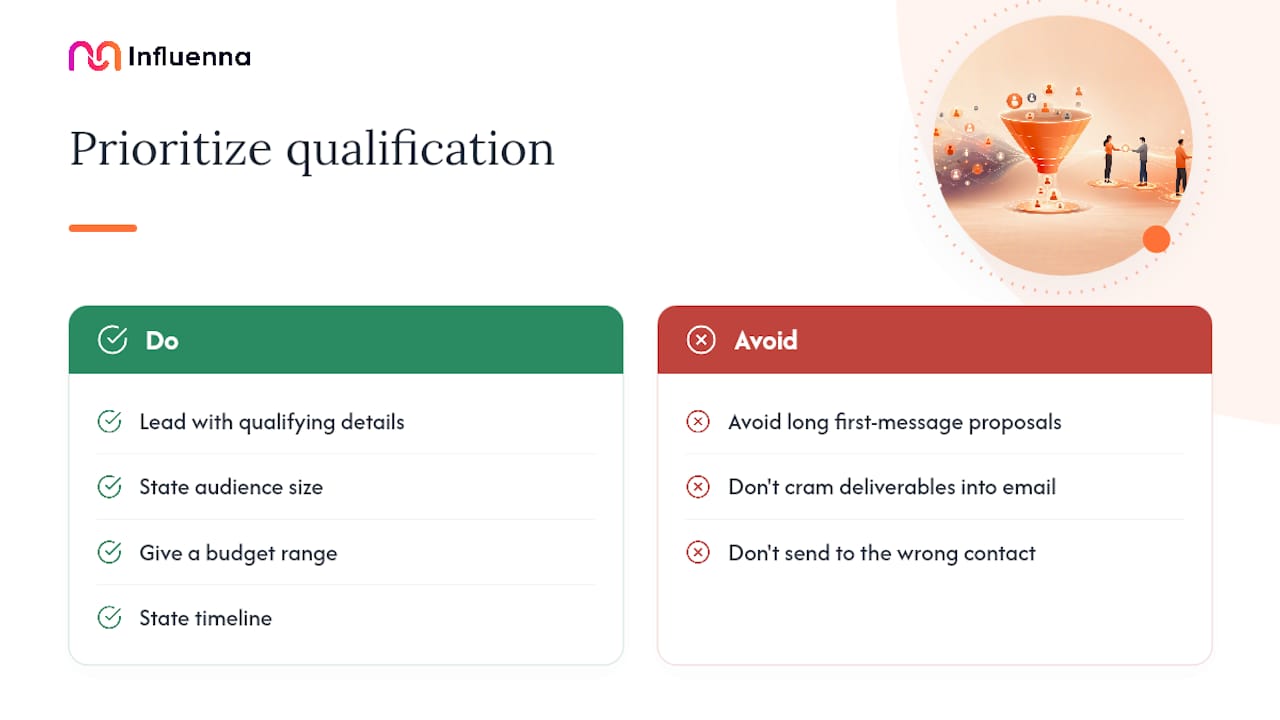
Where conventional advice falls short is treating the email and the proposal as one document. They're not. Cramming deliverables, budget, and terms into a first message is why so many collaboration proposals get ignored. Separate the two. Use the email to earn a "tell me more," and save the structured proposal or intake form for after that.
If you take one thing from this article, prioritize the qualifying details over polish. A plain email with a clear ask and the right audience-size context will outperform a beautifully designed pitch sent to a mismatched contact every time.
— Igor
A Faster Way to Send Structured Collaboration Requests
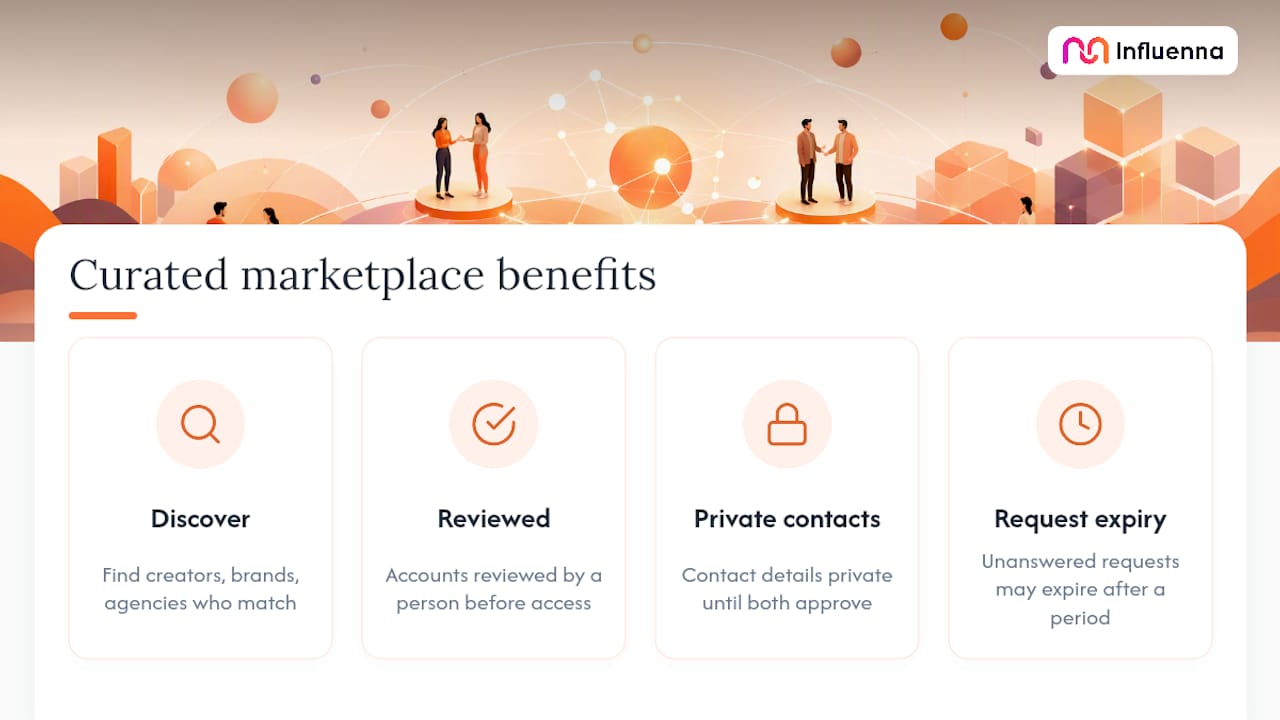
There are platforms that offer alternatives to sending templates into a cold inbox and hoping for the best. Instead of guessing who's a fit, you can discover creators, brands, talent agencies, or influencer marketing agencies who match what you're looking for, then send a structured collaboration request instead of a DM that might get ignored or lost.
On some curated platforms, accounts are reviewed by a person before getting marketplace access, so requests land with people who are actually there to collaborate. Contact details stay private until both sides approve, which means no exposed inboxes and no spam. Unanswered requests may expire after a certain period, so nothing sits in limbo indefinitely.
If the templates and follow-up cadence above sound like the workflow you want, but you'd rather not build the intake process yourself, join the Influenna waitlist for early access when the marketplace opens.
Templates and Forms Worth Bookmarking
A few ready-made resources cover what this article outlined: the WPForms content collaboration request form gives a quick intake sheet with audience tiers, the Lexar partnership request form shows real-world fields for social links and content style, the Jotform strategic partnership form demonstrates conditional-logic routing, the PandaDoc brand collaboration proposal covers a full formal proposal structure, and the OneSuite collaboration proposal template offers a simpler downloadable outline for smaller projects.
Sources
- Content collaboration request form template | WPForms
- Free Brand Collaboration Proposal Template | PandaDoc
- Partnership request form | Lexar
- Strategic Partnership Partner Contact Form | Jotform
FAQ
How Do You Write a Collaboration Request?
Open with a one-line introduction, mention something specific about the recipient's work, state the value you're offering, and end with one clear ask, such as a 15-minute call or a yes/no on interest.
What Are Good Examples of Collaboration?
Strong examples include a brand and creator co-launching a limited product bundle, two complementary businesses cross-promoting to each other's audiences, and an ambassador program built on ongoing content in exchange for a revenue share or discount code.
How Do You Politely Ask for Cooperation in an Email?
Keep it short, name the mutual benefit before you make the ask, and give the recipient an easy way to say yes, like a single question they can answer in one line rather than a form to fill out.
Can You Provide an Example of a Collaboration Email?
A working example: "Hi [Name], loved your recent post on [topic]. I run [Company], and I think a co-branded [product/content idea] could work well for both our audiences. Would you be open to a quick call this week to talk it through?"
When Should I Send a Formal Proposal Instead of an Email?
Send a formal proposal only after the recipient has responded with interest. Use it to lock in scope, deliverables, timeline, and budget, since packing all of that into a first message tends to overwhelm the reader and slow down a reply.