Vet Influencers by Audience Depth, Not Follower Count for Brands
10 min read

Vetting influencers is a process you run against every candidate, not a gut check on follower count. The reliable version moves through five phases: screen, authenticate, audit, evaluate, approve. Vanity metrics tell you almost nothing about how a campaign will perform, so the real work happens in the audit and evaluate phases, where you measure audience relationship depth and creative fit. Budget a few hours per candidate for a full pass, less for a quick triage.
TL;DR:
- Authenticity and brand safety scores carry more weight than aesthetic fit, with any very low scores leading to immediate disqualification.
- Growth patterns and comment quality are key indicators of genuine engagement, while sudden follower spikes often signal purchased followers.
- Content risk and disclosure compliance should be verified through keyword searches, manual review, and documentation before signing any partnership.
- Vetting micro-influencers requires only quick checks, while macro-influencers need full audits and possibly third-party background screening.
- Curated marketplaces streamline vetting by pre-screening accounts, shifting focus to confirmation and creative fit rather than initial filtering.
Table of Contents
- What Is the Step-by-Step Influencer Vetting Framework?
- How Do You Spot Fake Followers and Engagement Fraud?
- What Brand Safety and Disclosure Checks Should You Document?
- Which Tools Actually Help You Vet at Scale?
- How Deep Should You Vet Nano, Micro, and Macro Influencers?
- What a Curated Marketplace Changes About Early Vetting
- Sources
- FAQ
What Is the Step-by-Step Influencer Vetting Framework?
Most brands still lean on follower count and engagement rate to make go/no-go decisions. Both describe what already happened, not what's likely to happen in your campaign, which is why a documented vetting process outperforms a metrics-only screen. The five-phase model below gives you a repeatable structure you can apply to any creator, on any platform.
- Screen — Confirm the creator's platform, audience size, and niche fit against your brief. Reject obvious mismatches before spending more time.
- Authenticate — Check follower growth history, audience geography, and account age for signs of purchased growth.
- Audit — Sample comments and recent content for engagement quality, brand safety issues, and disclosure history.
- Evaluate — Assess creative fit, tone, and whether the creator's audience overlaps with your actual buyers.
- Approve — Document findings in a scorecard, get sign-off, and move to contract terms.
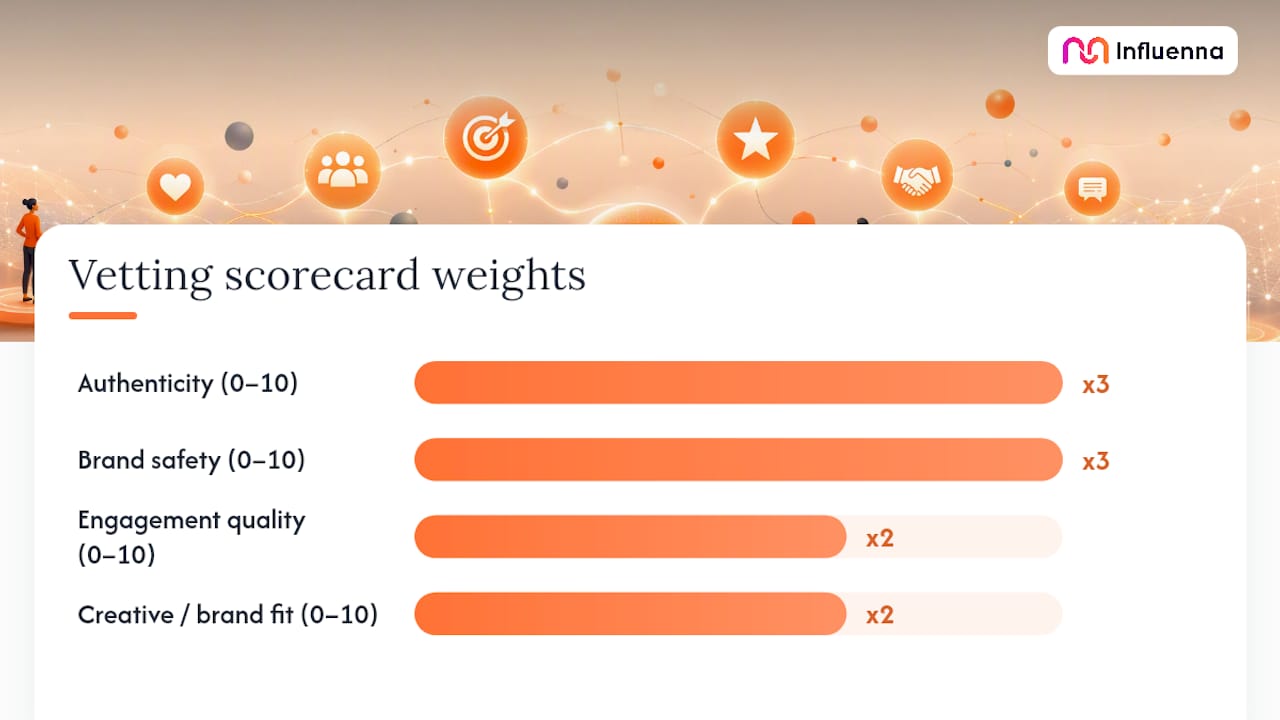
A simple scorecard works better than a pass/fail gut call. Weight each phase by risk: authenticity and brand safety should carry more weight than aesthetic fit, since a fraud problem or a controversy kills a campaign outright while a mediocre visual style just underperforms.
- Authenticity score (0-10): weight x3
- Brand safety score (0-10): weight x3
- Engagement quality (0-10): weight x2
- Creative/brand fit (0-10): weight x2
Set a knockout rule up front: any very low score on authenticity or brand safety ends the review immediately, regardless of the total. Escalate to a full audit or a third-party investigative check when the spend crosses a threshold you'd regret losing, or when the creator will represent a regulated product category.
Pro Tip: Build your scorecard as a shared spreadsheet template before your first campaign, not during it. Retrofitting a scoring system after you've already approved three creators creates inconsistent standards you can't defend later.
How Do You Spot Fake Followers and Engagement Fraud?
Purchased followers and engagement pods leave patterns you can catch with a careful look at the numbers and a manual read of the comments. Growth that spikes overnight, then flatlines, almost always signals a bought batch rather than organic reach. Genuine growth tends to track with posting frequency and platform algorithm shifts, not sudden jumps unconnected to any content event.
Red flags worth flagging on sight:
- Comment counts that stay flat while like counts climb sharply
- Generic comments ("Nice!" "Love this!") repeated across unrelated posts, often from the same handful of accounts
- Followers concentrated in countries with no logical connection to the creator's stated audience or language
- Engagement rate that's dramatically higher or lower than the platform's typical range for that follower tier
The comment-sampling protocol that catches the most fraud: pull 20 to 30 recent posts, then sample the top 30 comments across those posts, scoring each for purchase intent, specific product mentions, and conversational depth. A creator whose comments consistently reference specific products, ask follow-up questions, or tag friends has an audience that's actually paying attention.
Tool outputs on audience quality and bot scores are useful directionally, but they're not gospel. Platform tools can generate audience-quality signals and brand-safety flags, but they still require manual interpretation — a low bot score paired with dead comment sections is more trustworthy than a clean automated report alone.

What Brand Safety and Disclosure Checks Should You Document?
Before you sign anything, you need a paper trail showing you checked for content risk and disclosure compliance. Skip this and you're exposed if a partnership goes sideways or a regulator asks questions later.
Run a content-risk scan covering the creator's last 6 to 12 months of posts, searching for hate speech, NSFW material, misinformation, or political content that conflicts with your brand's positioning. A simple keyword and hashtag search across their platform history, plus a manual scroll through recent posts, catches most of what matters.
- Confirm native disclosure labels are used (Instagram's "Paid Partnership" tag, TikTok's branded content toggle), not just a caption hashtag buried at the bottom
- Verify caption placement puts #ad or #sponsored above the "more" fold, not hidden after ten lines of text
- Check for verbal disclosure in video content where required
- Log any past brand controversies, canceled partnerships, or public backlash tied to the creator's name
FTC guidance requires disclosures to be clear and conspicuous, meaning an average viewer shouldn't have to hunt for them. If you're working in a regulated category like supplements or financial products, category-specific advertising guidance applies on top of general disclosure rules, so build that check into your documentation before contracting.
Pro Tip: Screenshot every disclosure check you run and date it. If a partnership draws scrutiny six months later, you want proof you verified compliance at the time, not a memory of having done it.
Which Tools Actually Help You Vet at Scale?
Tools speed up the mechanical parts of vetting. They don't replace the manual comment reading and direct verification that catch what algorithms miss.
Three tool categories cover most of what you need: audience-quality platforms that flag suspicious follower patterns, brand-safety scanners that search content history for risk keywords, and native analytics dashboards that show you the creator's own platform data instead of third-party estimates. None of them substitute for a human reading actual comments.
A workflow that scales without losing rigor looks like this:
- Build a longlist using audience-quality and brand-safety tools to eliminate obvious fails.
- Run the quick-check (below) on the remaining candidates to prioritize who gets a full audit.
- Request native analytics screenshots directly from shortlisted creators, covering audience demographics and historical engagement.
- Ask for two references from past brand partners, especially for larger budget activations.
- Move approved candidates into contract negotiation with your scorecard attached as documentation.
A curated marketplace can shrink this timeline considerably, since candidates arrive pre-screened rather than sourced cold. Influenna's review process means every account passes human review before it's even discoverable, which narrows your longlist to people worth vetting in the first place.
How Deep Should You Vet Nano, Micro, and Macro Influencers?
Not every creator warrants the same level of scrutiny. Vetting a nano-influencer with 8,000 followers for a $200 gifted post the same way you'd vet a macro-influencer signing a $50,000 contract wastes time you don't have.
- Nano (1K-10K followers): Quick check only. Growth pattern, comment quality on 5-10 posts, basic disclosure history.
- Micro (10K-100K followers): Quick check plus a light content-risk scan covering the past 6 months.
- Mid-tier (100K-500K followers): Full audit: comment sampling, growth history, disclosure verification, reference check.
- Macro (500K+ followers): Full audit plus escalation to third-party investigative screening for high-budget or high-visibility campaigns, which firms like Kroll offer for reputational due diligence.
The compact 3-indicator quick check takes 15 to 20 minutes per creator: scan for engagement-rate anomalies against platform norms, sample comment quality on the five most recent posts, and check follower growth for unnatural spikes. Reserve the full audit, which typically runs one to two hours, for creators above your spend threshold.
Pro Tip: Set your spend threshold for a full audit before your budget season starts, not while you're mid-negotiation with a creator you're excited about. Excitement makes people skip steps.
What a Curated Marketplace Changes About Early Vetting
Most vetting frameworks assume you're starting from a cold list scraped off social platforms, which means the screen phase eats up disproportionate time just filtering obvious mismatches. A curated marketplace changes that math. When every account has already passed human review before it's discoverable, your longlist starts cleaner, and the authenticate phase becomes confirmation rather than discovery.
Structured collaboration requests matter more than people expect here. A cold DM gives you no context, no stated rates, no disclosed preferences, so verification starts from zero. A structured request format surfaces the basics upfront, which lets your team spend its scarce audit time on comment sampling and creative fit instead of chasing down whether a creator even works with brands in your category.
None of that removes the need for native analytics requests or reference checks. It just moves the finish line closer.
— Igor
Sources
- A step-by-step guide to the influencer vetting process
- Advertising and marketing | Federal Trade Commission
- The Creator Vetting Process That Actually Predicts Campaign Performance
- Advertising and promotion guidances | FDA
FAQ
What Are the Four Types of Influencers?
Marketers typically classify influencers by follower count tiers such as nano, micro, mid-tier, and macro. Vetting depth should scale with tier and campaign spend, not follower count alone.
What Are the Best Tools for Influencer Vetting?
The most useful setups combine an audience-quality platform for fraud signals, a brand-safety scanner for content history, and native analytics requested directly from the creator. Tool outputs still need manual comment review to be reliable.
What Is the 5-3-1 Rule for Social Media?
Definitions of the 5-3-1 rule vary by source and mostly relate to content posting cadence rather than influencer vetting, so it isn't a standard measure used in creator evaluation.
How Much Does an Influencer With 1,000,000 Followers Make?
Rates vary enormously by platform, niche, and deliverable type, and no single reliable figure applies across the board. Request native analytics and past rate history directly from the creator rather than relying on generic per-follower estimates.