Instagram Influencer Rates in 2026: What to Actually Pay
17 min read

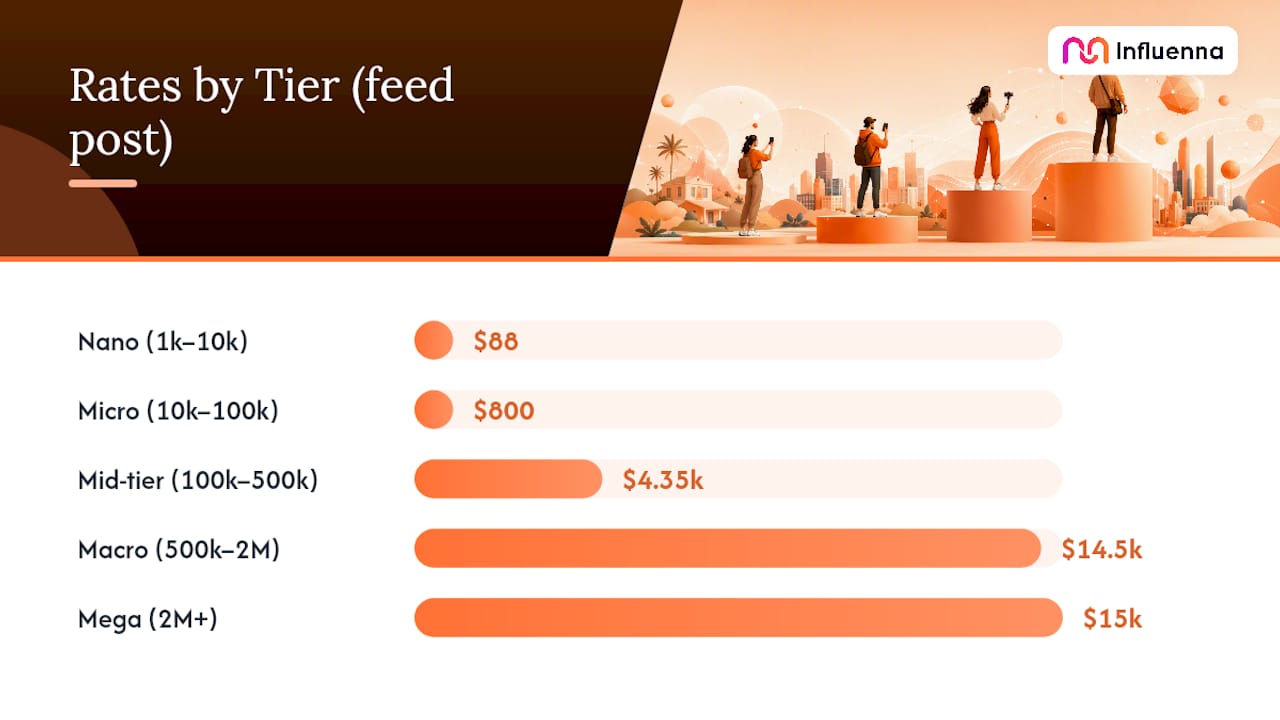
A nano creator (1,000 to 10,000 followers) typically charges $25 to $150 per feed post, a micro creator runs $100 to $1,500, mid-tier creators land between $700 and $8,000, macro influencers command $4,000 to $25,000, and mega creators start north of $15,000 and climb from there. Reels usually cost more than static posts. Stories usually cost less than both.
Before you sign off on any of those numbers, run one check: calculate the CPM using the creator's actual impressions, not their follower count. Take the quoted rate, divide by impressions, multiply by 1,000. If a creator wants $2,000 for a post that historically pulls 40,000 impressions, that's a $50 CPM, which is high for most lifestyle campaigns but defensible for finance or B2B content where buyer intent runs higher.
The second check takes ten seconds: look at the engagement rate on their last five to ten posts. A creator with 200,000 followers and a 0.4% engagement rate is a worse buy than one with 40,000 followers and 4% engagement, no matter what the rate card says.
Here's the fast version for your next brief or RFP:
- Feed post (nano to mid-tier): $25 to $8,000 depending on tier and niche
- Reel: 20 to 40% above the equivalent feed post price, per Shopify's influencer pricing data
- Story (single frame): typically 30 to 50% below a feed post
- Sanity-check formula: Rate ÷ Impressions × 1,000 = CPM. Compare against $8 to $22 for lifestyle content or $25 to $50 for finance/B2B, according to InfluencerFee's benchmark data
Paste those ranges straight into your budget deck. Everything below explains why they move, and how to defend your number when a creator or their agency pushes back.
Key Takeaways
Instagram influencer rates depend far more on impressions and engagement rate than on follower count, and a CPM sanity check catches inflated quotes before they hit your invoice.
| Point | Details |
|---|---|
| Use tier ranges as a starting point | Nano creators run $25 to $150 per post, mega creators start above $15,000; treat these as anchors, not final offers. |
| Always calculate CPM | Divide the rate by real impressions, multiply by 1,000, and compare against $8 to $22 for lifestyle or $25 to $50 for finance/B2B content. |
| Engagement rate is your red flag detector | A creator with low engagement relative to their tier is a worse investment than the follower count suggests. |
| Budget 1.5 to 2.0 times the base creator fee | Usage rights, paid amplification, and campaign management routinely double the headline creator cost. |
| Negotiate usage rights explicitly | Vague or open-ended usage language is the most common source of post-campaign billing disputes. |
Table of Contents
- What Are the Instagram Influencer Rates by Tier and Format?
- What Factors Actually Move Influencer Pricing?
- How Do You Check If a Quoted Rate Is Fair?
- Which Pricing Model Should You Negotiate?
- What Do Usage Rights and Add-On Fees Actually Cost?
- How Do You Build a Realistic Campaign Budget?
- What Should You Ask a Creator Before You Pay Them?
- Ready to Skip the Guesswork on Creator Rates?
- A 2026 Reality Check on Influencer Budgeting
- Sources
- FAQ
What Are the Instagram Influencer Rates by Tier and Format?
Rates scale with audience size, but not in a straight line, and the tier boundaries matter more than most brands realize. Here's how the industry typically breaks down creator tiers:
- Nano ($1,000 to $10,000 followers): $25 to $150 per feed post
- Micro (10,000 to 100,000 followers): $100 to $1,500 per feed post
- Mid-tier (100,000 to 500,000 followers): $700 to $8,000 per feed post
- Macro (500,000 to 2,000,000 followers): $4,000 to $25,000 per feed post
- Mega (2,000,000+ followers): $15,000 and up, with celebrity-tier creators charging far beyond that
Those ranges come from InfluencerFee's 2026 rate guide, and the spread within each tier is the part brands underestimate. A micro creator with 15,000 highly engaged followers in a niche with strong buyer intent, think skincare, personal finance, or home renovation, can reasonably charge toward the top of that $1,500 ceiling. A micro creator with 90,000 followers and a passive, scroll-past audience might land at $300.
Format changes the math substantially. Reels get a premium over static feed posts because they take more time to shoot and edit, and because Instagram's algorithm still favors video for organic reach. A carousel (multiple images swiped through) usually prices close to a single feed post, sometimes slightly higher if it requires more creative development, like a multi-step tutorial or before/after sequence.
Stories sit at the bottom of the format hierarchy. A single Story frame typically runs 30 to 50% cheaper than a feed post, and a multi-frame Story sequence (three to five frames telling a fuller story) prices somewhere between a single Story and a full feed post. Stories also have a shelf life of 24 hours unless the creator saves them to a Highlight, which is worth negotiating for at no extra cost.
Where these ranges shift
A few variables push rates outside the "typical" band in either direction:
- Niche premium. Finance, B2B software, and health/wellness creators often charge 20 to 50% more than lifestyle or entertainment creators with comparable follower counts, because their audiences convert at higher rates and their content requires more research or compliance review.
- Verified, high-quality audiences. A creator whose audience skews toward a brand's actual customer profile (age, geography, income) can justify a premium even without huge reach. This is where impressions and demographic data matter more than the follower count on the profile.
- Country and market differences. Rates in the United States and United Kingdom tend to run higher than equivalent-tier creators in much of Latin America, Southeast Asia, or Eastern Europe, driven by differences in local ad spend and cost of living.
- Parenting, beauty, and fitness niches often see more competition among brands for the same creators, which can push rates up during peak seasons like back to school or January fitness campaigns.
If a quote falls well outside these bands, that's not automatically a red flag. It's a prompt to ask why, and the answer should be a specific one: unusually high impressions, a licensing add on, or a seasonal rush fee. If the creator can't explain the gap, that's the actual warning sign.
What Factors Actually Move Influencer Pricing?
Two creators with identical follower counts can quote wildly different numbers, and almost every gap traces back to one of these nine variables.
- Platform and format. A Reel costs more to produce than a Story because it demands scripting, filming, and editing time. Static feed posts sit in the middle.
- Audience quality over audience size. Impressions, engagement rate, and how closely the follower base matches your customer profile predict campaign performance far better than raw follower count, a point Admetrics' pricing research makes clear.
- Niche and buyer intent. Finance, legal, health, and B2B creators charge more because their audiences are closer to a purchase decision when they see a post.
- Usage rights. Whether the brand can only post organically to its own account, or wants to run the content as a paid ad, changes the price significantly.
- Exclusivity. Asking a creator to avoid competing brands for a set window costs extra, often a flat percentage on top of the base fee.
- Geographic scope. A license limited to one country costs less than a global usage license.
- Cross-posting requirements. Asking for the same content pushed to TikTok or a creator's Facebook page adds cost, since it's technically a separate deliverable even if the file is identical.
- Frequency and seasonality. Rates climb around Black Friday, back to school, and January, when brand demand for the same creator pool spikes.
- Creator reputation and reliability. A creator known for hitting deadlines, following brand guidelines, and avoiding controversy commands a premium over one with a spottier track record, even at the same follower count.
Pro Tip: Ask every creator for their impressions and reach data on their last three sponsored posts, not just their organic ones. Sponsored content typically underperforms organic content on reach, and a creator quoting you based on organic numbers is quietly inflating your expected value.
Most negotiations fail because brands anchor on follower count instead of asking about these nine levers directly. A creator who can't answer a question about their engagement rate or audience geography in under a minute either doesn't track their own performance or is hoping you won't ask.
How Do You Check If a Quoted Rate Is Fair?
Run the CPM formula before you approve any invoice: Rate ÷ Impressions × 1,000 = CPM. Impressions should come from the creator's own post analytics (a screenshot from their Instagram Insights), not a guess based on follower count, since actual reach on a given post often runs at 10 to 30% of total followers.
Once you have the CPM, compare it against a benchmark tied to your campaign goal:
- Pure awareness campaigns: target $8 to $22 CPM for general lifestyle content, per InfluencerFee's benchmark data.
- Finance, B2B, or high-consideration purchases: $25 to $50 CPM is often justified because the audience converts at a higher rate.
- Compare against paid alternatives. Instagram ads themselves run about $2 to $6 CPM, with well-optimized campaigns hitting $2.50 to $3.50. Influencer content costs more per thousand impressions because you're also paying for trust and creative authenticity that a cold ad doesn't carry.
Engagement rate is your second filter. A healthy rate for micro creators typically falls between 3% and 6%; for macro and mega creators, 1% to 3% is normal since larger audiences naturally engage less as a percentage. If a creator's engagement rate sits well below their tier's typical floor, treat that as a warning sign worth investigating before you sign.
Here's how two real quotes stack up against each other:
Quote B, from a smaller creator, delivers a CPM close to the finance/B2B ceiling with engagement nearly five times higher. Follower count told you nothing useful here. Impressions and engagement told you everything.
Which Pricing Model Should You Negotiate?
Five pricing structures dominate Instagram creator deals, and picking the wrong one for your campaign goal is a common budgeting mistake.
- Flat fee. The creator charges a fixed price per deliverable regardless of performance. Simplest to budget, most common for awareness campaigns.
- CPM based. Rate scales with guaranteed impressions, common with mid-tier and macro creators who have consistent, trackable reach.
- Performance or affiliate. The creator earns a commission per sale or a bonus tied to a code's performance, often paired with a smaller flat fee to guarantee some baseline compensation.
- Product-only (gifting). No cash changes hands. Works only with nano creators genuinely enthusiastic about the product, and shouldn't be your default expectation above 20,000 followers.
- Retainer. A monthly fee for ongoing content, typically discounted per-post compared to one-off bookings, useful for always-on brand ambassador relationships.
A typical base fee should include the creative concept, one round of content creation, standard organic posting, and one round of revisions. Anything beyond that, usage rights, exclusivity, extra revisions, cross-posting, should show up as a separate line item, not buried in the base number.
On negotiation, a few tactics consistently work without squeezing creators unfairly:
- Multi-post discounts. Booking three posts at once instead of three separate one-offs typically earns a 10 to 20% discount per post.
- Faster payment terms. Offering net-15 instead of net-60 payment can shave a few percentage points off the quoted rate, since creators value cash flow.
- Bundling formats. Combining a feed post with a Story sequence in one deal usually costs less than booking them separately.
Pro Tip: Before signing, clarify exactly what "usage rights" means in the contract, whether it covers organic reposting only, paid amplification, or both, and for how long. Vague usage language is the single most common source of post-campaign disputes.
Red flags worth pausing on: contracts with no defined posting window, no revision limit (opens the door to endless back and forth), or usage rights language so broad it effectively grants perpetual, unlimited use for a one-time fee.
What Do Usage Rights and Add-On Fees Actually Cost?
The base creator fee rarely covers everything a brand actually wants to do with the content, and add-ons are where campaign budgets quietly balloon.
- Paid social amplification (whitelisting). Running a creator's post as a paid ad through their handle, rather than reposting it from your own account, typically adds 30 to 150% above the base creator fee, depending on scope and duration.
- Commercial or advertising usage rights. Full rights to use the content in paid ads, on your website, or in other marketing materials generally costs more than organic-only repost rights, sometimes double the base fee for extended, multi-channel use.
- Exclusivity windows. Asking a creator to avoid working with competing brands for 30, 60, or 90 days typically adds a flat percentage, often 15 to 30%, on top of the base rate.
- Rush fees. Needing content turned around in under a week instead of the standard two to three weeks often adds 10 to 25%.
- Revision surcharges. Most contracts include one round of revisions free; each additional round typically costs extra, either a flat fee or a percentage of the base rate.
How Do You Build a Realistic Campaign Budget?
Say a brand wants to launch a skincare product with five creators: two micro (30,000 followers), two mid-tier (200,000 followers), and one macro (800,000 followers), each delivering one feed post and one Story sequence, with paid amplification rights for 60 days.
Start with base creator fees:
- Micro creators (2 x $600 average): $1,200
- Mid-tier creators (2 x $3,500 average): $7,000
- Macro creator (1 x $12,000): $12,000
- Story add-ons (5 x $250 average): $1,250
That's $21,450 in base creator fees before a single usage right or ad dollar gets added.
That total lands right around 1.75 times the base creator fee number, consistent with the 1.5 to 2.0 times multiplier that InfluencerFee's cost analysis recommends brands apply when scoping a full campaign, not just creator payouts.
When you present this to stakeholders, show two scenarios rather than one fixed number. Giving stakeholders a range instead of a single number, backed by the line items above, makes the eventual actual spend look like planning rather than overrun.
What Should You Ask a Creator Before You Pay Them?
Request three things before any quote gets approved: a screenshot of post analytics showing reach and impressions, audience demographic data (age, gender, top locations), and engagement rate on their last five sponsored posts specifically, not organic ones.
For verification, rate estimator tools give you a ballpark before you even reach out. Engagement auditors and fraud detection tools flag suspicious follower growth spikes or bot-heavy audiences, useful when a creator's numbers look too good relative to their pricing history. Treat any of the following as a signal to dig deeper: engagement rate under half the tier average, refusal to share sponsored-post analytics, or a sudden follower spike with no viral moment behind it.
The most common calculator mistake brands make is plugging in follower count instead of average impressions. Followers are a ceiling, not a forecast. A creator platform like Influenna, which structures rate expectations and preferences directly into a creator's profile rather than leaving them to a cold DM negotiation, gives brands a clearer starting signal before the back and forth even begins.
Why this guide is reliable: Igor and Influenna's practical perspective
This guide was put together by Igor, a contributor covering influencer marketing for Influenna. The benchmarks reflect published industry pricing data cross-checked against how creator negotiations actually unfold in practice.
Influenna runs a human-reviewed, four-sided marketplace connecting creators, brands, talent agencies, and influencer marketing agencies. Every account is vetted before joining, and structured collaboration requests replace cold outreach. That model surfaces clearer rate signals because creators set expectations upfront rather than negotiating from scratch with every new brand that slides into their inbox.
Ready to Skip the Guesswork on Creator Rates?
Every benchmark in this guide gets you close, but the fastest way to a fair number is talking directly to a creator whose rates already reflect their actual impressions and engagement. Influenna connects brands, talent agencies, and influencer marketing agencies with creators who set their own rate expectations and preferences upfront, so conversations start with real numbers instead of a cold DM and a guess. Every account is reviewed by a person before joining, and contact details only unlock once both sides approve the match. Join the Influenna waitlist to get access when the marketplace opens.

A 2026 Reality Check on Influencer Budgeting
The conventional advice tells brands to set a budget based on follower tiers, then negotiate down. That gets the sequence backward. Impressions and engagement rate should set the price ceiling first, and follower count should only tell you which tier of creator you're even talking to.
What's overrated in most pricing guides is the idea that a single "fair rate" exists per tier. It doesn't.
If you take one thing from this guide, make it the CPM habit. Run it on every quote, every time, before you approve a budget line. It takes thirty seconds and it will save you from the single most common overspend in influencer marketing: paying premium prices for an audience that scrolled past without looking.
— Igor
Sources
- Instagram Influencer Pricing: Rate Guide 2026 | InfluencerFee
- Influencer Pricing: The Cost of Influencers in 2026 - Shopify
- How Much Do Instagram Ads Cost in 2026? | WordStream
FAQ
What Is the 5-3-1 Rule on Instagram?
The 5-3-1 rule is a content planning guideline suggesting creators post 5 pieces of curated or repurposed content, 3 original posts, and 1 promotional or sales-focused post per week to balance engagement with monetization. It's a content mix strategy, not a pricing formula.
How Much Do 1,000 Followers Cost on Instagram?
Instagram influencer rates don't scale as a fixed price per 1,000 followers; a nano creator with roughly 1,000 to 10,000 followers typically charges $25 to $150 per feed post, regardless of exact follower count within that range.
How Much Does an Instagram Influencer Charge?
Rates range from $25 to $150 for nano creators up to $15,000 or more for mega creators per feed post, with Reels typically costing 20 to 40% more than static posts and Stories usually running 30 to 50% cheaper, according to InfluencerFee's rate benchmarks.
How Much Does It Cost per 1,000 Views on Instagram?
For influencer content, a fair CPM (cost per 1,000 impressions) typically falls between $8 and $22 for general lifestyle campaigns and $25 to $50 for finance or B2B content, based on InfluencerFee's benchmark data, compared to $2 to $6 CPM for standard Instagram ads.
Do Usage Rights Always Cost Extra on Top of the Base Fee?
Yes.