YouTube Sponsored Video Rates: What to Charge in 2026
21 min read

Price sponsored YouTube integrations by (niche CPM × average views) ÷ 1,000, then quote a range and open near the high end. That's the entire formula. Everything else in this guide is detail on how to plug in the right numbers.
Here's the math in action: if your niche runs a $20 CPM and your last ten videos average 20,000 views, your base rate lands at $400. A finance or SaaS channel with the same view count could reasonably charge $1,600 to $2,000, because those niches command CPMs closer to $80 to $100 per the ytcalculators niche CPM benchmarks. Lifestyle and gaming channels sit lower, often in the $15 to $30 range as a cross-niche baseline.
Three things to lock in before you send a quote:
- Pull average views from your last 10 uploads, not your subscriber count or a lucky viral spike.
- Match your niche to the closest CPM benchmark rather than guessing.
- Always quote a range, not a single number, and let the brand's first counter tell you where the real budget sits.
Statistic to remember: A cross-niche CPM baseline of roughly $15 to $30 per 1,000 views applies to integrated segments across most non-finance categories, according to BEGL's 2026 rate data. If a brand offers less than that on a straightforward 60 to 90 second integration, you're being lowballed.
Table of Contents
- How Much Are YouTube Sponsored Video Rates by Channel Size?
- How Do You Calculate Your Sponsored Video Rate?
- What Deal Types and Add-Ons Change Your Price?
- What Should You Say When a Brand Reaches Out?
- Common Pricing Mistakes That Cost Creators Money
- Why Verified Metrics Matter More Than Self-Reported Numbers
- Does Audience Age and Gender Affect Your Rate?
- Do Rates Differ Across Sponsorship Platforms and Agencies?
- What Payment Terms Should You Expect on Sponsorship Deals?
- What Legal Rules Affect Sponsored Video Pricing?
- Editorial Take: Stop Treating Rate Cards Like Guesswork
- Get Matched With Brands That Already Know Your Rates
- Sources
- FAQ
How Much Are YouTube Sponsored Video Rates by Channel Size?
Channel size sets the ceiling, but niche and audience location decide where in that range you actually land. A nano creator with 8,000 average views in finance can out earn a mid-tier lifestyle channel pulling 40,000 views, because the CPM gap between those categories is that wide.
Brands generally bucket creators into five tiers based on average views per upload, not subscriber totals. Subscriber count is a vanity metric here. A channel with 200,000 subscribers but stagnant 5,000 view averages prices like a nano creator, not a mid-tier one.
| Tier | Avg. views | Sample integration rate | Sample dedicated video rate |
|---|---|---|---|
| Nano | 1,000–10,000 | $20–$300 | $30–$600 |
| Micro | 10,000–50,000 | $200–$1,500 | $300–$3,000 |
| Mid-tier | 50,000–250,000 | $1,000–$7,500 | $1,500–$15,000 |
| Macro | 250,000–1,000,000 | $5,000–$30,000 | $7,500–$60,000 |
| Mega | 1,000,000+ | $20,000+ | $30,000+ |
These bands assume a mid-range CPM around $20 to $30. Push into finance or B2B territory and every figure in that table effectively doubles or triples.
Niche CPM benchmarks vary sharply, and the gap keeps widening in 2026:
- Finance: around $100 CPM, the highest of any mainstream category.
- B2B/SaaS: around $80 CPM, driven by high customer lifetime value.
- AI/ML: around $70 CPM, a category that rose materially through 2026 as ad budgets chased the space.
- Education: around $50 CPM.
- Tech: around $45 CPM.
- Beauty: around $35 CPM.
- Gaming: around $30 CPM, a niche that has softened somewhat this year.
- Entertainment/general lifestyle: around $20 CPM, the most common baseline for vlog-style channels.
Geography moves the needle almost as much as niche. Audiences concentrated in the United States, UK, Canada, and Australia support roughly an 80% rate premium compared to a globally mixed audience, because ad buyers pay more to reach consumers in those markets. A channel with a $30 baseline CPM and a US-heavy audience should really be quoting closer to $54 CPM once the premium is factored in.
Check your YouTube Analytics geography breakdown before every quote. A channel that skews 70% United States and 30% rest-of-world is a fundamentally different sponsorship product than one splitting 50/50 with Southeast Asia or Latin America, even at identical view counts. Brands know this. Price accordingly, and don't leave that 80% on the table by quoting a flat, geography-blind number.
How Do You Calculate Your Sponsored Video Rate?
Start with real numbers, not hopeful ones. Pull your last 10 uploads from YouTube Studio, note the total views, and average them. Drop any obvious outlier, a video that went viral off a trending audio or a thumbnail that happened to catch an algorithm wave, since brands are paying for your typical reach, not your best day. A tool like a YouTube transcript extension can also help you pull performance and content data quickly when you're building a media kit alongside your rate card.
Step 1: Find your average views. Add up views from your last 10 videos, divide by 10.

Step 2: Identify your niche CPM. Match your content category to the closest benchmark. Beauty and lifestyle sit around $35 and $20 respectively; tech runs about $45.
Step 3: Run the base formula. (Niche CPM × average views) ÷ 1,000 = your floor rate.
Step 4: Apply your geography multiplier. If 60%+ of your audience is US/UK/Canada/Australia, increase your CPM input by roughly 80% before recalculating.
Step 6: Adjust for deal type. A dedicated video multiplies the base rate; a shorts mention divides it. More on that in the next section.
Here's the math side by side. Base CPM of $45, adjusted upward for geography to roughly $81, gives a floor of (81 × 30,000) ÷ 1,000 = $2,430 for a standard integration. Add the negotiation buffer and the opening quote lands around $2,900 to $3,000.
Creator B runs a general entertainment channel, averages 30,000 views, and has a globally mixed audience. Base CPM of $20 with no geography adjustment gives a floor of $600, with an opening quote closer to $700 to $750. Same view count, wildly different rate, because niche and geography did all the work.
Statistic to keep handy: at a 20,000 average view count, sample integration rates run $400 to $1,000 depending on niche and audience mix. That's the range most micro creators should be anchoring around when a brand's first offer comes in low.
One more decision point: flat fee or CPM-based pricing? Flat fee protects you when you expect strong performance and don't want to share the upside. CPM-based, sometimes called a CPV or "pay per view guarantee," protects the brand and only makes sense if you're unusually confident in your view floor. Most small to mid-tier creators are better off with a flat fee quoted using the CPM math above, not an ongoing CPM-tracked payout.
What Deal Types and Add-Ons Change Your Price?
Not all "sponsored video" requests are the same product, and pricing them identically is one of the fastest ways to undercharge. A brand asking for a 60 to 90 second integration inside your regular content is buying something very different from a brand asking for an entire video built around their product.
The common formats, roughly in ascending order of what they should cost:
- Shorts mention: a brief callout inside a Shorts video, typically priced at a fraction of your standard integration rate.
- Mid-roll integration: a 60 to 90 second segment placed mid-video, the most common baseline sponsorship format.
- Pre-roll integration: the same segment placed at the top of the video, often commanding a slight premium since it can't be skipped past as easily.
- Dedicated video: the entire video built around the sponsor's product, priced at roughly 1.5× to 2× your integration rate.
- Livestream mention: pricing varies widely by average concurrent viewers rather than upload views; treat this as its own quote.
- Ambassadorship or multi-video package: negotiated as a bundle, usually with a 10% to 20% per-video discount in exchange for the guaranteed volume.
Beyond the format itself, brands routinely ask for rights that go beyond the video staying live on your channel. These are billable add-ons, and treating them as included in your base rate is where creators quietly give away the most value.
- Usage rights (letting the brand repost your content on their own channels): add 25% to 50% of the base fee, depending on duration of use.
- Whitelisting (running the video as a paid ad from your handle): add another 25% to 50%, since this extends your reach and face to the brand's ad spend.
- Exclusivity (agreeing not to work with competing brands for a set window): add 25% to 100% depending on category and length of the exclusion window.
Usage rights and whitelisting together can double a base fee when a brand wants both, so list them as separate line items in every quote rather than folding them into one number.
Pro Tip: Put a dollar figure or percentage next to every add-on in your rate sheet before you ever get on a call. Brands negotiate line items much more reasonably when they can see exactly what each one costs, instead of feeling like you invented a number on the spot.
What Should You Say When a Brand Reaches Out?
The first email from a brand rarely includes a number, and the second one often lowballs you if you don't set the frame first. A short, confident reply does more work than a long one.
When a brand asks "what's your rate" with no budget mentioned, try this: "My rate for a standard integration runs $X to $Y depending on scope. What's the budget range for this campaign?" That question does double duty. It signals you have a process, and it gets the brand to reveal their ceiling before you commit to a number.
When the first offer comes in low, don't just say no. Try: "That's below my usual range for this format. My integrations typically run $X to $Y for [format], and that's before usage rights or exclusivity. Is there flexibility in the budget?"
Having a pricing menu ready before any of this speeds up every conversation:
- Mid-roll integration: $X, includes the segment plus one round of revisions.
- Dedicated video: $Y (roughly 1.5× to 2× the integration rate), includes full creative control within brand guidelines.
- Add a usage rights or whitelisting rider: +25% to 50% per right requested.
Every quote should travel with a media kit, and brands consistently ask for the same handful of numbers:
- Average views across your last 10 to 20 uploads.
- Average watch time or retention percentage.
- Top 3 to 5 audience geographies by percentage.
- Basic audience demographics (age brackets, gender split) from YouTube Analytics.
- Engagement rate (likes plus comments divided by views).
- Results from 1 to 2 past sponsored campaigns, if you have permission to share them.
Keep the kit to one page. Brands skim these fast, and a cluttered kit reads as disorganized before they've even seen a number.
Common Pricing Mistakes That Cost Creators Money
The single biggest mistake is pricing off subscriber count instead of average views. A channel with 100,000 subscribers and 4,000 average views is not a "100K channel" to a brand doing its homework; it's a 4,000 view channel, and quoting subscriber-based rates to a brand that checks Analytics or a third-party tool damages your credibility before negotiations even start.
The second most common error is folding in every possible ask, usage rights, whitelisting, exclusivity, into one flat number instead of itemizing. It leaves value on the table and makes it harder to trim scope if a brand's budget is tight, since you can't remove a line item that was never separated out.
A few fixes worth adopting this week:
- Price off average views from your last 10 uploads, always, regardless of what the brand assumes your subscriber count implies about your rate.
- When a low offer arrives, restate your range and ask directly what the campaign budget is, rather than countering blind.
- Set a personal minimum fee below which you simply say no, even for product-only or affiliate-hybrid deals that sound appealing on paper.
- Treat product-only deals as acceptable only when the product's retail value is genuinely useful to you and the brand is small enough that cash truly isn't available, not as a default fallback.
Pro Tip: Keep a simple spreadsheet logging every offer you receive, accepted or not. After ten or fifteen entries, you'll have your own real market data instead of relying purely on published benchmarks, and that data becomes leverage in every future negotiation.
Why Verified Metrics Matter More Than Self-Reported Numbers
Every benchmark in this guide is only useful if the numbers feeding into it are accurate. Brands increasingly discount rate cards built on self-reported stats they can't confirm, which is part of why platforms built around verification exist in the first place.
Influenna reviews every creator, brand, and agency account manually before granting marketplace access, and it labels audience metrics by how they were obtained, verified, estimated, or self-reported, rather than blending them into one flattering number. Instagram, TikTok, and YouTube figures are shown separately too, since a creator's YouTube average views and Instagram reach are not interchangeable data points, no matter how many rate calculators treat them that way.
A rate card only works as leverage when the other side trusts the numbers behind it. Manual review and metric provenance exist to protect that trust, not to slow anyone down.
A few things worth noting about how this applies to pricing conversations specifically:
- Structured collaboration requests replace cold DMs, so a brand reaching out through a curated process has typically already reviewed your stated rates and preferences.
- Contact details unlock only after both sides approve, which filters out the scattershot outreach that tends to lowball everyone.
- The full Influenna marketplace covers Instagram, TikTok, and YouTube creators, brands, talent agencies, and influencer marketing agencies, all reviewed before joining.
Igor writes on creator economy pricing and partnership structure for Influenna.
Does Audience Age and Gender Affect Your Rate?
Yes, and often more than creators expect. Brands buy audiences, not just views, and a channel whose viewers match a sponsor's ideal customer profile commands a real premium over one with identical view counts but a mismatched demographic.

A finance channel whose audience skews 35 to 54 and majority male aligns tightly with what most B2B and fintech sponsors are trying to reach, which is part of why finance CPM benchmarks run so high. A beauty channel with a mostly 18 to 34 female audience is exactly what skincare and cosmetics brands are hunting for, and that alignment is often worth more to the sponsor than raw reach.
Mismatches work against you even at strong view counts. A gaming channel skewing heavily toward viewers under 18 is a weaker fit for most B2B software sponsors, regardless of how impressive the view numbers look, simply because that audience can't buy the product.
Pull your age and gender breakdown from YouTube Analytics and put it directly in your media kit, next to your geography numbers. When a brand's target customer clearly overlaps with your audience skew, say so explicitly in your pitch. It's one of the easiest ways to justify sitting at the top of a rate range instead of the middle, and it costs you nothing but a sentence in your outreach email.
Do Rates Differ Across Sponsorship Platforms and Agencies?
They do, and the gap can be substantial. Direct brand deals, sourced through your own outreach or inbound requests, generally let you keep the full negotiated fee, since no intermediary is taking a percentage.
Influencer marketing agencies working on behalf of brand clients often negotiate on a set budget handed down from the client, and their own margin comes out of that budget before it reaches you. That doesn't make agency deals worse, they frequently bring bigger campaigns and more professional briefs, but it does mean the number they offer may already have agency fees baked in, and there's less room to negotiate upward than in a direct brand relationship.
Talent agencies representing you as a creator work the opposite direction: they negotiate on your behalf and typically take a percentage of what they secure, usually in exchange for handling outreach, contracts, and follow-up you'd otherwise do yourself. Whether that trade is worth it depends entirely on how much deal flow you're already generating without one.
Curated marketplaces sit somewhere in between. Influenna, for example, facilitates the introduction between creators and brands or agencies but never brokers the deal or takes a cut, meaning whatever rate you negotiate directly with the other party is what you actually receive. Knowing which structure you're dealing with before a number gets mentioned changes how much room you should expect to have.
What Payment Terms Should You Expect on Sponsorship Deals?
Most brand sponsorships pay on a net basis after the video goes live, commonly net 30, meaning payment arrives roughly 30 days after delivery or publish date. Some agencies and larger brands run net 45 or net 60, which is worth clarifying before you sign anything, since a 60 day wait on a large invoice can genuinely strain a small creator's cash flow.
Brands with established sponsorship programs are usually comfortable with this structure; smaller or first-time sponsors sometimes need it explained as standard practice rather than an unusual ask.
Get payment terms in writing before you film anything. A simple one-page agreement covering the fee, the payment schedule, the deliverable format, and the usage rights window protects both sides and heads off the awkward follow-up email chasing a payment that was never clearly scheduled in the first place. If a brand resists putting terms in writing, treat that as a signal worth weighing before committing production time.
What Legal Rules Affect Sponsored Video Pricing?
Disclosure requirements don't just protect your audience, they protect the deal itself, since brands increasingly avoid creators with a history of undisclosed sponsorships. The FTC's endorsement guidance requires clear, conspicuous disclosure whenever you have a material connection to a brand, including paid sponsorships, free products, and affiliate commissions.
In practice, that means a one-line verbal or on-screen disclosure near the start of the sponsored segment, plus a pinned comment or description note using a term like "sponsored" or "ad," not a vague thank-you that leaves the relationship ambiguous. Brands expect this now; building it into your standard rate sheet as a non-negotiable part of every deal signals professionalism rather than friction.
On the payment side, sponsorship income is generally taxable, and the distinction between straightforward advertising payments and other sponsorship structures can affect how income gets reported. The IRS guidance on advertising and sponsorship payments is a useful starting reference, though a tax professional familiar with self-employment or creator income should handle the specifics of your situation, especially once sponsorship income becomes a meaningful part of your earnings.
Sponsored video rates carry real financial weight, and (niche CPM × average views) ÷ 1,000 remains the fastest way to defend a quote with real math instead of a guess.
| Point | Details |
|---|---|
| Use the core formula | Calculate (niche CPM × average views) ÷ 1,000, then quote a range slightly above that floor. |
| Price on views, not subscribers | Average your last 10 uploads and exclude viral outliers before setting your base rate. |
| Apply niche and geography multipliers | Finance and B2B CPMs run far higher than lifestyle, and a US-heavy audience adds roughly 80%. |
| Itemize add-ons separately | List usage rights, whitelisting, and exclusivity as their own line items rather than folding them in. |
| Verify before you pitch | Influenna's manually reviewed marketplace labels audience metrics by platform and provenance so brands can trust the numbers behind your rate card. |
Editorial Take: Stop Treating Rate Cards Like Guesswork
Most rate guides hand creators a single number and call it a day. That's backwards. The actual skill here is running the formula correctly for your specific niche, geography, and deal type, then having the nerve to quote near the top of your range instead of the bottom.
The conventional advice, "price based on your subscriber count," has been wrong for years and stays wrong in 2026. Views, niche CPM, and audience geography do far more to determine what a brand will actually pay. A finance creator with 15,000 average views and a US-heavy audience should out earn a general lifestyle channel with triple the subscribers.
What I'd prioritize first: build the media kit before you need it, not during a negotiation under time pressure. And treat metric verification as leverage, not paperwork. A rate card backed by numbers a brand can trust closes faster than one that asks them to take your word for it.
Get Matched With Brands That Already Know Your Rates
Instead of DMing brands cold and hoping someone reads it, or waiting on a marketing agency to notice you exist, Influenna puts your rate card and platform metrics in front of brands and agencies actively looking for a creator in your niche. You set your rates and preferences on your own terms, and the platform's manual account review and structured request system mean the brands reaching out have already seen the real numbers, not a guess based on your subscriber count.
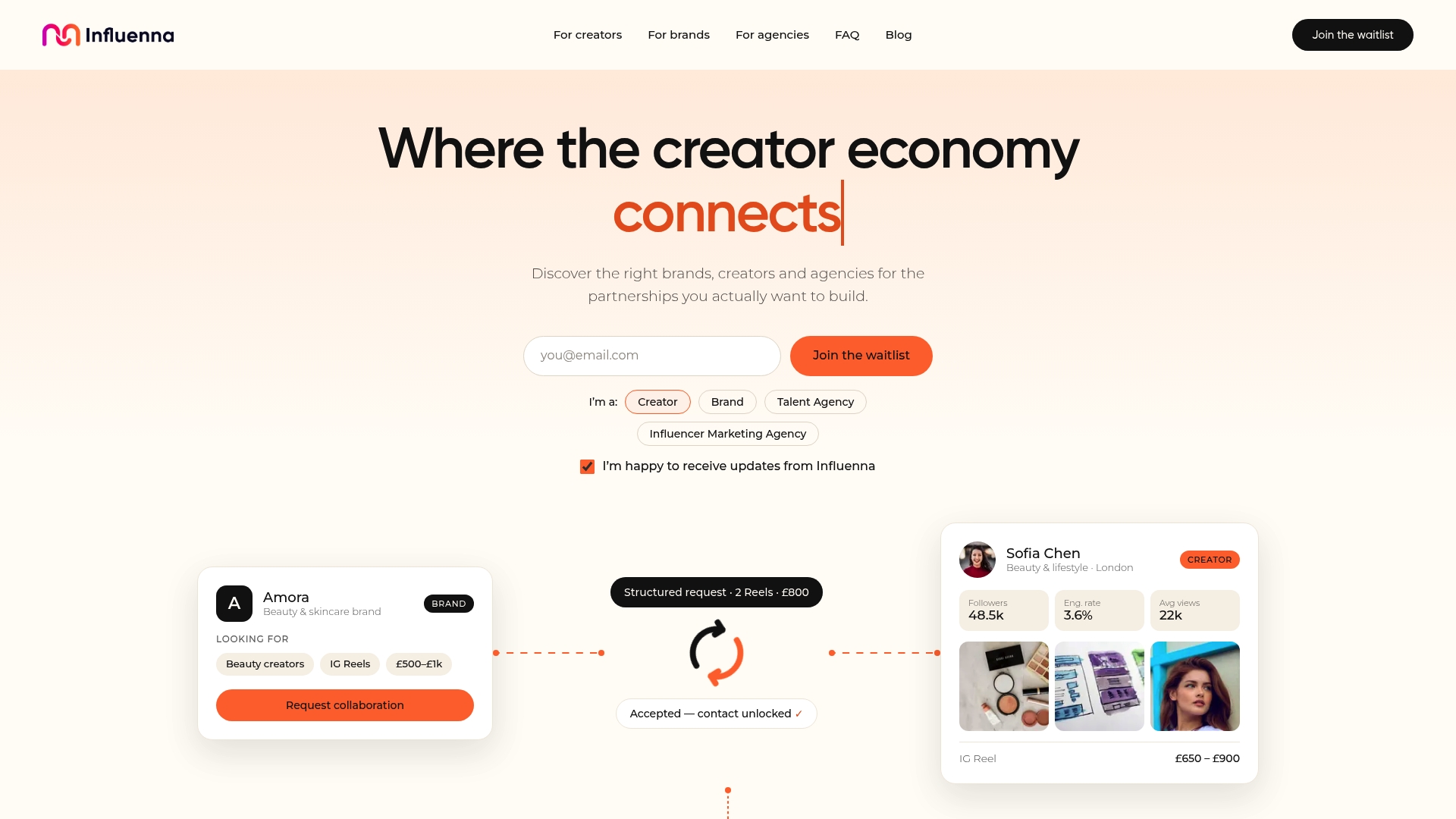
Every account gets reviewed by a person before it goes live in the marketplace, so you're not competing with spam accounts or scraped follower lists. Contact details only exchange once both sides say yes, which means the conversations that start on Influenna tend to be ones where budget and fit are already roughly aligned. If you've been relying on inbound cold outreach to set your rates, that's exactly the gap this closes.
Join the Influenna waitlist to get early access when the marketplace opens to your account type.
Sources
- How Much Do Sponsors Pay YouTubers in 2026
- How Much Should You Charge for a Sponsored YouTube Video? (2026 Rates) | BEGL
- YouTube Sponsorship Rates 2026: Updated CPM Benchmarks by Niche
- FTC's Endorsement Guides — What People Are Asking
FAQ
How much should I charge for a sponsored YouTube video?
A 20,000 average view channel in a $20 CPM niche should open around $400 to $1,000 for a standard integration.
How much do YouTube sponsors pay per 1,000 views?
Cross-niche CPM for sponsored integrations typically runs $15 to $30 per 1,000 views, while finance and B2B/SaaS channels command $80 to $100 per 1,000 views due to higher advertiser value.
How many YouTube views do I need to make $2,000 a month?
At a $20 CPM, you'd need roughly 100,000 sponsored views across your month's videos to reach $2,000 from sponsorships alone; a higher CPM niche like tech or finance reaches that figure with far fewer views.
How many YouTube views do I need to make $3,000 a month?
Using the same $20 CPM baseline, a high number of sponsored views gets you to $3,000; finance or B2B creators at $80 to $100 CPM can reach that total with roughly 30,000 views instead.
Does subscriber count matter for sponsorship pricing?
Subscriber count matters far less than average views from your last 10 uploads, since brands and rate calculators price based on actual reach, not total followers.
How do I present my rates professionally to brands?
Pair your pricing menu with a one-page media kit showing average views, engagement rate, top geographies, and demographics, and consider a verified marketplace like Influenna where metrics are labeled by platform and provenance before brands ever see them.