Influencer Brief Template: Copy-Paste One-Page Briefs
16 min read

A short influencer brief template that covers nine specific fields lets you brief a creator in one page and cut most of the back-and-forth that drags campaigns out. Those fields are the conversion event, creative direction, banned phrases, disclosure language, publish window, deliverable shape, format and length by platform, revisions, and measurement. According to InfluencerAdvisory, brands using this nine-field structure close deals faster than those working from longer, less focused documents, and Sprout Social's template checklist backs the same idea: partnership guidelines, platform-specific deliverables, and creative inspiration in one place beat a scattered email thread. When you're ready to send it, a platform like Influenna lets you attach the brief directly to a structured collaboration request instead of a cold DM.
Paste this into an email or doc to start:
"We're partnering with creators on [campaign name] to drive [conversion event]. Deliverables: [1 Reel + 3 Stories], due [date]. Must include: [#ad disclosure, discount code CREATOR20]. Avoid: [medical claims, competitor mentions]. Approval: 48 hours before publish. Payment: [$X] on publish, usage rights [30 days paid social]."
- Paste the objective and deliverables into your first outreach message.
- Paste mandatory inclusions and disclosure language into the contract.
- Paste timeline and approval steps into your project tracker.
Pro Tip: Put the conversion event first, every time. A brief that opens with "we want more Instagram followers" instead of "we want 50 uses of code LAUNCH20 by June 1" gives creators nothing concrete to aim for.
| Brief type | Best for |
|---|---|
| One-page short brief | Micro and mid-tier creators, quick-turn campaigns |
| Extended brief | Macro creators, product launches, paid usage rights |
| Field | Why it matters |
|---|---|
| Conversion event | Defines success in one measurable action |
| Disclosure language | Keeps the post compliant from the first draft |
Key Takeaways
A one-page influencer brief built around nine specific fields, conversion event, creative direction, banned phrases, disclosure, publish window, deliverable shape, format and length, revisions, and measurement, is usually enough to brief a creator without extended back-and-forth.
| Point | Details |
|---|---|
| Lead with one conversion event | State a single measurable action instead of a list of vague goals. |
| Put disclosure text in the brief, not just the contract | Use the exact required wording to avoid last-minute publishing delays. |
| Separate mandatory items from creative direction | Bullet non-negotiables; leave tone and messaging directional. |
| Match brief format to creator tier | Use the one-page version for micro-creators, the extended version with appendices for macro talent. |
| Send briefs through structured requests | Influenna lets you attach a one-page brief to a structured collaboration request and unlock contact only after mutual approval. |
Table of Contents
- What Is an Influencer Brief Template?
- What Goes Into an Effective Influencer Brief?
- Copy-Paste Templates You Can Use Today
- Brief Mistakes That Slow Down Campaigns
- Pre-Send Checklist for Your Brief
- Why Structured Requests Beat Cold Outreach
- Customizing the Brief by Creator Type and Goal
- Talking to Creators Without Losing the Plot
- A Practitioner's Note on What Actually Speeds Things Up
- Where Influenna Fits Into Your Brief Workflow
- Sources
- FAQ
What Is an Influencer Brief Template?
An influencer brief is a single document that tells a creator what you need, why it matters, and what "done" looks like. It's not the contract (that covers payment terms and legal obligations) and it's not the rate card (that's just pricing). Think of it as the creative and operational half of the relationship, sitting alongside those other two documents rather than replacing either.
Marketers reach for a brief in four moments: initial outreach to gauge interest, onboarding once a creator has agreed to the partnership, creative approval rounds during production, and post-campaign reporting to confirm deliverables matched expectations.
Send the brief early. Attach a short version to your first outreach message so creators can self-select based on fit, then follow with the extended version once they've said yes. The brief itself should flex by creator tier: micro-creators typically need less structure and more creative freedom, while macro creators and agency-repped talent expect detailed usage terms and formal review steps built in from the start.
Pro Tip: If a creator asks "what exactly do you need from me?" after reading your first message, your brief was too vague. Send the one-page version before you ever pick up the phone.
What Goes Into an Effective Influencer Brief?
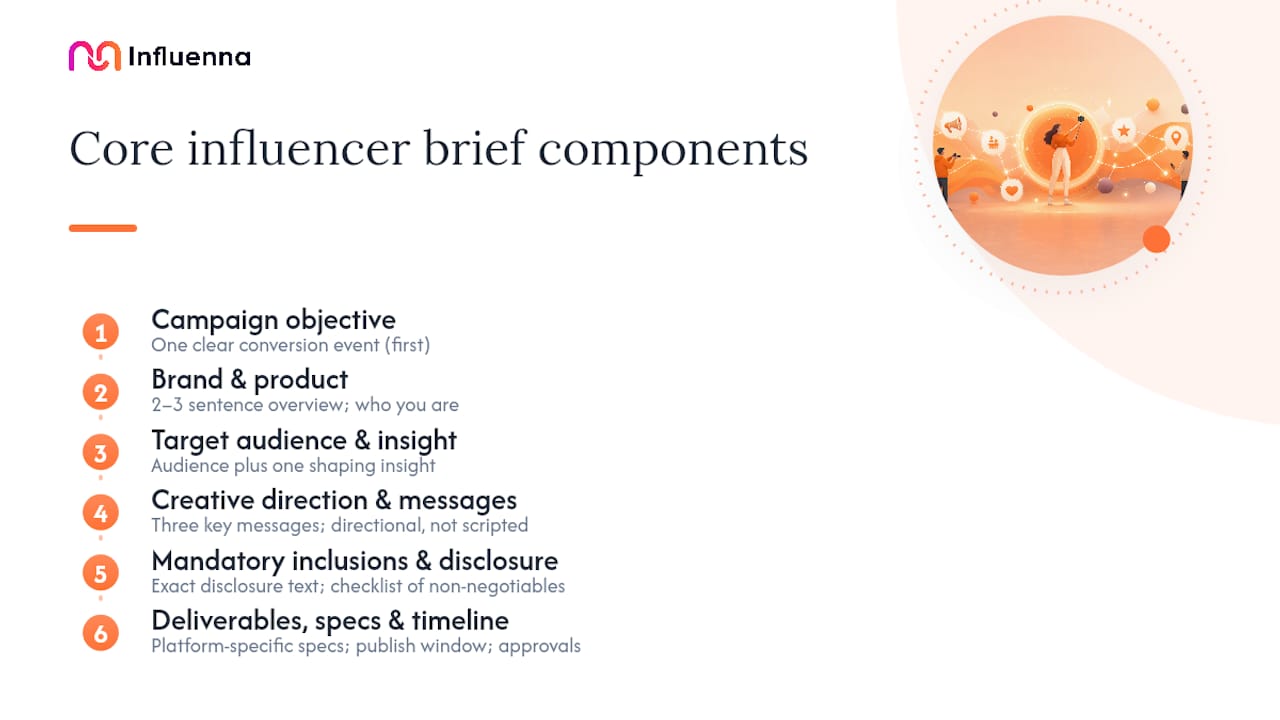
Every solid influencer campaign brief breaks down into eleven components. Skip one and you'll likely field a clarifying email or, worse, get content you have to reject.
Campaign objective. State one conversion event, not a wish list. Bad: "raise brand awareness and drive sales and grow our following." Good: "drive 200 uses of code SPRING25 by April 15." InfluencerAdvisory notes the conversion event should be field number one on the page, and for good reason: a creator producing content against one clear goal makes sharper editorial decisions than one juggling three vague ones.
Brand and product overview. Two or three sentences on who you are and what the product does. Example lines: "We make a zero-sugar electrolyte mix." "Our audience is endurance athletes aged 25 to 45." "This is our first collaboration with creators outside the running space."
Target audience and key insight. Describe who the creator is talking to and the one insight that should shape the content. Example: "Our buyer already works out, but feels guilty about wanting an easy option." That single insight often does more for content quality than a full paragraph of demographic data.
Creative direction and key messages. This is directional, not scripted. Give three key messages the content should hit, then let the creator's voice carry it. Example: "Mention the 30-day guarantee." "Show the product in a real workout, not a studio shot." "Reference how it tastes compared to sports drinks you dislike."
Mandatory inclusions and disclosure language. This is the one section that should read like a checklist, not prose, because these items are non-negotiable. Include the exact disclosure text, not a paraphrase. The FTC's guidance on influencer disclosures is explicit that disclosures like #ad must be clear and prominent, never buried in a hashtag pile at the end of a caption. Put that exact wording in the brief itself rather than leaving it to the contract; FTC-aligned practitioner guidance treats this as one of the most common causes of last-minute publishing delays.
Deliverables and platform specs. List format, quantity, and technical requirements by platform. Meltwater recommends spelling out aspect ratio, duration, and caption length for each platform separately, since a spec that works for TikTok often doesn't translate cleanly to Instagram or YouTube.
"Provide platform-specific specs, aspect ratio, duration, caption length, link placement, in the deliverables section to reduce rework across TikTok, Instagram, and YouTube." This single habit, according to Meltwater's brief guidance, prevents the single most common source of revision requests.
Timeline and publish window. State the exact date range for posting, plus draft submission deadlines working backward from it.
Approval and revision process. Set a hard number, typically one or two rounds, and a response window like 48 hours.
Measurement and reporting. Name the metrics you'll track (link clicks, code redemptions, saves) and whether the creator needs to share screenshots afterward.
Budget, payment, and usage rights. State the fee, payment timing, and exactly how long you can reuse the content and where (organic only, or paid social too).
Contact and logistics. Who approves content, who ships product, and who to email with questions.
The mistake most brands make here is treating all eleven sections as equally weighted prose. Sprout Social's approach draws a sharper line: separate what's mandatory (disclosure, banned phrases, legal requirements) from what's directional (tone, creative references, mood boards). Mandatory items belong in short bullet form. Creative direction can breathe a little more.
Copy-Paste Templates You Can Use Today
Here's a one-page short brief built around the nine fields that matter most:
- Conversion event: [specific, measurable action]
- Creative direction: [2-3 key messages, tone reference]
- Banned phrases: [medical claims, competitor names, etc.]
- Disclosure: [exact required text, e.g. "#ad" at start of caption]
- Publish window: [start date to end date]
- Deliverable shape: [1 Reel, 3 Stories, etc.]
- Format and length: [aspect ratio, duration, caption length]
- Revisions: [number of rounds, response time]
- Measurement: [metrics tracked, reporting deadline]
For bigger launches or macro-creator partnerships, expand it with a brand overview paragraph, an audience insight section, a full usage-rights clause, and appendices for a mood board or asset list. A downloadable Notion template works well here if you want pre-built fields rather than starting from a blank doc.
Here's a filled example for a fictional launch, styled after the format InfluencerFee documents in its own filled brief:
Conversion event: 100 redemptions of code GLOW20 by June 30. Deliverable shape: 1 Reel + 2 Stories. Disclosure: "#ad" as first word of caption. Banned phrases: "cure," "guaranteed results." Publish window: June 10 to June 20. Revisions: 1 round, 48-hour turnaround. Measurement: link clicks and code redemptions, reported via screenshot by July 2.
Pro Tip: Keep the filled example nearby as a reference. When a creative director asks "how detailed should this be?", showing them a real filled brief settles the debate faster than describing the format in the abstract.
Brief Mistakes That Slow Down Campaigns
Most delays trace back to five recurring errors, and all of them are easy to fix once you see them named.
- Vague conversion goals. "Increase awareness" gives a creator nothing to build content around. Fix: name one measurable action.
- Over-prescriptive creative direction. Scripting every line kills the authenticity that made the creator worth hiring. Fix: give three key messages, not a shot list.
- Missing disclosure language. Leaving it to the contract risks a creator publishing before it's finalized. Fix: paste the exact disclosure text into the brief itself.
- Burying mandatory items in paragraphs. A banned phrase buried in sentence four of a long paragraph gets missed. Fix: bullet it.
- No measurement or payment details upfront. This creates disputes after the content is live. Fix: state metrics and payment timing on page one.
Dos and don'ts:
- Do give one conversion event. Don't list five equal objectives.
- Do bullet mandatory inclusions. Don't bury them in prose.
- Do paste exact disclosure wording. Don't say "disclose appropriately."
- Do specify platform-by-platform formats. Don't write one generic spec for all channels.
- Do set a fixed revision count. Don't leave "a few rounds" undefined.
- Do state payment timing. Don't leave it for a follow-up email.
Pre-Send Checklist for Your Brief
Run through this before you hit send on any influencer campaign brief:
- Conversion event stated in one sentence
- Exact disclosure language included
- Deliverables listed by platform with format specs
- Publish window and draft deadline dated
- Payment amount and timing confirmed
- Measurement metrics named
- Approval process and revision count set
For micro-creators, you can often drop the licensing appendix. For macro or agency-repped talent, add a usage-rights clause and a formal sign-off step.
Pro Tip: Print this checklist and tape it above your desk during launch season. It takes 90 seconds to run through and catches most of the errors that cause a brief to bounce back with questions.
Why Structured Requests Beat Cold Outreach
A one-page brief attached to the first message does more than save time. Sprout Social's guidance frames a clear brief as the foundation of campaign performance, and creators consistently respond faster to messages that already answer their first three questions: what do you want, what do I get, and what are the rules.
Pro Tip: Include your disclosure language in the very first outreach message, not after the creator has already agreed. It signals you've done this before and prevents a contract renegotiation over wording that should have been settled on page one, per FTC disclosure guidance.
Structured requests, the kind you'd send through a platform like Influenna rather than a DM, work the same way: both sides see the brief upfront, approve or decline based on real terms, and only exchange contact details once both agree. That cuts out the guessing that fills up a typical inbox full of cold pitches.
Customizing the Brief by Creator Type and Goal
A brief for a nano-creator with 8,000 followers shouldn't look like one built for a macro-creator repped by an agency. Micro and nano creators generally want lighter creative direction and faster turnaround; heavy legal language up front can feel like overkill for a single Reel. Keep their brief to the one-page format, skip the licensing appendix unless you genuinely need paid usage rights, and lean on the "key insight" field to give them something to riff on.

Macro creators and agency-managed talent expect more formality. They're used to usage-rights clauses, multi-round approval processes, and clear payment schedules, so the extended brief with appendices fits better here. Tools like Modash for creator discovery or Aspire for campaign workflow management often surface these tier distinctions automatically, tagging creators by follower count and engagement so you know which brief format to reach for before you even write it.
Campaign goal matters just as much as creator tier. A brand-awareness campaign can run on lighter creative direction since you're optimizing for reach and impressions, not a specific action. A conversion-focused campaign, on the other hand, needs the mandatory inclusions section tightened: exact code placement, exact link-in-bio instructions, exact CTA wording. If you're running a product launch versus an evergreen ambassador program, the timeline and publish window sections need the most adjustment. Launches need a tight window and same-day coordination across creators; ambassador programs can spread deliverables over months with looser deadlines.
Match the brief's formality to the relationship, not to a one-size template.
Talking to Creators Without Losing the Plot
The brief is a starting point, not a script to enforce word for word. Once you've sent it, the real work is making sure the creator feels like a collaborator rather than a vendor filling an order form.
Set expectations for how you'll communicate before content starts. Will you review drafts over email, in a shared doc, or through the platform where you found them? Agree on this upfront so nobody's waiting on a reply that never comes. When you give feedback on a draft, tie it back to the brief's specific fields rather than general notes. "This doesn't hit the conversion event we listed" lands better than "this doesn't feel right."
Respect the revision count you set. If your brief says one round and you come back with a second round of notes, you're eroding trust and setting a bad precedent for the next campaign. If a creator pushes back on creative direction, listen. They know their audience better than your internal team does, and forcing a script onto content that doesn't fit their voice usually shows in the engagement numbers.
Keep the tone collaborative even in the mandatory-inclusions section. A brief that reads like a legal notice start to finish makes creators feel like a vendor rather than a partner, and that shows up in how much effort they put into the content. The best briefs read like a clear ask from someone who respects the creator's time and craft.
A Practitioner's Note on What Actually Speeds Things Up
The single biggest predictor of a fast approval cycle isn't length or polish. It's whether the brief states one conversion event and includes the exact disclosure wording on page one. Briefs that bury either of those in paragraph three almost always generate a clarifying email before anything gets produced.
Pro Tip: Tier your briefs by creator size: keep it to one page for micro-creators, and reserve the extended version with appendices for macro talent and agency-managed rosters where usage rights actually matter.
Where Influenna Fits Into Your Brief Workflow
Influenna gives you a faster way to get a brief in front of the right creator than sending it cold and hoping for a reply. Instead of DMing a creator and attaching your one-page brief to a message they might never open, you send a structured collaboration request through Influenna's marketplace, where creators, talent agencies, and brands are all manually reviewed before they can join.
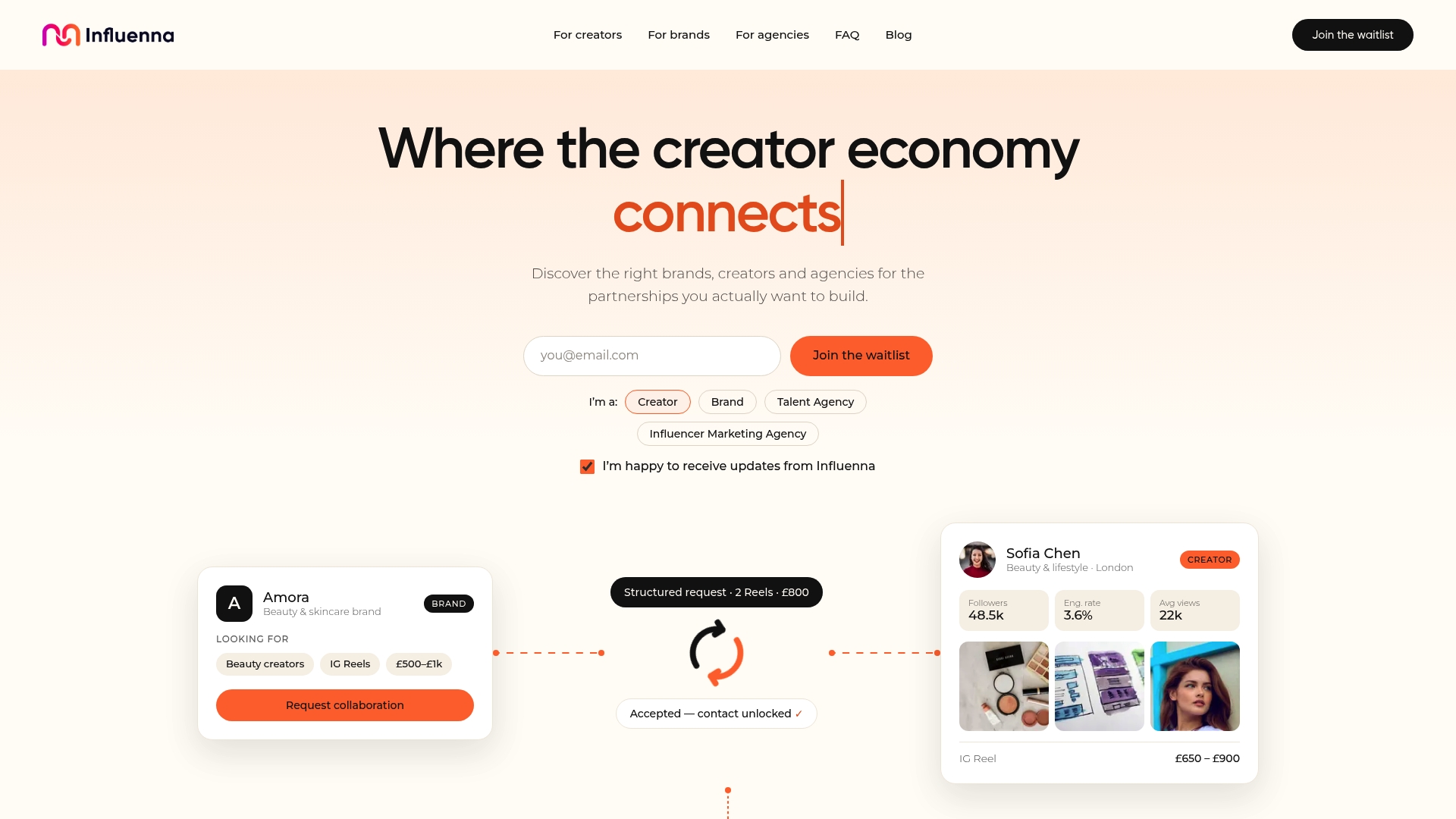
The workflow maps directly onto what this article recommends: you search and filter for creators by platform and fit, attach your brief details to a structured request instead of a cold pitch, and only exchange contact information once both sides approve. Rates and preferences can be set upfront so a micro-creator brief and a macro-creator brief don't get sent into the same funnel. Worth being clear on what this isn't: Influenna doesn't act as an agency, doesn't broker the deal, and doesn't take a cut. It makes the introduction; the collaboration and the brief itself stay between you and the creator.
If cold outreach and guesswork are the main friction points in your current process, join the Influenna waitlist to get access once the marketplace opens, and start planning which creator tiers you'll brief first.
Sources
- Disclosures 101 for Social Media Influencers (FTC)
- Influencer Marketing Brief Template | Sprout Social
- How to Write an Influencer Brief + Free Template (Meltwater)
- How to Write an Influencer Brief, 2026 Brand Guide (InfluencerAdvisory)
FAQ
How Do I Write an Influencer Brief?
Start with a single conversion event, then add mandatory inclusions like disclosure language, deliverables by platform, a publish window, and measurement criteria, ideally all on one page.
What Are the Five Parts of a Design Brief?
Design briefs commonly cover the objective, target audience, brand overview, deliverables, and timeline, though exact structures vary by team and project type.
What Is an Example of a Creative Brief?
A filled creative brief typically states one goal (like "100 code redemptions by June 30"), a deliverable list (like "1 Reel plus 2 Stories"), and mandatory inclusions such as exact disclosure wording, as shown in InfluencerFee's published example.
What Should a Short Brief Include if I'm Sending It Through a Platform Like Influenna?
The same nine core fields apply: conversion event, creative direction, mandatory inclusions, disclosure, timeline, deliverable shape, format specs, revisions, and measurement, attached to a structured collaboration request rather than a cold message.
How Detailed Should an Influencer Deliverables List Be?
It should name exact quantity and format per platform, such as "1 Reel, 3 Stories" for Instagram versus a single TikTok video with a specified duration and caption length, per Meltwater's guidance.