Pick the Best Influencer Search Tools in Two Weeks for Marketing Teams
18 min read

Pick your tool by matching it to the job: discovery databases for volume prospecting, social listening for finding creators already talking about your category, verified-audience platforms when a budget decision hinges on real demographics, and curated marketplaces when you want vetted, privacy-minded matches instead of cold outreach. If your team keeps getting burned by inflated follower counts or ghosted DMs, a curated marketplace like Influenna is worth testing alongside your existing stack. Whichever category you pick, run it through the decision rubric below before you sign anything.
TL;DR:
- Discovery databases are the fastest way to generate large influencer lists but rely on estimated data, which may reduce accuracy.
- Social listening uncovers organic engagement on your category but needs supplementing with search tools for scale.
- Verified-audience platforms offer high-confidence demographic data suitable for campaigns targeting specific groups but come at higher costs.
- Curated marketplaces provide vetted, privacy-focused matches through human review, ideal for reducing outreach fatigue.
- Combining multiple tool categories, such as a volume database and a quality vetting platform like Influenna, yields better results than relying on a single solution.
Table of Contents
- What Do Influencer Search Tools Actually Do?
- What Features Actually Matter When Comparing Tools?
- How Do You Choose the Right Tool for Your Team?
- How Do You Avoid Roster Fatigue and Find Niche Creators?
- How Do the Top Influencer Search Tools Compare?
- What Do Successful Mixed-Discovery Searches Look Like?
- How Do Search Tools Fit Into a Broader Influencer Strategy?
- In-House, Agency, or Marketplace: Which Fits Your Team?
- Influenna: A Curated Alternative to Cold Outreach and Endless Scrolling
- Sources
- FAQ
What Do Influencer Search Tools Actually Do?
Most marketing teams think "influencer search tool" means one thing: a searchable database of creators you can filter by follower count and niche. That's true for one category, but it undersells what the broader market of best influencer search tools actually covers. Four distinct categories solve four different problems, and confusing them is the single biggest reason procurement conversations drag on for weeks.
Discovery databases are the largest category by volume. They index millions of creator profiles across Instagram, TikTok, and YouTube, then let you filter by follower range, engagement rate, niche keywords, and location. Think of them as a search engine built specifically for creators rather than web pages. They're fast for building a long list, but the data behind the numbers is usually scraped or estimated rather than pulled directly from the platform's own analytics.
Social listening tools work differently. Instead of searching a static index, they monitor live conversation, hashtags, mentions, and brand tags to surface people already talking about your product category. Brandwatch's approach to influencer discovery treats this as a complement to database search rather than a replacement. The advantage: you find people with organic interest in your space, not just anyone who happens to fit a follower bracket.
Native creator marketplaces live inside the platforms themselves. Instagram and TikTok both run internal marketplaces where creators opt in and brands browse. Because the data comes straight from the platform, the numbers update in real time and can't be inflated by third-party estimation, according to Hootsuite's comparison of influencer marketing tools. The tradeoff is scope: native marketplaces only cover creators active on that one platform, and you're working inside that platform's interface rather than a unified dashboard.
Verified-audience platforms sit closer to analytics software than search engines. Creators connect their own account analytics directly, so the demographic breakdowns, engagement history, and audience location data come from the source instead of a third-party crawler. This matters most when a campaign's entire budget justification rests on hitting a specific demographic, say, women aged 25 to 34 in a particular region.
There's a fifth model that doesn't fit neatly into any of the four above: the curated collaboration marketplace. Rather than indexing every public profile it can crawl, a platform like Influenna reviews every account, creator, brand, talent agency, or influencer marketing agency, before granting access. Instead of scraping contact information for cold outreach, members send structured collaboration requests, and contact details only unlock once both sides approve. It's less about casting the widest net and more about filtering for genuine fit before anyone spends time on a pitch.
Here's how the five categories break down at a glance:
- Discovery databases: broad, fast, estimated data, best for early-stage prospecting at scale.
- Social listening tools: narrower but higher-intent, best for finding creators already engaged with your topic.
- Native platform marketplaces: single-channel, real-time, best when your campaign lives entirely on one platform.
- Verified-audience platforms: smaller pool, high data confidence, best when budget hinges on precise demographics.
- Curated collaboration marketplaces: human-reviewed, privacy-minded, best when you want vetted matches and structured requests instead of cold DMs.
None of these categories is universally "the best." The right starting point depends entirely on where you are in the funnel: building a long list, narrowing to a shortlist, or trying to close a deal with someone you already trust looks legitimate.
What Features Actually Matter When Comparing Tools?
Feature lists on vendor sites tend to blur together after the third demo call. Strip away the marketing language and a handful of criteria actually predict whether a tool will save your team time or waste it.
- Audience provenance. Every metric a tool shows you is either verified (pulled directly from the creator's connected analytics), estimated (modeled from public data), or self-reported (typed in by the creator). G2's user reviews of Modash consistently show that practitioners rank data accuracy above almost every other feature when choosing a paid platform, because a wrong number here doesn't just look bad. It skews your entire budget allocation.
- Filter depth. Follower count and niche are table stakes. The filters that actually save time are content-type (Reels versus carousel versus long-form video), audience locale down to city or region, primary audience language, and posting frequency. A tool that only filters by broad category forces you back into manual scrolling anyway.
- Workflow and CRM features. Once you've found candidates, the real time sink starts: briefing, outreach, contract tracking, approvals. Tools that bolt on templated briefs and outreach sequencing cut days off a campaign timeline compared to managing the same steps in spreadsheets and email.
- Integrations. Does the tool export clean data into whatever you already use for campaign tracking? A platform that traps your shortlist in its own interface with no export option creates rework the moment you need to report up the chain.
- Reporting and attribution. The tools worth paying for close the loop: they connect discovery to actual campaign performance, not just discovery to a spreadsheet of names.
Authenticity checks deserve their own line item, separate from the feature checklist. Even the best databases can be fooled by bot-inflated follower counts and engagement pods. Look for tools that flag sudden follower spikes, unusually high like-to-comment ratios, or audience geography that doesn't match the creator's stated market. None of this is exotic. It's the same due diligence a smart procurement team would apply to any vendor claim, just applied to a person's audience instead of a company's revenue figures.
Pro Tip: *Before you commit budget to a paid seat, run the same five creators through two different tools and compare the follower and engagement numbers side by side.
Reporting deserves one more note. If a tool can't show you cost-per-engagement or link creator output to downstream conversions, you'll be stuck building that bridge in a spreadsheet regardless of how good its discovery search feels. For a practical template on closing that loop, see this guide to influencer campaign reporting.
How Do You Choose the Right Tool for Your Team?
Start with the brief, not the vendor list. What is the actual campaign asking for? A single-platform product launch with a hard KPI on reach needs something different than an always-on ambassador program built around long-term relationships.
Map your primary KPI to a category. If the goal is raw reach at the lowest cost per impression, a discovery database that lets you filter and batch-outreach at volume is the right starting point. If the goal is engagement quality or a specific demographic match tied to budget approval, a verified-audience platform earns its higher price tag. If the goal is finding people already organically discussing your category, social listening tools that combine with database search outperform either approach used alone.
Match the tool to your team's capacity. A two-person marketing team running quarterly campaigns doesn't need an enterprise platform with a six-week onboarding process. A team running twenty concurrent campaigns across regions probably does, because the CRM and approval workflow features stop being a nice extra and start being the only thing keeping the program from collapsing into chaos.
Understand the budget shape before you demo. Seat-based pricing punishes teams that need many people touching the platform occasionally. Usage-based pricing (per search, per export, per contact unlocked) punishes high-volume prospecting. Enterprise quoting usually bundles in account management and custom reporting, which is worth it only if you're running programs large enough to need a dedicated point of contact.
Set realistic timeline expectations. A platform-assisted search can produce a workable shortlist in days. A fully manual search, done properly with logged seeds and repeatable queries, usually takes longer but produces a more defensible, auditable list, since treating manual discovery like a research process rather than ad-hoc browsing is what makes it scalable at all.
Once you know your category and budget shape, match it to influencer tier. Micro-influencers with tightly engaged audiences behave very differently in a search tool than macro creators with broad reach, and choosing between micro and macro influencers changes which filters and price points actually matter.
Here's a rubric you can drop straight into an RFP or vendor trial checklist:
| Criteria | Question to ask the vendor | Red flag answer |
|---|---|---|
| Data provenance | Is this metric verified, estimated, or self-reported? | "We don't disclose our data source" |
| Filter depth | Can I filter by content type and audience locale simultaneously? | Only broad category filters available |
| Workflow fit | Does outreach and approval happen inside the platform or outside it? | No export, no integration path |
| Pricing shape | Is this seat-based, usage-based, or enterprise quoted? | Pricing only available after a sales call |
| Timeline | What's the average time from search to shortlist? | No answer, or "it depends" with no range |
- Discovery databases: fastest to a long list, weakest on data confidence.
- Social listening: strongest on intent signal, weaker on raw volume.
- Verified-audience platforms: strongest on data confidence, priciest per seat.
- Curated marketplaces: strongest on vetting and privacy, smaller total pool.
How Do You Avoid Roster Fatigue and Find Niche Creators?
Roster fatigue is what happens when every brand in your category ends up pitching the same forty creators, because everyone ran the identical database search with the identical filters. Audiences notice. Engagement on those creators' sponsored posts trends down precisely because their feed is saturated with brand deals that all look alike. Pure database search accelerates this problem instead of solving it, since the database surfaces the same top-ranked profiles to every brand that searches the same keywords.
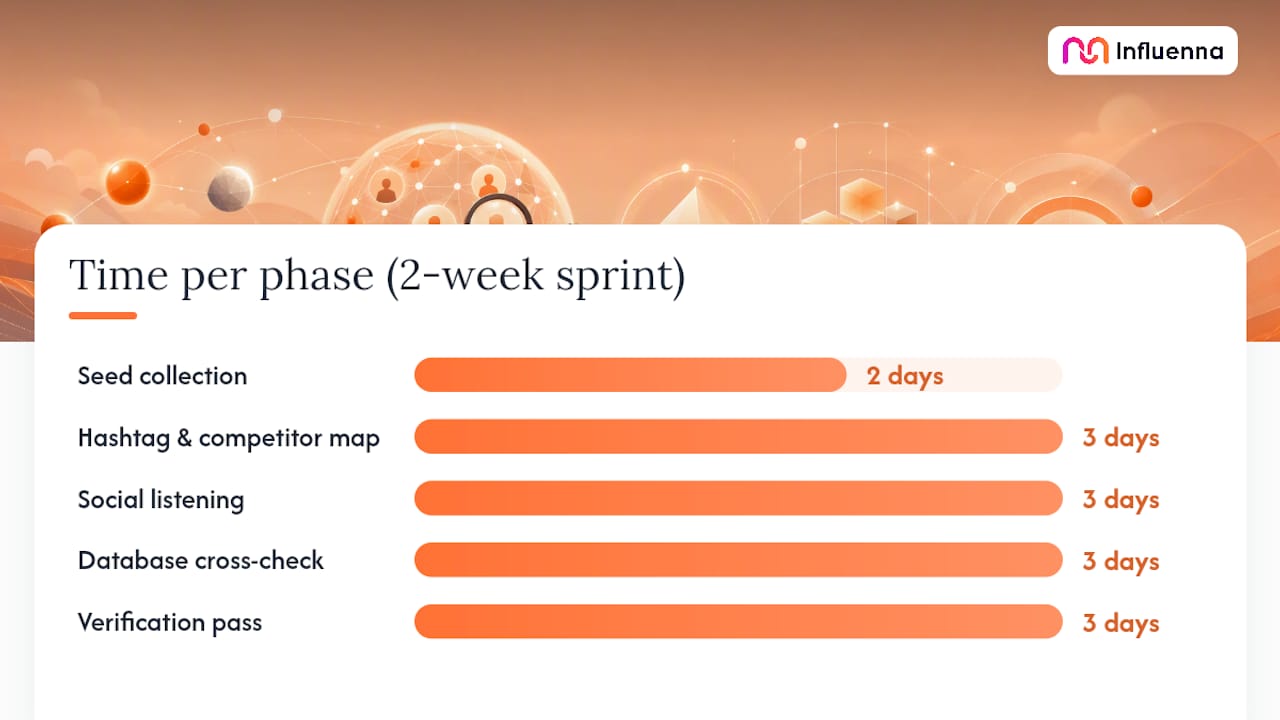
The fix is a mixed-method discovery sprint. Here's a two-week version marketing teams can run without hiring outside help, using tools like Sona to find proven ideas and write in your voice:
- Days 1 to 2, seed collection. Pull ten to fifteen creators you already know are a good fit, from past campaigns, competitor tags, or internal recommendations. Log each seed with the date, source, and why it's relevant.
- Days 3 to 5, hashtag and competitor mapping. Search the hashtags your seeds use and check who else shows up organically. Map which creators are already tagging or mentioning competitor products, since combining database search with social listening surfaces people already engaged with your category rather than people who simply fit a demographic filter.
- Days 6 to 8, social listening queries. Run listening searches for your product category and adjacent conversation topics, not just your brand name. This is where niche and emerging creators show up first, often before they've hit the follower threshold that gets them indexed in a standard database.
- Days 9 to 11, database cross-check. Take the names surfaced by listening and seeds, then run them through a discovery database to fill in engagement history and audience breakdown.
- Days 12 to 14, verification pass. Sample each candidate's last ten posts for consistency, check audience geography against your target market, and look up any past brand partnerships for conflicts or red flags.
The verification checklist matters as much as the sourcing. Practitioner guidance on manual and mixed discovery recommends sampling recent content, checking audience provenance labels rather than trusting headline follower counts, and cross-checking engagement patterns for irregular spikes that suggest bought followers or engagement pods.
Pro Tip: Keep a running spreadsheet of every seed, search query, and date searched. When the next campaign comes around, you're not starting from zero. You're refining a pipeline that already has six months of context built in.
How Do the Top Influencer Search Tools Compare?
No single tool wins across every category, and that's the point of choosing by use case rather than by brand reputation. Discovery databases win on raw scale but usually price data accuracy as a premium add-on, exactly the pattern G2 reviewers flag repeatedly when comparing paid tiers. Social listening platforms win on catching organic conversation early but tend to need a second tool for the actual outreach and contract workflow. Native platform marketplaces win on real-time accuracy because the data comes straight from the source, but they're locked to one platform, so a cross-channel campaign means juggling two or three separate interfaces. Verified-audience platforms win on demographic confidence but usually carry the highest per-seat cost of the group. Curated marketplaces trade raw search volume for vetting quality. You won't browse millions of profiles, but every account you see has already passed a human review, and every conversation starts from a structured request instead of a cold pitch that might land in a spam folder.
The practical takeaway: budget for at least two tool categories if your program runs more than one or two campaigns a year. A database for volume, paired with either listening or a curated marketplace for quality, covers more ground than any single platform does alone.
What Do Successful Mixed-Discovery Searches Look Like?
A beauty brand launching a niche skincare line for sensitive skin illustrates the mixed-method payoff well. A pure database search using "skincare" and follower-count filters returns thousands of profiles, most already saturated with competitor sponsorships. Layering in social listening for phrases like "sensitive skin routine" and "fragrance-free" surfaces a smaller pool of creators actively discussing that specific problem, often with tighter, more responsive audiences than the generic "beauty influencer" search would ever find.
A B2B software company hunting for LinkedIn-adjacent creators on YouTube faces the opposite problem: too few results, not too many. Seeding the search with competitor tags and mapping who comments on competitor product review videos turns up niche reviewers who never show up in a standard keyword search because their content is technical rather than lifestyle-branded.
A regional restaurant group needing local food creators found that structured requests through a curated marketplace outperformed cold outreach because the creators reviewing the requests had already opted in to being contacted by relevant brands, rather than needing to be convinced from zero that the message wasn't spam.
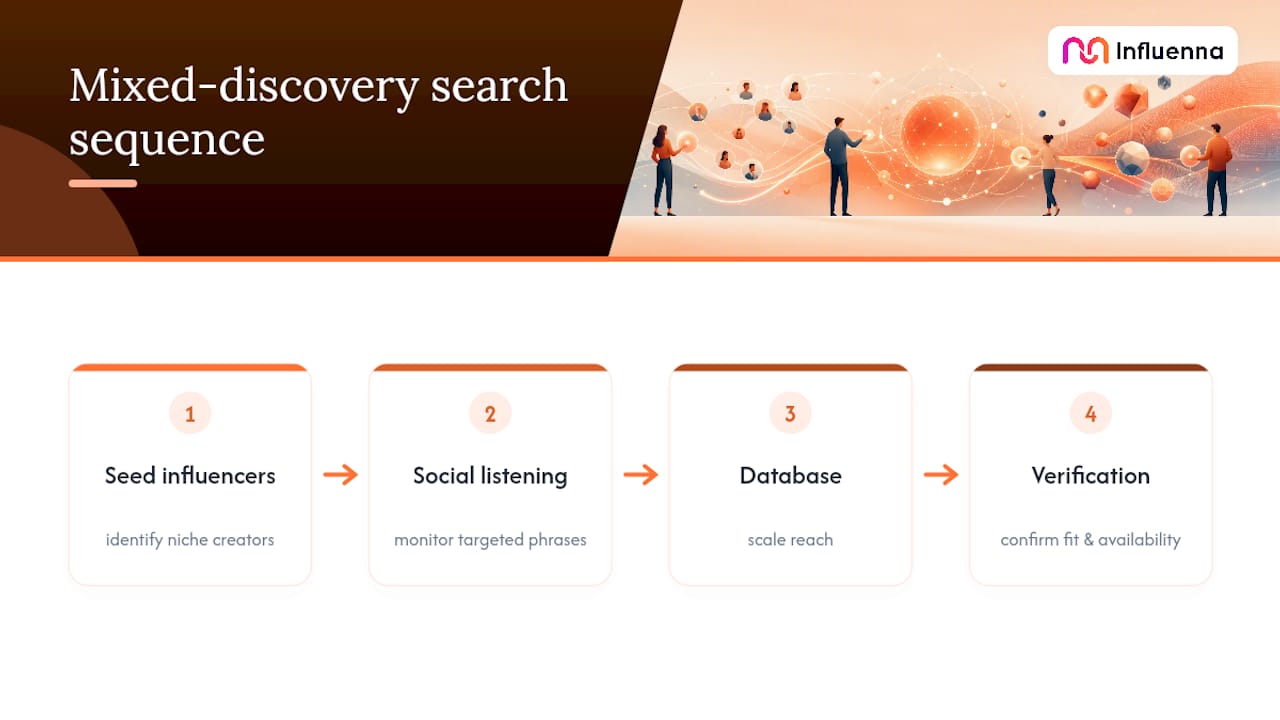
The common thread across all three: the tool matters less than the sequencing. Seeds first, listening second, database for scale, verification last.
How Do Search Tools Fit Into a Broader Influencer Strategy?
A search tool is the sourcing layer, not the strategy. Treating a database subscription as your entire influencer marketing plan is how teams end up with a folder of names and no actual campaign. The tool should feed directly into a brief that states your objective, budget per creator tier, content requirements, and disclosure expectations before you ever send an outreach message. A reusable one-page brief template keeps that step from turning into a new document for every single campaign.
Outreach comes next, and it's worth treating as its own discipline rather than an afterthought to search. Message quality determines your response rate more than your search tool's filter precision ever will. Templates built around getting actual replies tend to outperform generic pitch copy by a wide margin, because creators can tell within one sentence whether a brand did any homework at all.
Finally, close the loop with reporting. Whatever tool sourced the creator, your campaign tracking needs to connect that source back to performance, so next quarter's search starts smarter instead of from scratch. Programs that treat discovery, outreach, and reporting as three connected steps consistently outperform ones that treat search as a one-off task disconnected from everything that happens after the deal closes.
In-House, Agency, or Marketplace: Which Fits Your Team?
There's no universally correct operating model, only the right tradeoff for where your team stands right now. In-house discovery keeps control and confidentiality tight but demands real headcount hours you might not have. Agencies buy speed and existing relationships, at a markup and with less direct visibility into how candidates were vetted. A curated marketplace sits between the two: you keep control of the actual conversation and negotiation, while the platform handles the vetting layer that usually eats the most in-house time.
Ask three questions before choosing: How much does confidentiality matter before a deal is signed? How much internal capacity exists to manage outreach and vetting manually? How fast does this specific campaign need to move? Programs often start manual, add a marketplace or database as volume grows, and bring in an agency only once campaign count outpaces what either can handle alone.
— Igor
Influenna: A Curated Alternative to Cold Outreach and Endless Scrolling
Influenna is the alternative to scraping databases and sending cold DMs. Instead of browsing an index of profiles you have to vet yourself, every creator, brand, talent agency, and influencer marketing agency on Influenna is reviewed by a person before they get access to the marketplace. You search and filter for partners, then send a structured collaboration request instead of a cold pitch. Contact details stay private until both sides approve, and unanswered requests expire after 14 days instead of sitting in limbo forever.
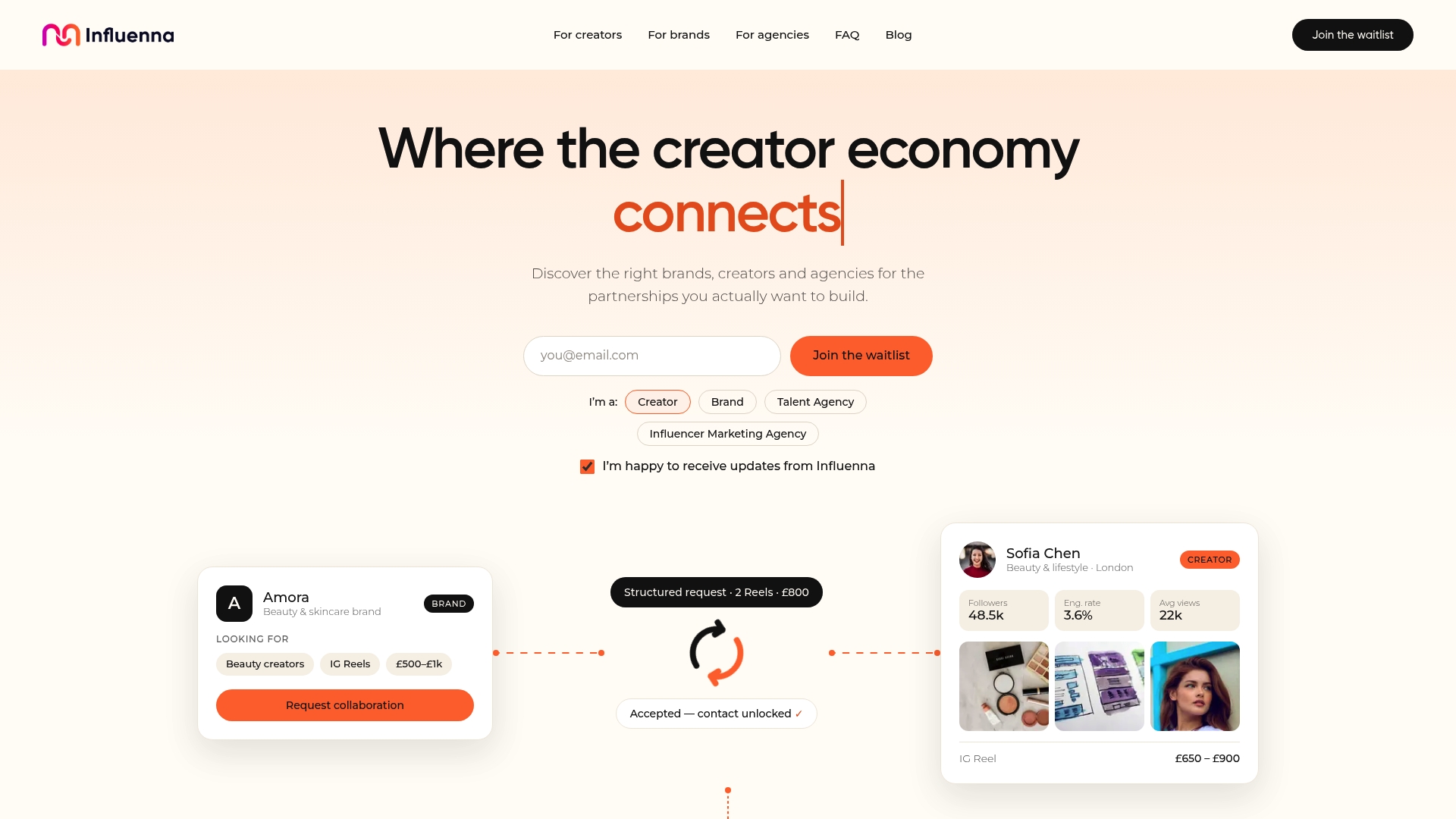
This model fits teams that want vetted matches over raw volume, and privacy over mass outreach. Audience metrics are labeled by provenance, verified, estimated, or self-reported, and shown separately by platform, so you're never comparing numbers that were never meant to sit side by side. If your current search process is producing long lists with no real vetting behind them, or endless cold outreach with low reply rates, a curated marketplace offers a different starting point.
The platform is currently pre-launch, and the public site runs on a waitlist. Join the waitlist to get access when the marketplace opens, and browse the Influenna blog for practical templates you can start using today, regardless of which tool sources your next campaign.
Sources
The comparisons and recommendations in this article draw on a mix of platform analysis, review-site data, and practitioner guidance. Each source below is useful for a different piece of the decision.
- How influencer marketing tools compare (Hootsuite)
- How Brandwatch helps with influencer discovery (Brandwatch)
- Lessie
- Modash reviews (G2)
FAQ
What Is the Best Influencer Search Tool for Small Teams?
Small teams with limited hours to spend on manual outreach usually do best starting with a discovery database for volume, then layering in a curated marketplace like Influenna for vetted, lower-effort matches once cold outreach response rates start dropping.
How Do Influencer Discovery Platforms Verify Audience Data?
Verified-audience platforms require creators to connect their own account analytics directly, producing demographic and reach data straight from the platform rather than a third-party estimate, which is why G2 reviewers consistently rank data accuracy as a top factor in tool selection.
Is Social Listening Better Than a Discovery Database?
Neither is strictly better. Social listening finds creators already engaged with your topic organically, while a discovery database offers far greater scale, and combining both consistently outperforms relying on either alone.
How Long Does It Take to Find the Right Influencers?
A platform-assisted search can produce a workable shortlist in days, while a disciplined manual process with logged seeds and repeatable queries, as practitioner guides recommend, usually takes longer but produces a more defensible, auditable list.
Does Influenna Replace a Discovery Database or Social Listening Tool?
No. Influenna is best paired with a database or listening tool for initial sourcing, then used for structured, privacy-minded requests once you've identified creators worth a direct conversation.