Influencer Outreach Message Templates That Get Replies
12 min read

The influencer outreach message that works is short, personalized, and value-first: 150 to 200 words, a subject line that references the creator's actual content, one line stating what they get, and a single clear call to action. No jargon, no attachments on the first email, no vague "collaboration opportunity" pitch.
Every reply-worthy email hits three notes: a subject that proves you did your homework, a value proposition the creator can grasp in one sentence, and one ask instead of five. Personalized messages that reference a specific post get a notably higher response rate than generic pitches, and that gap alone explains why so much brand outreach lands in the archive folder unanswered.
Here's the shape to copy:
- Subject: "Loved your [specific post topic] video, [Creator Name]"
- Opening: One line referencing their content, one line on who you are
- Body: What they get, what you're asking for, rough timeline
- Close: One question they can answer with a yes or a link to book time
Key Takeaways
A short, personalized email with one clear ask consistently outperforms long pitches, cold DMs, or generic mass templates.
| Point | Details |
|---|---|
| Keep it short | Cap outreach emails at 150 to 200 words with the key ask in the first two lines. |
| Personalize the subject | Reference a specific post or video; generic subject lines get ignored far more often. |
| Follow up once, maybe twice | Send the first follow-up at 5 to 7 days, a second at 12 to 14 days, then stop. |
| Attach a brief for paid offers | Include goal, deliverables, timeline, compensation, and usage rights on one page. |
| Use structured requests over cold DMs | Influenna's manual review and structured collaboration requests replace guesswork with a clear approval step before contact details are shared. |
Table of Contents
- How to Write an Influencer Outreach Message That Gets Opened
- Structuring the Email: Subject, Opening, Body, Close
- Copy-Ready Influencer Outreach Email Templates
- What to Put in a One-Page Campaign Brief
- When and How Often to Follow Up
- Tracking What Actually Works in Outreach
- Why Personalization Still Beats Volume
- Find and Contact Creators Without the Cold-Email Guesswork
- Sources
- FAQ
How to Write an Influencer Outreach Message That Gets Opened
A generic pitch tells a creator they're one of five hundred people who got the same email. Preparation is what makes personalization real instead of performative, and it starts before you write a single word.
Run through this checklist before drafting anything:
- Audience fit: Does their following overlap with your actual buyers, not just their total follower count?
- Content fit: Have they posted about your category, your competitors, or adjacent products recently?
- Engagement quality: Are comments genuine conversations or bot spam?
- Contact method: Check their bio first. Many creators list a preferred contact method right there, whether that's "DM for collabs" or a business email.
If a manager or agency is listed, contact them directly rather than the creator's personal inbox, especially for anyone with a sizable following. Skipping that step is one of the fastest ways to get ignored. Preparation around fit and contact method, more than follower count, is what actually predicts whether outreach succeeds.
Pro Tip: Like or comment on one or two recent posts a few days before you email. It's a small signal that you're a real person paying attention, not a mail-merge script.
Structuring the Email: Subject, Opening, Body, Close
Every outreach email breaks into four parts, and each one has a job to do.
Subject line rules: Keep it under 50 characters and reference something specific. Generic subjects get ignored; subject lines that mention actual content the creator posted consistently outperform vague pitches.
Six examples that work:
- "Your skincare routine post + a quick idea"
- "Partnership idea from a fan of your channel"
- "Loved your Bali trip series, [Name]"
- "Quick collab idea for [Creator]"
- "Following up on your March 3 reel"
- "[Brand] x [Creator]: quick question"
Opening hook: Start with a specific compliment or reference, not "I hope this finds you well." Follow with one line on who you are, then the value proposition. That's it. Three sentences, done.
Body: State the ask plainly. Cover deliverables, rough timeline, and a compensation signal (even a range) in a couple of tight bullets or two short sentences. Don't bury the offer under three paragraphs of brand history.
Close: One call to action. A reply, a calendar link, or a simple yes/no question works better than three options stacked at the bottom.
A few dos and don'ts worth pinning above your desk:
- Do personalize the first line every single time, no exceptions.
- Do keep the whole message under 200 words.
- Don't demand analytics screenshots or a media kit before you've even said hello.
- Don't open with "Dear Influencer" or any subject line containing the word "opportunity."
Copy-Ready Influencer Outreach Email Templates
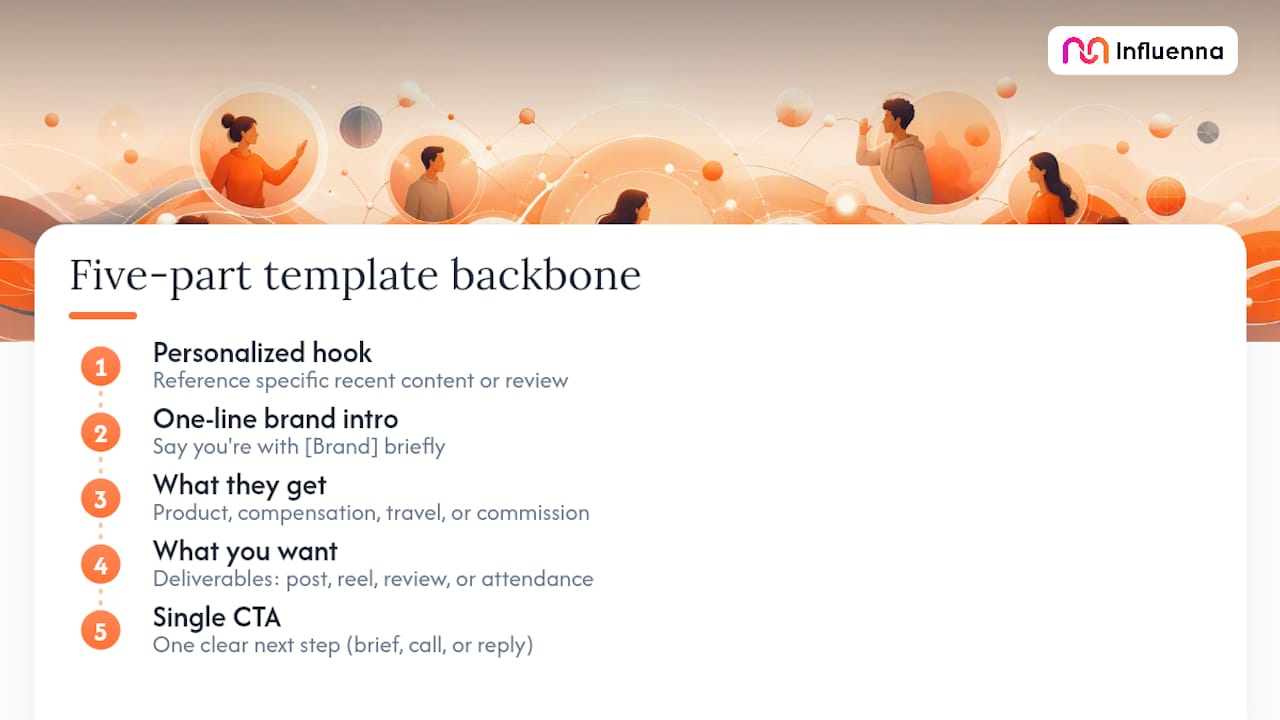
Every template below follows the same five-part backbone: personalized hook, one-line brand intro, what they get, what you want, single CTA. Swap in your own details, then send.
1. Micro-influencer, gift-first Subject: "Your reviews always feel so honest, [Name]" "Hi [Name], your review of [product category] last month was the most useful one I've seen. I'm with [Brand], and we'd love to send you [product] with zero strings attached. If you like it and want to post, great. If not, keep it. Interested?"
2. Paid collaboration with clear deliverables Subject: "Paid collab idea for your [platform]" "Hi [Name], your [specific content type] consistently stands out in [niche]. We're [Brand], and we'd like to sponsor one Reel and one story set for [budget range], deliverable within three weeks. Want the quick brief?"
3. Product review Subject: "Would love your take on [product]" "Hi [Name], loved your recent breakdown of [related topic]. We make [product] and think your audience would want an honest review, no script required. Compensation plus product included. Worth a short call?"
4. Event invite Subject: "You're invited: [event name]" "Hi [Name], we're hosting [event] on [date] and thought of you given your [related content] coverage. Travel and access covered. Can I send details?"
5. Affiliate or long-term program Subject: "Ongoing partnership idea, [Name]" "Hi [Name], we've followed your content on [topic] for a while. We run an affiliate program at [commission rate] plus a flat fee for creators who post monthly. Want the specifics?"
6. Concise follow-up Subject: "Quick follow-up, [Name]" "Hi [Name], following up in case this got buried. Still happy to send over the details if you're interested. No worries either way."
For nano and micro creators, gifting and low-pressure asks work best. For macro creators, lead with the budget number since their time is worth more and vague pitches get filtered fast. Templates save time, but every one needs real customization before it goes out, and attaching a one-page brief on paid offers speeds up their decision.
What to Put in a One-Page Campaign Brief
A brief turns "sounds interesting" into a signed agreement faster, because it answers the questions a creator would otherwise have to email back and ask.
Keep it to one page with six things:
- Campaign goal: Awareness, conversions, or app installs?
- Deliverables: Content type and count (one Reel, two stories, etc.)
- Timeline: Draft due date and posting window.
- Compensation range: Even a rough number beats silence.
- Usage rights: How long can the brand repost the content, and where?
- KPI for the creator: What does success look like from their side?
Attach the brief as a PDF for paid collaborations once there's real interest, but don't front-load a full brief in the first email. It reads as impersonal and skips the relationship step entirely. Link a private doc instead of attaching a large file, and if you're managing multiple campaigns at once, structured requests through a platform like Influenna keep briefs, approvals, and contact details organized in one place instead of scattered across email threads.
Pro Tip: Include one sample creative or caption idea in the brief. Creators respond faster when they can picture the actual post instead of guessing at your brand voice.
When and How Often to Follow Up
Silence doesn't always mean no. It usually means your email got buried under forty others that day.
Send your first follow-up five to seven days after the original message. That window balances patience with momentum without coming across as pushy. If you follow up a second time, wait another 12 to 14 days, and stop there for cold outreach. Two follow-ups is the ceiling.
Each follow-up should add something new rather than just repeating the ask:
- Add a small detail: updated budget, a new deliverable option, or a specific reason you're still interested.
- Offer an easy out: "No worries if this isn't a fit right now."
- Try a channel switch if email goes cold. A short, polite DM sometimes reaches creators who check Instagram more than their inbox.
Sample: "Hi [Name], circling back in case this got lost. We bumped the budget slightly since our last email. If timing's off, totally fine. Just let me know either way."
Tracking What Actually Works in Outreach
Guessing which subject line performs better wastes weeks of send volume. Tracking four numbers tells you exactly what to fix.
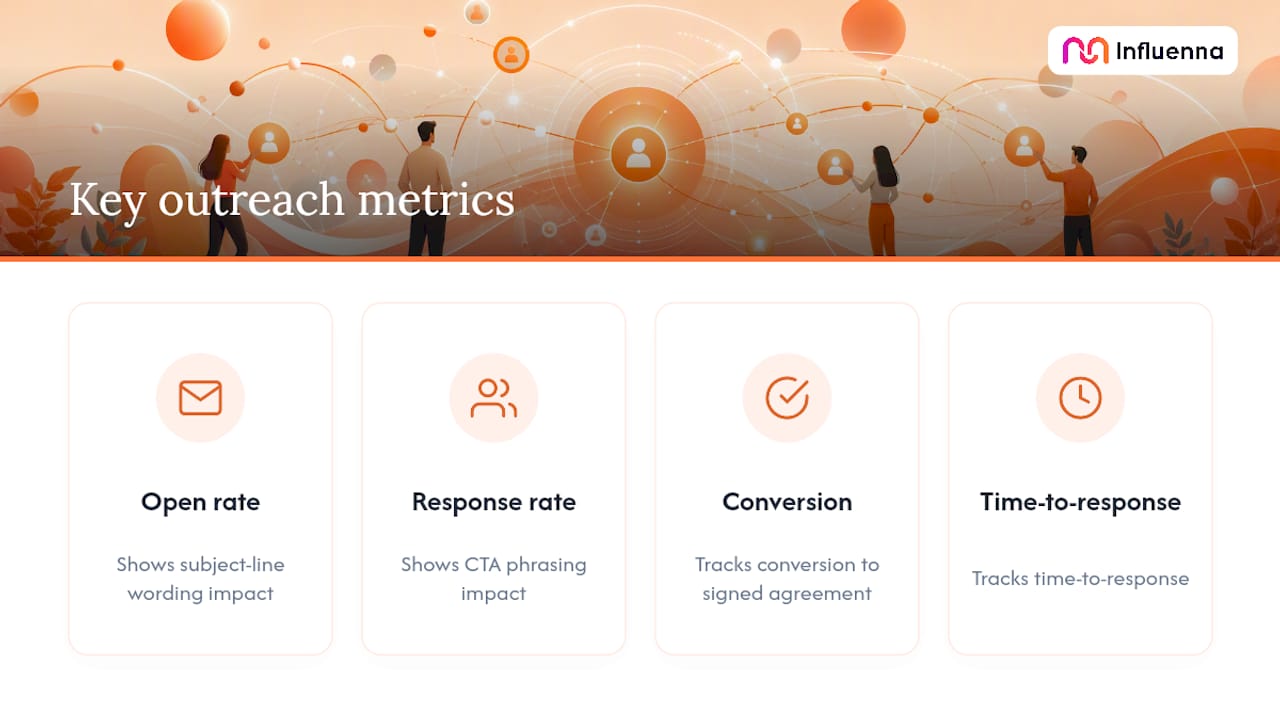
Watch these metrics: open rate, response rate, conversion to signed agreement, and time-to-response. Testing subject-line wording and CTA phrasing is how outreach teams actually improve reply rates over time, rather than relying on gut feeling about what "sounds good."
Run simple A/B tests: a fully personalized opening against a lightly personalized one, Tuesday sends against Friday sends, and a direct CTA ("Want the brief?") against an open-ended one ("Thoughts?"). Log results in a spreadsheet or an influencer management tool, and once a sequence beats your baseline by a meaningful margin, scale it across your next batch of prospects. For teams running outreach at volume, a KPI dashboard modeled on the approach in this growth marketing KPI guide makes it easier to see which stage of the funnel is actually leaking replies.
Why Personalization Still Beats Volume
I've reviewed enough outreach threads to notice a pattern: the emails that get replies aren't the ones sent to the most people, they're the ones that prove someone actually watched the video or read the caption before typing. Pair that with a concise brief and one clear ask, and reply rates jump in a way that spray-and-pray sending never matches. Platforms built around manual review and structured requests, rather than open inboxes, tend to produce exactly that kind of higher-signal exchange.
Find and Contact Creators Without the Cold-Email Guesswork
Influenna is a curated marketplace built for exactly the workflow this article walks through: research the right creator, then reach them with a structured request instead of a cold email that might land in spam or get lost in a crowded DM inbox. Every creator, brand, and agency account is reviewed by a person before joining, so you're not guessing whether a profile is real or whether the audience numbers hold up.
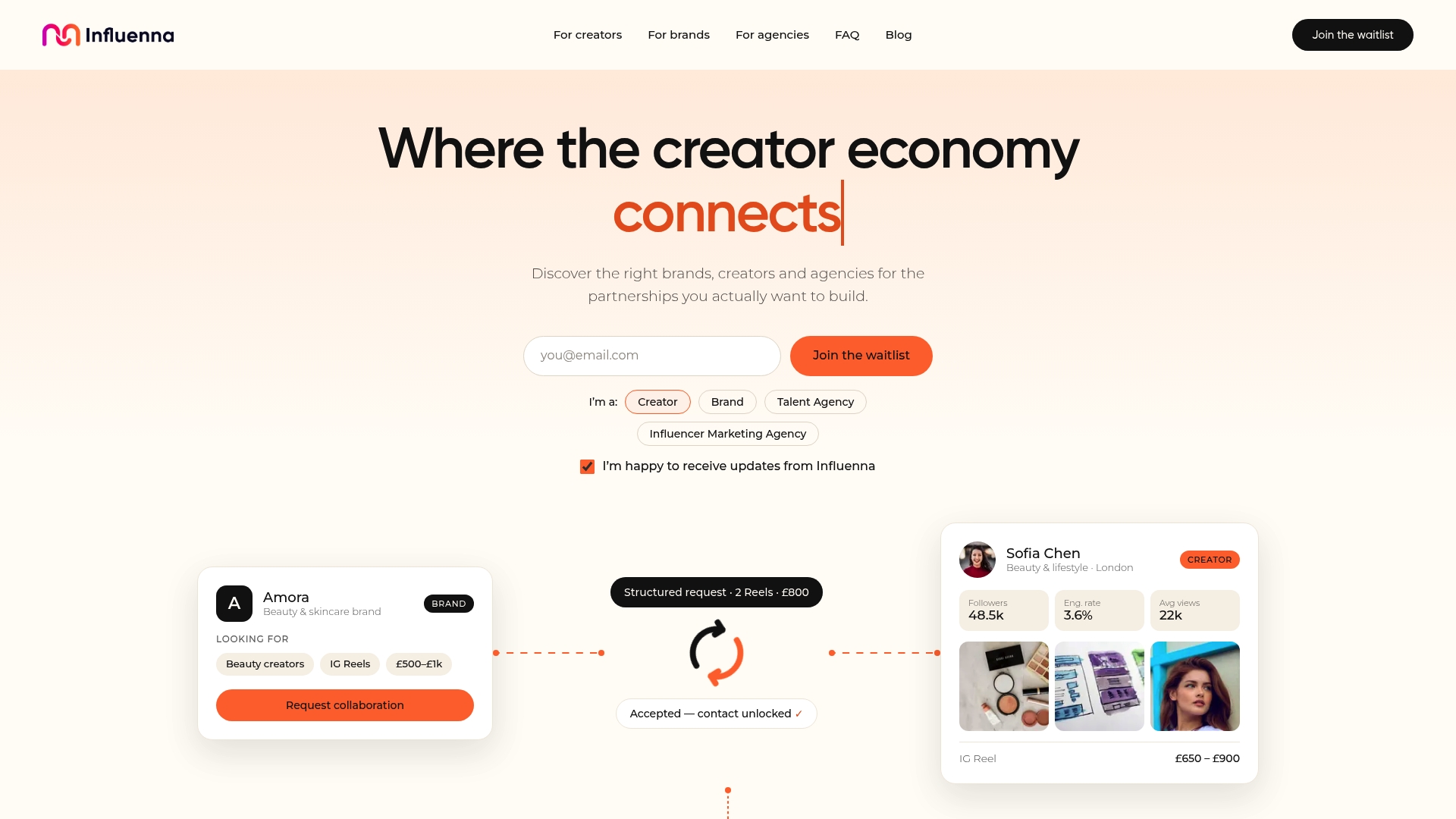
Instead of hunting for a bio link or guessing at a manager's email, you send a structured collaboration request with your deliverables, timeline, and compensation range built in. Contact details unlock only once both sides approve, so no one wastes time on a mismatch. If outreach volume and reply rates have been a struggle, join the Influenna waitlist and get access as soon as the marketplace opens to your account type.
Sources
- How to Write an Influencer Outreach Email | Mailchimp
- Influencer outreach email templates | Sprout Social
- Influencer Outreach Email Templates | ConversionStudio
- How to Email an Influencer
FAQ
How long should an influencer outreach email be?
Keep it between 150 and 200 words, with the value proposition and ask stated in the first two sentences.
What should the subject line say?
Reference a specific piece of content the creator posted, and keep it under 50 characters. Avoid generic words like "collaboration" or "opportunity."
How many times should I follow up?
Send one follow-up at 5 to 7 days, a second at 12 to 14 days if needed, then stop for cold outreach.
Should I DM or email influencers?
Check their bio for a stated preference first. Email typically offers better deliverability and a clearer paper trail for professional agreements than direct messages.
Do I need to attach a brief in the first email?
No. Save the full brief for once there's real interest, especially for paid collaborations, and link it rather than attaching a large file.
How can I find creators without cold-emailing strangers?
A curated marketplace like Influenna lets you search for relevant creators and send a structured request instead of guessing at contact details or sending a cold DM.