Bundle, Anchor, Close: Negotiate Influencer Rates for Brands
17 min read

The best approach to negotiating influencer rates is to set a maximum budget before you start talking, then move price with structure, not pressure: bundle deliverables, restructure scope, or shift part of the fee to performance. Pair that with clear, separately priced terms for usage rights and exclusivity, and you land on a fair rate that covers the creator's work while protecting your campaign math.
TL;DR:
- Bundling multiple posts or platform content often reduces rates by 15% to 30%, especially when deliverables share a shoot day or theme.
- Adjusting scope, such as reducing content length or number of deliverables, better aligns costs with your budget without harming creator relationships.
- Using hybrid pay structures that combine a lower guaranteed fee with performance-based bonuses helps scale expenses based on actual results.
- Separately pricing and specifying usage rights and exclusivity terms prevents costly renegotiations and clarifies ownership duration and channels.
- Preparation with engagement data, CPM estimates, and campaign math ensures your opening offer stays within a realistic ceiling, avoiding overpayment and underperformance.
Table of Contents
- How to Negotiate Influencer Rates Using Real Leverage
- What Data Do You Need Before You Negotiate?
- Ready-to-Send Counter-Offer Scripts for Common Scenarios
- What Contract Terms Should You Lock In Before Signing?
- How Long Does an Influencer Rate Negotiation Take?
- Negotiating Fairly Without Burning the Relationship
- How a Curated Marketplace Cuts Negotiation Friction
- What Igor Checks Before Sending Any Offer
- Find Vetted Creators Before You Ever Negotiate a Rate
- Sources
- FAQ
How to Negotiate Influencer Rates Using Real Leverage
Most brands try to negotiate influencer rates by asking for a flat discount. That rarely works, and it often insults the creator you're trying to build a relationship with. The stronger approach is to change the shape of the deal instead of just cutting the number at the bottom.
Bundling is the most reliable lever in the entire negotiation toolkit. When you ask a creator to commit to three Reels and two Stories instead of one standalone post, you're offering something valuable: guaranteed volume and a longer working relationship. Creators frequently drop their per-post rate by 15% to 30% for a bundled commitment, because batch production is more efficient for them too. Bundling works best when the deliverables share a shoot day, a theme, or a product line. It works poorly when you're asking for wildly different content types across a long, unpredictable timeline.
Scope negotiation is the second lever, and it's the one most marketers overlook. Instead of asking a creator to lower their rate for the same work, ask what they'd do at your target price. Maybe that's a 30-second Reel instead of a 60-second one, or a single feed post instead of a post plus three Stories. You're not haggling. You're right-sizing the deliverable to match the budget, which creators generally respect far more than a lowball counter.
Hybrid compensation shifts part of the payment from guaranteed cash to performance. A reduced base fee paired with a commission on affiliate sales, or a bonus tied to a click-through benchmark, lets you scale spend to actual results instead of vanity metrics. This model works especially well with creators who already have an engaged, purchase-ready audience, since it rewards them for driving real revenue rather than just posting content.
Usage rights and exclusivity are not favors. They're products, and they should be priced as separate line items on every quote. A pricing worksheet that itemizes usage, exclusivity, and rush fees keeps everyone honest about what they're actually buying. A short-term usage license (organic reposting for 30 to 90 days) should cost noticeably less than a perpetual buyout that lets you run the content as paid media indefinitely. Locking in whitelisting permissions and a usage window in the original agreement is far cheaper than going back to negotiate them after the content already performed well, according to Shopify's breakdown of 2026 influencer pricing.
Exclusivity should be scoped, not blanket. Instead of asking a creator to avoid every competing brand in the category for a year, narrow it to direct competitors, for the campaign window, on the specific platforms you're using. A tightly scoped exclusivity clause costs less and is far more likely to get a yes.
- Bundle deliverables across posts or platforms to earn a volume discount.
- Adjust scope (length, platform, revisions) before touching the base rate.
- Use hybrid base-plus-performance pay to align cost with results.
- Price usage rights and exclusivity separately, and specify duration.
- Reserve product-for-post or gifting arrangements for nano and micro creators only.
Non-cash compensation, meaning free product or extended access, can substitute for part of a fee with nano-creators (under 10,000 followers) and some micro-creators, especially for a first collaboration. It almost never works for creators with established rate cards, and offering it there signals you haven't done your homework.
Pro Tip: Never negotiate usage rights and base fee as one number. Ask for two lines on the quote: "posting fee" and "usage license." Creators who are used to real negotiations will already expect this, and it makes your counter-offer far easier to justify.
What Data Do You Need Before You Negotiate?
Walking into a negotiation without numbers is how brands end up overpaying for content that underperforms. Preparation has three parts: understanding what actually predicts value, running the math on your ceiling, and knowing where your opening offer should land.
- Weight engagement over follower count. A creator with 40,000 followers and a 6% engagement rate, strong save numbers, and a track record of affiliate conversions is worth more than one with 150,000 followers and a 1% engagement rate. Saves and shares matter more than likes because they signal content that spreads organically rather than sitting flat in a feed.
- Run two anchoring formulas before you quote a number. The engagement-based formula estimates fair pay from audience size times engagement rate times a category multiplier. The CPM check compares the quoted rate to the creator's average views, translated into cost per thousand impressions. Both frameworks are standard enough that Shopify's influencer pricing guide walks through them in detail, and running both catches outliers: a rate that looks fine on engagement but wildly expensive on CPM (or the reverse) tells you exactly where to push in the negotiation.
- Calculate your true ceiling from campaign math, not gut feel. Take your target return on ad spend, your average order value, and a realistic conversion assumption for sponsored content in your category, then work backward to a maximum per-creator spend that still clears your ROAS target. If you don't have a mature CPM or affiliate baseline, Statista's influencer marketing ROI data is a reasonable starting benchmark for what comparable campaigns return.
- Read creator-supplied metrics with a skeptical eye. Screenshots of "reach" or "impressions" are easy to inflate through boosted posts or short-lived spikes. Ask for platform-native analytics screens with dates visible, not a summary slide.
- Open at 75% to 85% of your ceiling, never at your ceiling. This gives you room to move when the creator counters, which they usually will, without ever exceeding the number your campaign math actually supports.
One more thing worth building into your prep: decide in advance whether you'll share your budget range. Making creators guess your number is a common cause of rate inflation, since guesses tend to skew high and each cycle of back-and-forth resets the anchor upward, according to Forbes' analysis of what's driving rates up. Sharing a realistic range, even a wide one, often shortens the entire process. Influenna's guide to calculating engagement rate walks through the exact formula referenced above if you need the underlying math spelled out step by step.
Ready-to-Send Counter-Offer Scripts for Common Scenarios
Having the right lever in mind doesn't help if you don't know how to phrase the actual message. These are the three most common negotiation scenarios and language you can adapt directly.
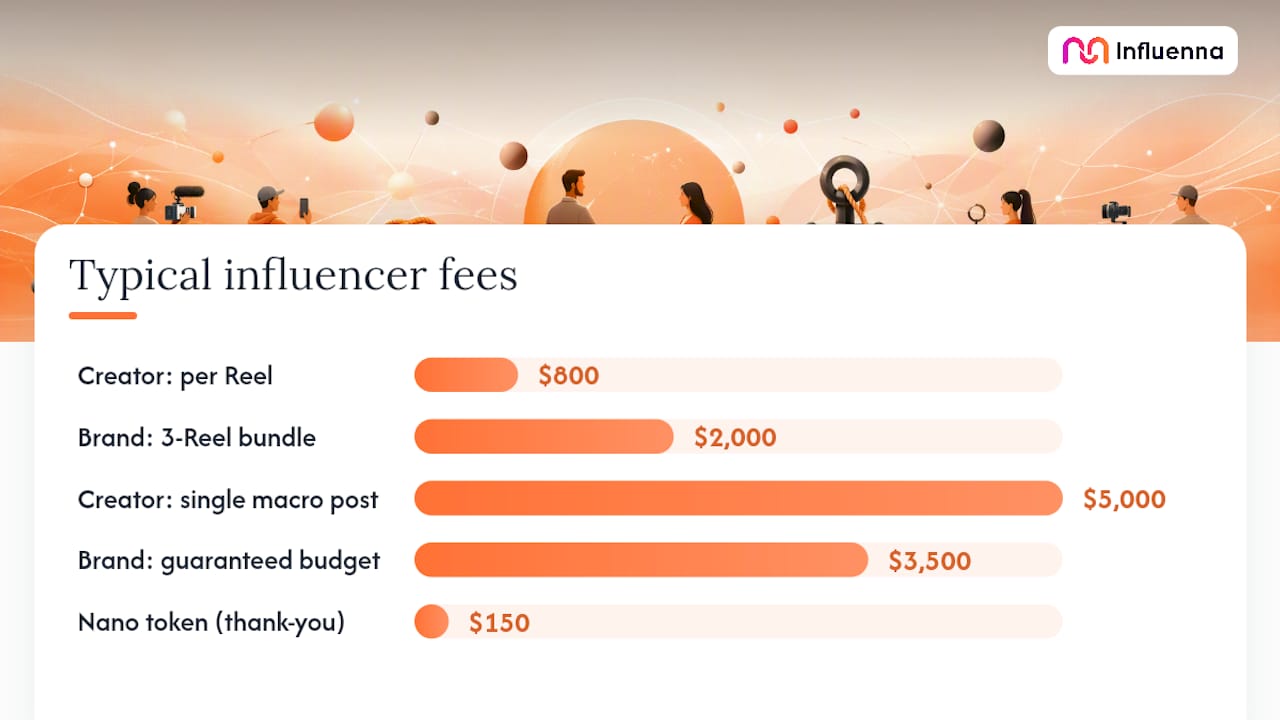
1. The flat-fee bundle counter. A creator quotes $800 per Reel. You need three pieces of content across a month.
"Your work is exactly the tone we're looking for. Our budget for this campaign works better as a bundle: three Reels over four weeks at $2,000 total, with usage rights for organic reposting included. If you'd want paid-ad usage on top, we're happy to quote that separately."
This works because it doesn't ask the creator to devalue a single post. It reframes the conversation around volume, and it separates usage from the base number right from the first message.
2. The hybrid base-plus-performance counter. A macro creator quotes $5,000 for a single dedicated post promoting a product launch, and your budget tops out around $3,500 guaranteed.
Based on your past campaign performance, that structure often lands above the flat rate you quoted."
Hybrid deals land best with creators who already run affiliate links or promo codes, since they can see their own historical conversion data and judge whether the upside is real.
3. The nano/micro gifting-plus-token counter. A creator with 8,000 highly engaged followers hasn't set formal rates yet.
"We'd love to send you the full product line to feature however feels authentic to your content, along with a $150 thank-you for your time. If this is a good fit, we'd want to build a paid partnership for future launches."
Framing this as a trial, with a clear path to paid work later, sets honest expectations instead of implying free product is the permanent arrangement.
A few additional principles apply across all three scripts:
- Always name usage rights and exclusivity as separate items in the same message, even if the price is $0 for a first campaign.
- Restate the deliverable specifics (length, platform, number of revisions) in the same message as the price, so nothing gets renegotiated later under the guise of "clarifying."
- Close every counter-offer with a specific next step ("Let me know by Thursday if this works, and I'll send the agreement") rather than leaving the timeline open-ended.
- If a creator counters your counter, respond to the actual number they gave, don't restart from your original offer.
Talent managers tend to treat a creator's first quote as an opening anchor rather than a fixed price, and the negotiation room usually comes from restructuring the deal, not demanding a straight percentage cut. Keep that framing in your own scripts and you'll get further than brands who just ask for "a better rate."
What Contract Terms Should You Lock In Before Signing?
The rate is only half the deal. The terms around it determine whether you're protected if something goes sideways, and whether the price you negotiated actually holds.
- Deliverables and timeline: exact post count, content type, platform, posting window, and number of revision rounds included in the fee.
- Proof of post: a requirement that the creator sends screenshots or a link within 24 to 48 hours of publishing, so you're not chasing confirmation weeks later.
- Payment schedule: typical structure is a deposit (often 50%) on signing and the balance on delivery or on proof of post, with any performance bonus paid on a defined date after the tracking window closes.
- Usage rights, spelled out by channel, duration, and territory: organic-only versus paid-ad use, how long the license runs, and whether it covers just the brand's channels or the creator's too.
- Exclusivity scope and duration: which competitor categories are covered, and for exactly how long, priced as its own line separate from the base fee.
Common red flags to reject outright: a "perpetual, all-media" usage grant folded into a standard posting fee with no separate price, vague language like "brand may use content as needed" with no channel or duration specified, and any clause requiring unpaid revision rounds beyond what was quoted upfront. If a creator's manager is involved, clarify early whether their commission is layered on top of the quoted rate or already baked in, since that materially changes your real cost per deliverable, per Shopify's pricing breakdown. Influenna's contract basics checklist covers the clause-level detail if you want a template to work from before your legal review.
How Long Does an Influencer Rate Negotiation Take?
Most micro and mid-tier creator negotiations wrap up in a handful of business days across two to four message exchanges: initial quote, your counter, their response, and a final confirmation. Macro creators and anyone represented by a manager or agency take longer, often stretching to a couple of weeks, since approvals route through a third party and contracts get more scrutiny.
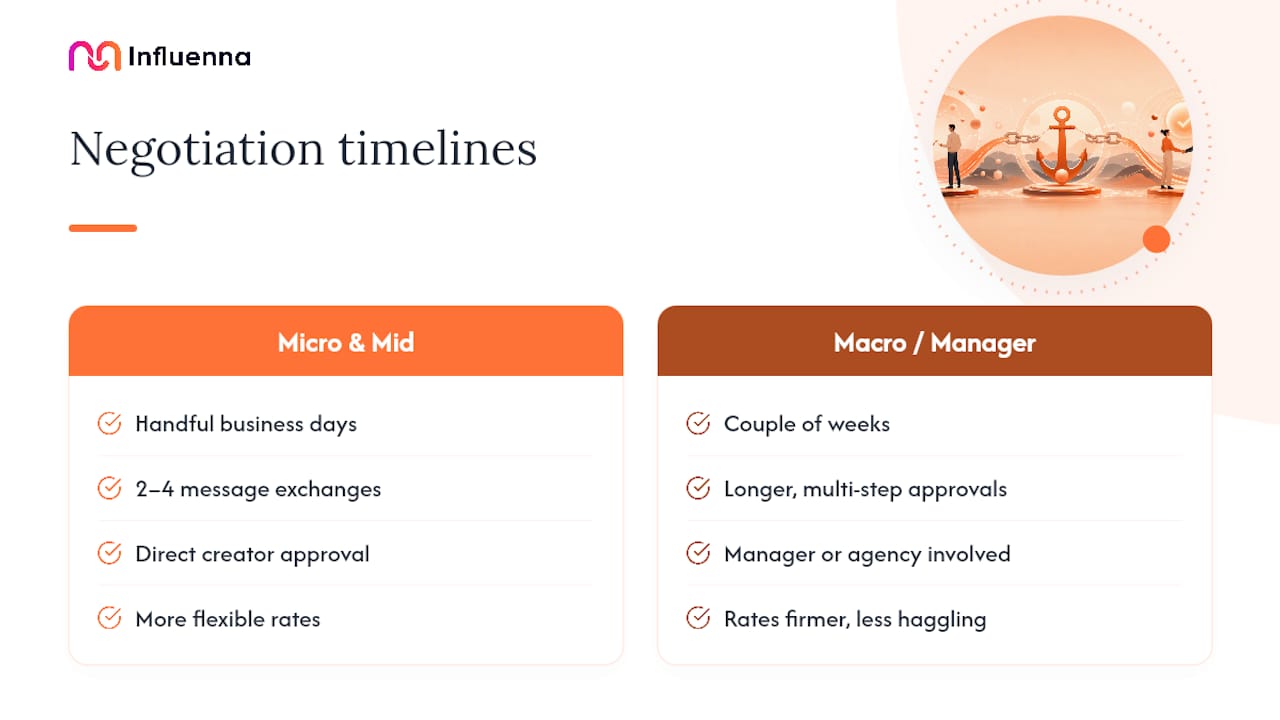
Once a manager enters the conversation, expect the pace to slow and the price to firm up. Managers rarely negotiate down from a rate card the way an unrepresented creator might, but they also tend to bring cleaner contracts and faster turnaround on paperwork once terms are agreed.
Whatever tier you're negotiating with, confirm every agreed term by email the same day you reach a verbal or DM agreement. A one-paragraph recap ("Confirming: 3 Reels, $2,000 total, organic usage for 90 days, delivery by the 15th") prevents the single most common source of rework: two sides remembering the same conversation differently a week later.
Negotiating Fairly Without Burning the Relationship
Extreme lowballing doesn't just cost you a discount. It costs you the creator, and often their entire network of peers who hear about the offer. Push back on a high quote with data and structure, not with a number so low it reads as disrespectful. A polite "that's above our range, but here's what we can do at this scope" gets a far better response than silence followed by a much lower counter.
Watch for the same red flags on your own side of the table that you'd reject in a contract: don't ask for perpetual usage rights inside a one-post fee, don't leave usage terms vague, and don't ask for "just one more" unpaid revision. Treat comparable creators consistently. Paying two creators with similar reach and engagement wildly different rates for the same deliverable erodes trust fast once they compare notes, which they increasingly do. Being upfront about budget and consistent across creators is one of the clearest ways brands build durable, repeat partnerships instead of one-off transactions.
Pro Tip: If a negotiation isn't converging, close it gracefully instead of letting it die by silence. A short "this isn't the right fit for this campaign, but we'd love to stay in touch for future work" keeps the door open, and creators remember who treated them well even when the deal didn't happen.
How a Curated Marketplace Cuts Negotiation Friction
A lot of wasted negotiation time isn't about price at all. It's about ambiguity: unclear deliverables, budgets nobody wants to say out loud first, and messages that vanish into a DM inbox. Curated marketplaces address this by structuring the request itself. On Influenna, a collaboration request includes fields for budget, deliverables, and usage expectations from the first message, which means both sides are negotiating from the same starting document instead of reconstructing it over five separate texts.
Contact details only unlock once both sides approve the request, which cuts down on the ghosting that plagues cold outreach and keeps early conversations focused on terms instead of on convincing someone you're a real inquiry. That structure doesn't replace the work covered in this article. It's still on you to bring your benchmarks, your ceiling, and your counter-offer scripts. Influenna makes the introduction and gets both sides talking with the same information in front of them. The agreement itself, and every clause in it, is still a matter between your brand and the creator, negotiated in writing.
What Igor Checks Before Sending Any Offer
Before I send a single number to a creator, I run the same short mental checklist. First: is the campaign goal and audience fit actually confirmed, or am I negotiating a rate for a partnership I haven't fully justified yet? Second: which lever am I planning to pull, bundling, scope, or hybrid pay, and do I have the engagement or ROAS data to back that specific ask if the creator pushes back?
Third, and most often skipped: does my offer separate the base fee from usage rights and exclusivity as their own line items, and have I written down the exact terms I expect confirmed in return? A number without structure isn't an offer. It's a guess dressed up as one, and creators can tell the difference immediately.
— Igor
Find Vetted Creators Before You Ever Negotiate a Rate
A curated marketplace can get you to the negotiating table faster by cutting the search and vetting time out of the front end. Accounts are reviewed before marketplace access, so you're not sorting through cold DMs or unverified media kits to figure out who's actually worth a conversation. Structured collaboration requests carry budget, deliverables, and usage expectations from the first message, which means the negotiation groundwork, benchmarks, scope, usage terms, starts on solid footing instead of from scratch.
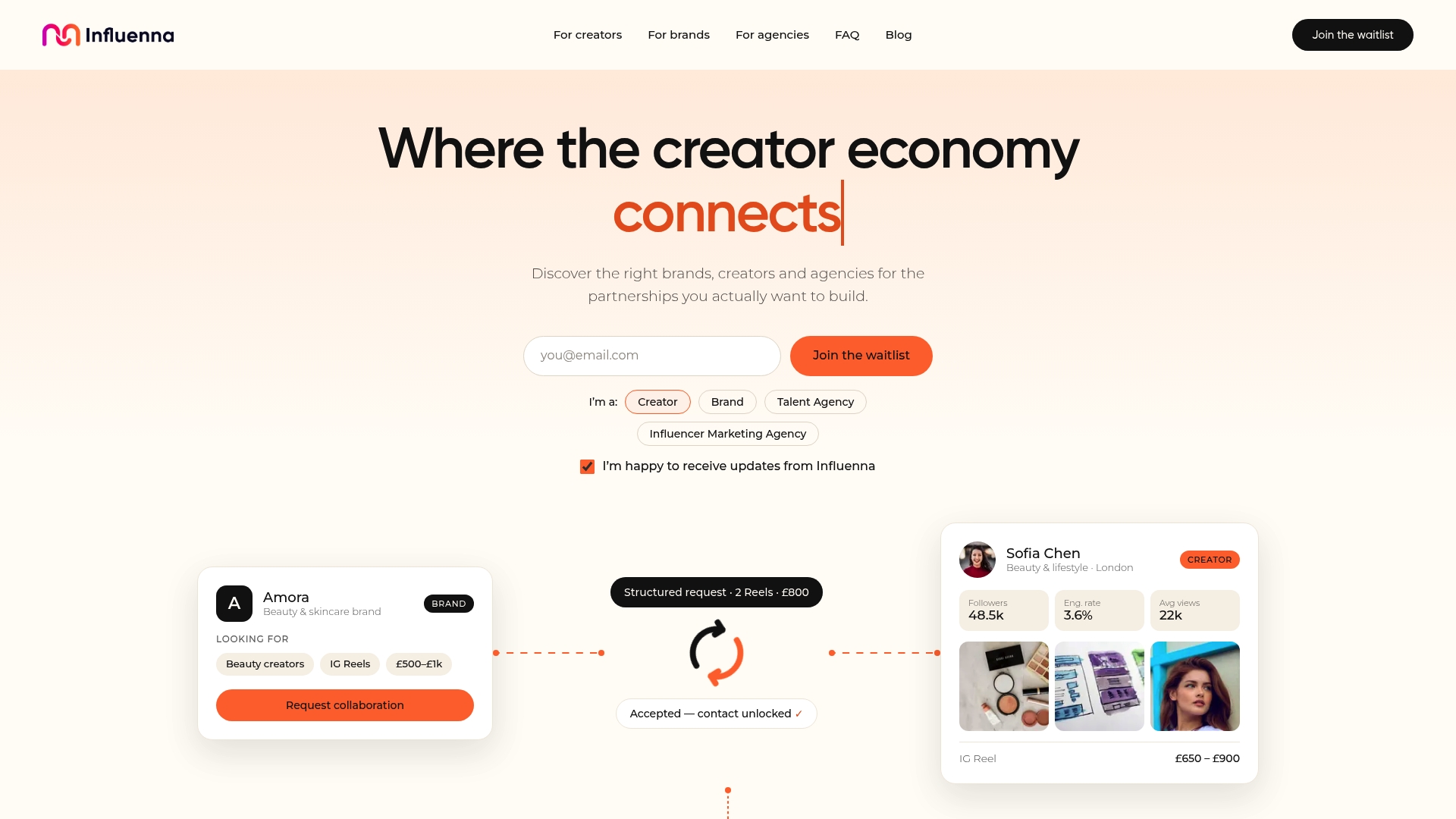
Contact details only exchange once both sides approve the request, so the creators who respond are already interested in the terms you've laid out, not fielding a mass outreach blast. The marketplace does not broker the deal or take a cut. It makes the connection, and the agreement, contract, rate, and every clause you've read about here, stays a direct conversation between you and the creator. If you're building out a roster of partners to negotiate with over the coming quarter, join the Influenna waitlist to get marketplace access when it opens.
Sources
- How to Negotiate Influencer Rates | Sprout Social
- Influencer Pricing: The Cost of Influencers in 2026 - Shopify
- Creator negotiation worksheet and pricing chart | Ad Age
- The Negotiation Mistake Driving Higher Influencer Rates | Forbes
FAQ
What rates should I charge as an influencer?
Rates vary widely by platform, niche, and engagement rate rather than follower count alone. Most creators and brands anchor to an engagement-based formula or a CPM check against past post performance, detailed in Shopify's pricing guide, rather than a single industry-wide number.
How do I ask an influencer for their rates?
Ask directly for their media kit or rate card and specify the deliverable, platform, and usage rights you need upfront, since vague requests produce vague, inflated quotes. A structured request that states budget range and deliverables together tends to get a faster, more accurate response.
What are some effective ways to negotiate with influencers?
The most effective methods are bundling deliverables for a volume discount, adjusting scope instead of cutting the base rate, and offering hybrid base-plus-performance pay. Pricing usage rights and exclusivity as separate line items, rather than folding them into one number, also prevents the most common disputes later.
How many influencers make over $100,000?
Reliable, verifiable figures on income distribution across the full creator population aren't publicly available in a form specific enough to state here. What's better documented is that pay scales sharply with engagement quality and niche, not follower count alone.
How long should I expect an influencer rate negotiation to take?
Most micro and mid-tier negotiations conclude within a handful of business days across two to four exchanges. Macro creators working through a manager typically take longer, since contracts and approvals route through a third party.