Earned Media Value for Marketing Teams: 30 Day Tracking & 2026 CPMs
11 min read

Earned media value (EMV) estimates the advertising cost equivalent of the organic reach and engagement an influencer generates. It's a benchmarking tool for awareness campaigns and stakeholder reporting, not a substitute for revenue-based ROI. Use it to compare creators and justify budget, never to claim it as profit.
TL;DR:
- EMV effectively benchmarks influencer reach and engagement but should not be used to claim direct revenue or profit figures.
- Calculating EMV involves three main formulas—reach-based, engagement-based, and hybrid—with the hybrid approach recommended for most reporting.
- To accurately assess campaign impact, layer EMV with attribution tools like unique codes and UTM links, and track data for at least 30 days post-posting.
- EMV is most reliable when paired with full cost and conversion data, with caution to avoid ending measurement windows too early or relying on a single formula.
- Smaller influencers generally yield higher EMV-to-spend ratios for awareness, while larger creators provide scale but lower efficiency per dollar.
Table of Contents
- What Earned Media Value Means for Influencer Campaigns
- Calculating EMV: Formulas, a Worked Example, and Benchmarks
- Layering EMV With Attribution for Campaign Reporting
- Where EMV Falls Apart: Limitations and Misuse
- Setting Expectations: CPM, Creator-Tier, and EMV-to-Spend Benchmarks
- How Long to Track EMV and What to Capture
- How Influenna Approaches Better EMV Measurement
- The Real Problem With How Marketers Use EMV
- Sources
- FAQ
What Earned Media Value Means for Influencer Campaigns
EMV translates unpaid exposure into a dollar figure by asking a simple question: what would it cost to buy this same reach and engagement as an ad? If a creator's post reaches tens of thousands of people organically, EMV puts a price tag on that reach based on what a comparable ad buy would run.
The metric earns its keep in specific situations. Brand awareness campaigns, creator benchmarking, and executive reporting all benefit from a single number that translates "impressions and likes" into a budget line finance people already understand. EMV is a weak fit for direct-response campaigns where sales are the goal.
Treat EMV as one input among several:
- It helps compare creator tiers on a consistent scale.
- It gives non-marketing stakeholders a familiar unit (dollars) instead of raw engagement counts.
- It contextualizes spend against ad-equivalent value, especially for gifted or barter collaborations.
- It does not measure revenue, retention, or conversion impact on its own.
HubSpot's guidance on earned media value is blunt about this: EMV is an advertising equivalent, and it only tells the full story when paired with ROAS, conversion rate, and lifetime value.
Calculating EMV: Formulas, a Worked Example, and Benchmarks
Three formulas dominate practical use, and each serves a different purpose.
Reach-based formula: (Impressions ÷ 1,000) × CPM. This works when impression data is reliable and you want a quick apples-to-apples comparison against paid media rates.
Engagement-based formula: assigns a dollar value to each like, comment, share, or save, then sums the total. This version rewards content that actually moves people, not just content that gets seen.
Hybrid formula: blends reach and engagement, then applies a quality or sentiment multiplier. Nowadays' 2026 benchmark guide recommends the hybrid approach for stakeholder reporting because it resists inflation from passive views alone.
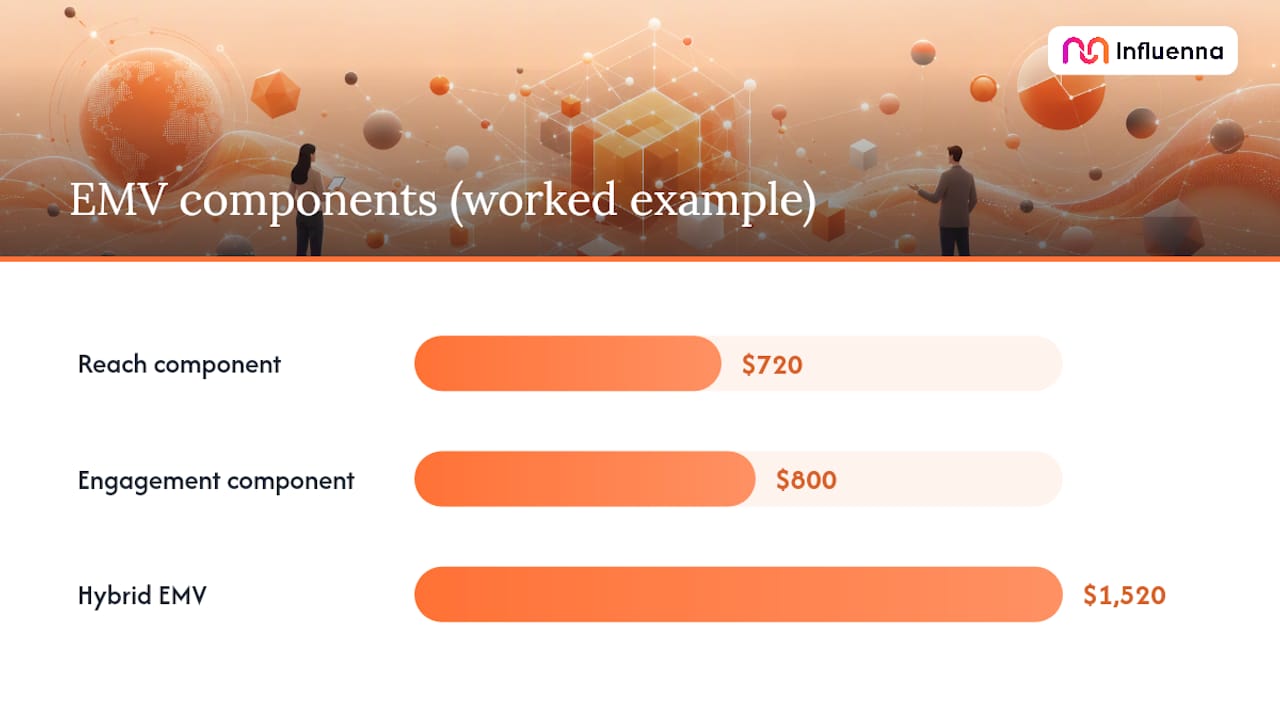
Here's a worked example. A creator's post generates 80,000 impressions and 3,200 engagements. At a $9 CPM, the reach component is (80,000 ÷ 1,000) × $9 = $720. If each engagement is valued at $0.25, the engagement component adds $800. A hybrid EMV lands around $1,520, before any quality multiplier.
| Platform/Tier | Typical CPM | EMV Per Post Range |
|---|---|---|
| TikTok | $9 average | $800 (micro) |
| $9 CPM range | $600 (micro) | |
| YouTube | $15 maximum | $1,200 (mid-tier) |
| $10 minimum | $500 (nano to micro) | |
| X (Twitter) | $5–$10 | $300 (nano to micro) |
Figures reflect platform CPM and EMV benchmarks reported for 2026.
Pro Tip: Run all three formulas on your last three campaigns before picking one. The gap between reach-based and engagement-based EMV tells you whether your audience is scrolling past your content or actually stopping for it.
Layering EMV With Attribution for Campaign Reporting
EMV alone doesn't survive a budget review. Pair it with a tracking stack that shows what actually happened after the post went live.
- Use unique promo codes per creator to isolate direct sales.
- Add UTM-tagged links for every collaboration, tracked through your campaign reporting workflow.
- Pull data from platform-native shop tags where available (TikTok Shop, Instagram Shopping).
- Run post-purchase surveys asking how customers heard about you.
- Where budget allows, test incrementality with holdout audiences to isolate the campaign's true lift.
Storika's ROI framework recommends layering multiple attribution methods because no single one captures the full picture, and calculating ROI against a fully loaded cost base, not just the creator fee. A tool from the attribution technology space can help automate this stack once you're running more than a handful of creators at once.
When you present numbers to finance, label EMV clearly as an estimate, show your formula and assumptions, and state the measurement window. A report that mixes EMV and revenue in the same line item without labels invites the wrong questions in the wrong meeting.
Where EMV Falls Apart: Limitations and Misuse
EMV is an advertising-cost equivalent, not revenue. Reporting it as if it were profit is the single most common misuse, and it's the fastest way to lose credibility with finance.
- Don't judge a campaign on a 48-hour window. Organic content keeps generating reach well past the first few days.
- Don't rely on one formula. Reach-only EMV inflates passive-view campaigns; engagement-only EMV underweights sheer visibility.
- High EMV paired with low conversion usually signals an audience mismatch, not a broken funnel. Check sentiment and purchase intent before assuming the creator failed.
- Validate EMV claims with cohort tracking, incrementality tests, and post-purchase surveys rather than treating the estimate as the final word.
A meta-analysis of 1,531 effect sizes across 251 studies found that post content and influencer characteristics strongly moderate purchase behavior. In practice, that means two creators with identical EMV can produce wildly different sales, depending on content quality and audience fit.
Setting Expectations: CPM, Creator-Tier, and EMV-to-Spend Benchmarks
Benchmarks vary by platform and creator tier, and objective matters as much as size.
- Verified 2026 cost ranges run roughly $5 to $25 CPM, $0.15 to $0.50 CPE, $2 to $15 CPA for seeding, and $20 to $80 CPA for paid influencer placements, according to Storika's measurement framework.
- Nano and micro creators often deliver a higher EMV-to-spend ratio because fees are lower relative to engaged reach, while mega influencers deliver scale but thinner efficiency per dollar. The meta-analytic review backs this up: smaller influencers tend to drive higher engagement, while larger ones move purchase intent more.
- Awareness campaigns tolerate lower EMV-to-spend ratios than conversion campaigns, where you need engagement dollars translating into measurable revenue.
Matching creator tier to campaign objective before you negotiate rates saves you from comparing a nano creator's engagement efficiency against a mega creator's reach on the wrong axis. Budget planning gets easier once you set EMV-to-spend targets by tier rather than applying one blanket ratio across every creator size.
How Long to Track EMV and What to Capture
- Track daily for at least 30 days. Organic content keeps generating impressions and engagement well past the first week, and ReferralCandy's tracking guidance points to a long organic tail that a 48-hour snapshot simply misses.
- Log impressions, reach, engagements, clicks, and conversions daily or weekly, so you can see the tail rather than guess at it.
- Capture full costs, including product, shipping, labor hours, and any agency fees, before calculating a final ROI figure.
Pro Tip: Set a recurring calendar reminder at day 7, day 14, and day 30 to pull fresh numbers. Campaigns that look flat at day 7 often show a second engagement spike once a creator's audience shares the content into new circles.
How Influenna Approaches Better EMV Measurement
Cleaner inputs produce cleaner EMV numbers. When creator discovery is curated rather than cold-DM chaos, the resulting partnerships tend to fit the brand and audience better, which reduces the noisy mismatches that skew EMV comparisons across creators.
Structured collaboration requests ask for deliverables and tracking expectations upfront, rather than leaving them to be negotiated after the content ships. That structure reduces the missing-data gaps that make post-campaign EMV calculations unreliable.
Use EMV as one input for choosing creators, not the only one. Layer it with the revenue attribution methods above, and let curated discovery handle the fit problem EMV formulas can't solve on their own.
The Real Problem With How Marketers Use EMV
Most EMV criticism misses the actual problem. EMV isn't a bad metric. It's a metric asked to do a job it was never built for. The complaint that "EMV is just a vanity number" usually comes from someone who tried to report it as revenue and got called out for it.
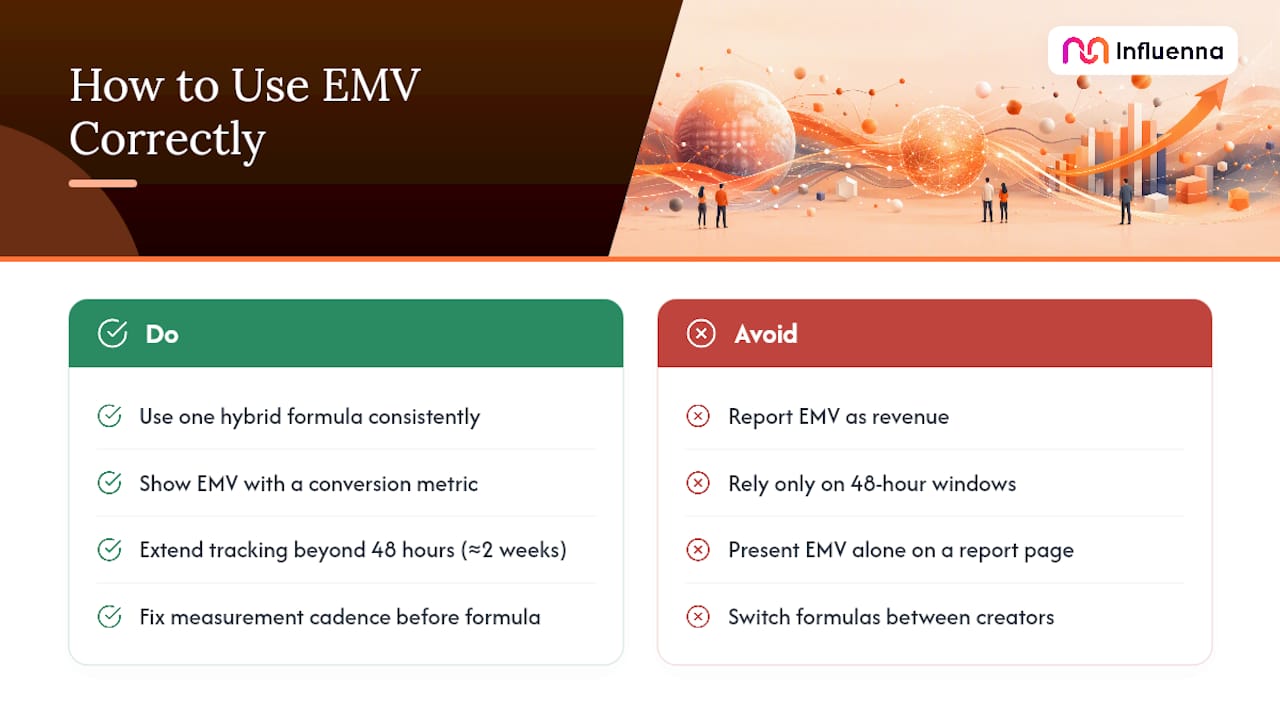
The conventional advice tells marketers to "pair EMV with other metrics," which is true but useless without specifics. What actually works is narrower: pick one formula, the hybrid version, apply it consistently across every creator you compare, and never let it appear in a report without a conversion metric sitting next to it on the same page.
The bigger failure isn't the formula. It's tracking windows that end at 48 hours, when the real story is often still unfolding two weeks later. Fix your measurement cadence before you fix your formula. A precise EMV number calculated on a fifth of the actual data isn't precise. It's just wrong with more decimal places.
— Igor
Sources
- Influencer marketing effectiveness: A meta-analytic review (Journal of the Academy of Marketing Science)
- Earned Media Value (EMV): How to Calculate It With 2026 Benchmarks - Nowadays
- How to measure influencer marketing ROI: A practical framework for 2026 (Storika)
- How to track influencer campaign performance (ReferralCandy blog)
- Maximize your marketing with earned media value (HubSpot)
FAQ
What Is Earned Media Value in Influencer Marketing?
EMV estimates the advertising-spend equivalent of the organic reach and engagement an influencer generates for a brand, expressed as a dollar figure. It's used for benchmarking and reporting, not as a direct revenue measure.
How Much Does an Influencer With 1,000,000 Followers Make?
Earnings vary widely by platform, engagement rate, and deal structure, and no single figure applies universally. Rates typically scale with the CPM and CPE benchmarks noted above, applied to that creator's actual reach and engagement rather than raw follower count.
What Is the 5-3-2 Rule on Instagram Marketing?
The 5-3-2 rule is a content-mix guideline suggesting a weekly posting cadence split across curated or third-party content, original brand content, and personal or engagement-driven posts. Definitions of the exact split vary across sources, so treat it as a starting framework rather than a fixed standard.
What Are the Four Types of Influencers?
Influencers are commonly grouped by audience size into nano, micro, macro, and mega tiers. Nano and micro creators tend to deliver stronger engagement rates, while macro and mega creators tend to drive stronger reach and purchase-intention effects, according to the meta-analytic review of influencer effectiveness studies.
How Long Should You Track EMV After a Campaign Goes Live?
Track engagement and EMV daily for an extended period after posting, generally at least 30 days, as organic content often continues generating reach and value well beyond the initial days after posting.