Influenna First: Best Influencer Marketplaces for Brands & Agencies
17 min read

This platform leads this list for brands and agencies that want vetted creators and structured, private introductions instead of cold outreach. Upfluence, CreatorIQ, Shopify Collabs, and Meltwater round out the shortlist for ecommerce attribution, enterprise scale, and reputation-sensitive campaigns. The rest of this guide breaks down a comparison table, a demo checklist, and the platform types that actually match specific campaign goals.
TL;DR:
- Curated marketplaces like Influenna ensure higher match quality by reviewing all accounts before access and using structured collaboration requests to reduce spam.
- Platforms such as Upfluence and Shopify Collabs directly link creator activity to sales data, making revenue attribution more accurate and reliable.
- Enterprise solutions like CreatorIQ and Meltwater are best suited for large-scale, multi-market programs requiring compliance, monitoring, and detailed reporting.
- Speed of onboarding varies greatly, with open marketplaces providing instant access while curated and enterprise platforms involve delays due to human review and setup.
- Verifying the provenance of audience data is crucial, as platforms that cannot clearly explain whether numbers are verified, estimated, or self-reported pose higher long-term risks.
Table of Contents
- What Are the Best Influencer Marketplaces Right Now?
- How Do These Platforms Actually Compare?
- How Should You Choose the Right Platform for Your Team?
- Which Platform Type Actually Fits Your Campaign?
- Why Curation and Structured Requests Change the Match Quality
- What Should You Expect From Onboarding on These Platforms?
- How Do You Judge Support Quality Before You Commit?
- What Do Successful Campaigns on These Platforms Look Like?
- Can These Platforms Scale With Your Campaign Size?
- What the Research Actually Supports (and What It Doesn't)
- Ready to Try a Curated Marketplace? Here's What to Prepare
- Sources
- FAQ
What Are the Best Influencer Marketplaces Right Now?
Picking the right platform depends less on brand recognition and more on what your campaign actually needs: verified reach, sales attribution, compliance controls, or simply a faster way to find creators who want to work with you. Here's the shortlist worth putting in front of your team.
Influenna sits at the top of this list because it solves a problem most marketplaces ignore: noise. Every creator, brand, and agency account gets reviewed by a person before it can access the marketplace. Instead of cold DMs, members send structured collaboration requests with clear terms up front, and contact details only unlock once both sides say yes. For teams tired of chasing media kits or fielding spam pitches, that structure changes the entire intake experience.
- Upfluence pairs discovery with deep ecommerce integrations, letting brands attribute sales directly to individual creators rather than guessing from reach alone.
- Sprout Social Influencer Marketing folds influencer workflows into the same suite teams already use for social publishing and listening, which cuts down on tool-switching for lean marketing teams.
- Brandwatch pairs social listening with influencer discovery, a fit for comms teams who need to know how a partnership will land before it goes live.
- Afluencer offers a lightweight marketplace for brands that want fast, low-friction matches without a long procurement cycle.
- GRIN functions more like a creator CRM, built for brands running long-term ambassador programs rather than one-off campaigns.
- LTK stays retail-native, built around affiliate links and shopper-facing storefronts for commerce-heavy partnerships.
- Influencity runs on scale, with a large profile database and filtering built for teams doing high-volume discovery.
- Shopify Collabs ties creator collaboration directly into merchant storefronts, which suits Shopify sellers who want commerce and creator outreach in one place.
- YouTube BrandConnect focuses on long-form video deals, useful when a campaign depends on a creator's YouTube audience specifically.
- Meltwater blends media intelligence with influencer discovery, built for global teams tracking brand sentiment alongside partnerships.
- CreatorIQ targets enterprise programs, with compliance tooling and integrations built for multi-market scale, and it's been named an enterprise leader by IDC MarketScape.
How Do These Platforms Actually Compare?
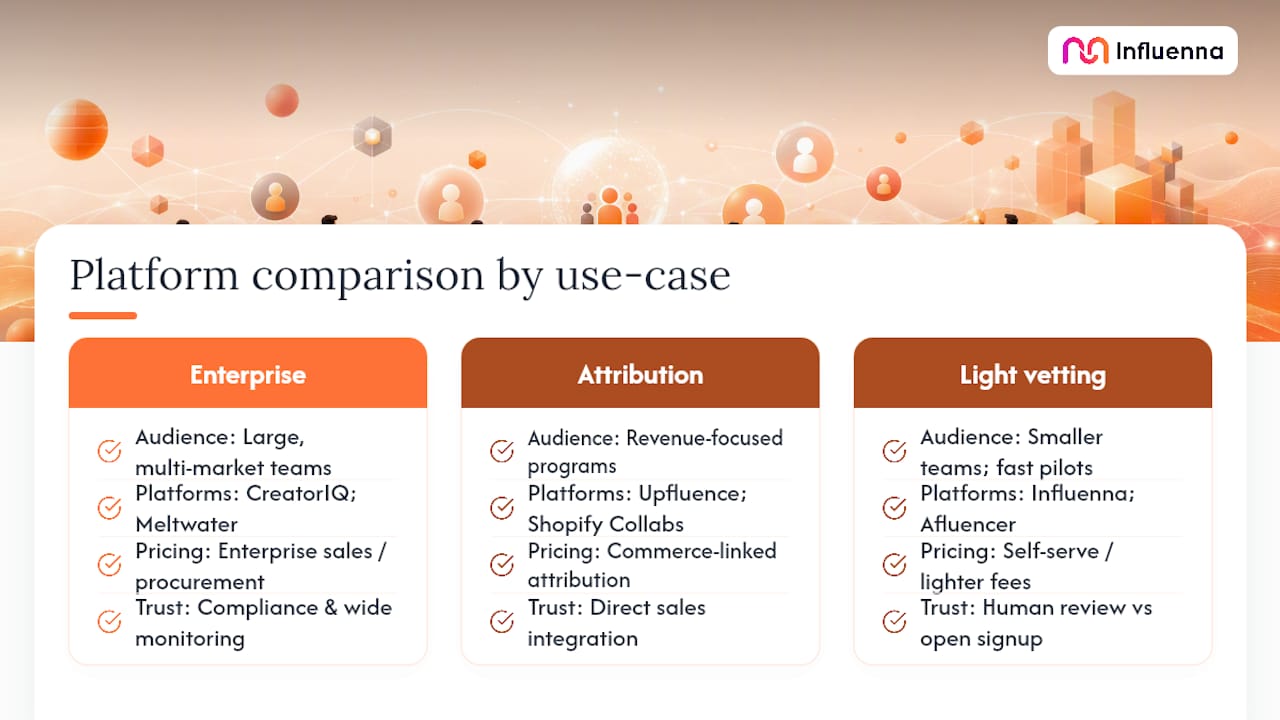
Before you book a single demo, it helps to see these platforms side by side on the dimensions that actually predict whether a partnership works: who they're built for, how they charge, and how they handle trust.
Influencer marketing platforms have shifted from optional add-ons to core infrastructure, part of why Sprout Social's roundup frames platform choice as a measurable, scalable workflow decision rather than a nice-to-have. Brands increasingly allocate real budget toward vetting and measurement tools as programs mature past their first few campaigns, which is exactly why the wrong platform choice compounds over time instead of just costing you one bad quarter.
Three quick reads on where to start your demo list:
If you're running enterprise, multi-market programs, start with CreatorIQ and Meltwater. Both carry the compliance depth and monitoring range large teams need, and CreatorIQ's enterprise positioning gives procurement teams a third-party reference point to lean on.
If revenue attribution is the whole point of the campaign, Upfluence and Shopify Collabs deserve the first demo slot. Both tie creator activity directly to sales data instead of forcing your team to reconstruct attribution from UTM codes after the fact.
If you want vetted partners without an enterprise sales cycle, Influenna and Afluencer sit at the lighter end of the spectrum. Influenna's human review process adds a filtering step Afluencer's open signup doesn't, which matters more the higher your brand risk tolerance is.
How Should You Choose the Right Platform for Your Team?
Most procurement mistakes in this category come from evaluating features before evaluating fit. Start with what your campaign actually requires, then filter platforms against that list, not the other way around.
Run your evaluation against these criteria:
- Campaign objective. Awareness, sales attribution, and long-term ambassador programs favor different platforms entirely.
- Audience data provenance. Ask whether follower and engagement numbers are verified, estimated, or self-reported. Blended or unclear provenance is a red flag.
- Required integrations. If you're on Shopify or run affiliate codes, integration depth matters more than database size.
- Reporting and attribution needs. Decide upfront whether you need per-creator sales attribution or just reach and engagement summaries.
- Creator management workflow. CRM-style tracking suits ongoing programs; a simple matching flow suits one-off campaigns.
- Budget and fee model. Subscription, commission, and enterprise licensing all shift your total cost differently as campaign volume grows.
- Legal and disclosure workflow. Confirm the platform supports FTC-style disclosure requirements and contract terms your legal team will accept.
On the actual demo call, work through this checklist:
- Can you export raw campaign data, or only platform-generated reports?
- How is sales attribution calculated, and what happens when a creator posts across multiple platforms?
- What does the creator opt-in process look like, and can creators set their own rates and preferences?
- Is contact information exchanged only after mutual approval, or can any account browse it freely?
- How are payments processed, and does the platform hold funds in escrow?
- What service-level agreements exist for support response times?
- What's the refund or dispute process if a creator doesn't deliver?
Pro Tip: Ask every vendor directly how they source audience data. A platform that can't explain whether a number is verified, estimated, or self-reported is often relying on scraped or purchased databases. That's your clearest red flag, and it's also your best negotiation lever. Vendors who can't answer clearly tend to move on price fast when you point out you're comparing them against ones who can.
Which Platform Type Actually Fits Your Campaign?
Not every platform in this category is solving the same problem, and sorting them by type makes the shortlist easier to navigate than sorting by name recognition.
- Open marketplaces run on free or low-barrier signup, so discovery is fast but vetting is thin. Afluencer fits here: good for quick, low-stakes matches, weaker for brand-safety-sensitive campaigns.
- Curated marketplaces add a human review layer before accounts get access. Influenna fits this category, screening creators, brands, and agencies before they can send or receive requests, which slows initial access slightly but raises the quality of every connection that follows.
- Ecommerce-native collaboration tools build creator workflows directly into a commerce platform. Shopify Collabs and LTK both fall here, connecting creator content to storefronts so sales tie back to a specific partnership.
- Enterprise influencer suites prioritize compliance, integrations, and scale over speed of matching. CreatorIQ and Meltwater sit in this bracket, built for teams running dozens of campaigns across multiple markets at once.
A product launch on Shopify calls for an ecommerce-native tool. A multi-year ambassador program calls for CRM depth like GRIN offers. A performance-driven, direct-response push calls for attribution-first tools like Upfluence. Matching type to scenario before you demo saves a genuine amount of back-and-forth with your team later.
Why Curation and Structured Requests Change the Match Quality
I've spent enough time watching brand teams manage influencer outreach to notice the same failure pattern repeat: open inboxes flooded with generic pitches, media kits that never arrive, and creators who ghost after three messages. Curated marketplaces exist specifically to interrupt that pattern.
This platform's approach is built around two mechanics worth understanding on their own terms. First, every account, whether creator, brand, talent agency, or influencer marketing agency, goes through human review before it gets marketplace access. Second, instead of cold DMs, members send structured collaboration requests that include real details upfront, and unanswered requests simply expire after 14 days rather than sitting in limbo.
Picture a mid-size skincare brand searching for three TikTok creators for a spring launch. Instead of scanning hundreds of open profiles and guessing at rates, the brand filters for relevant creators, sends structured requests stating budget range and deliverables, and only exchanges contact details once a creator opts in. That structure alone removes most of the back-and-forth that usually eats the first two weeks of a campaign timeline.
A human-reviewed, curated marketplace shortens the path to a meaningful first conversation because both sides walk in with clearer intent, and rates, already on the table.
What Should You Expect From Onboarding on These Platforms?
Onboarding speed varies more than most brand teams expect going in. Open marketplaces like Afluencer tend to let you start browsing and messaging within minutes of signup, since there's no review step standing between registration and access.
Curated platforms trade some of that speed for quality control. This platform's model requires every application to pass human review before marketplace access unlocks. This adds a short wait but filters out low-intent or fake accounts before they ever reach your inbox. Enterprise suites like CreatorIQ and Meltwater sit at the other extreme entirely, often involving a sales process, onboarding calls, and account configuration that can stretch onboarding into weeks rather than days.
For agencies managing multiple brand clients or creator rosters, look specifically at whether a platform supports one account acting on behalf of several managed relationships. This platform's structure allows agencies to represent the creators and brands they manage from a single account, rather than juggling separate logins for every client relationship. That distinction matters more once you're managing five or ten client accounts instead of one, and it's worth asking about explicitly on any enterprise demo, since not every platform handles multi-client management the same way.
How Do You Judge Support Quality Before You Commit?
Support quality is hard to evaluate from a sales deck, so test it directly during your evaluation window. Send a real question to the support channel before you sign anything, and time how long it takes to get an answer that actually addresses your question.
Enterprise platforms like CreatorIQ and Meltwater typically assign dedicated account managers, which suits teams running high campaign volume but adds cost that smaller teams may not need to carry. Mid-market tools often rely on shared support queues or knowledge bases, which work fine for straightforward questions but can slow down when something breaks mid-campaign.
Ask directly about service-level agreements for response time, and ask what escalation looks like if a payment or contact-exchange issue comes up during an active campaign. A platform that can't give you a specific answer on escalation is telling you something about how they'll handle a real problem later. It's also worth asking whether support differs for creators versus brand accounts. On a four-sided marketplace where creators, brands, talent agencies, and influencer marketing agencies all need support, the quality of that experience on both sides of a match affects how quickly a collaboration actually gets off the ground.
What Do Successful Campaigns on These Platforms Look Like?
Success stories in this category cluster around a few repeatable patterns rather than one-size-fits-all wins. Ecommerce brands using Upfluence's attribution tools typically report success in terms of per-creator revenue, tying specific sales back to specific partnerships instead of relying on vague reach numbers.
Retail brands on LTK tend to measure success through affiliate conversion, since the platform's storefront model is built around shoppable content from the start. Enterprise programs on CreatorIQ often frame success around scale and consistency: running the same quality of vetting and compliance across dozens of markets rather than one standout viral moment.
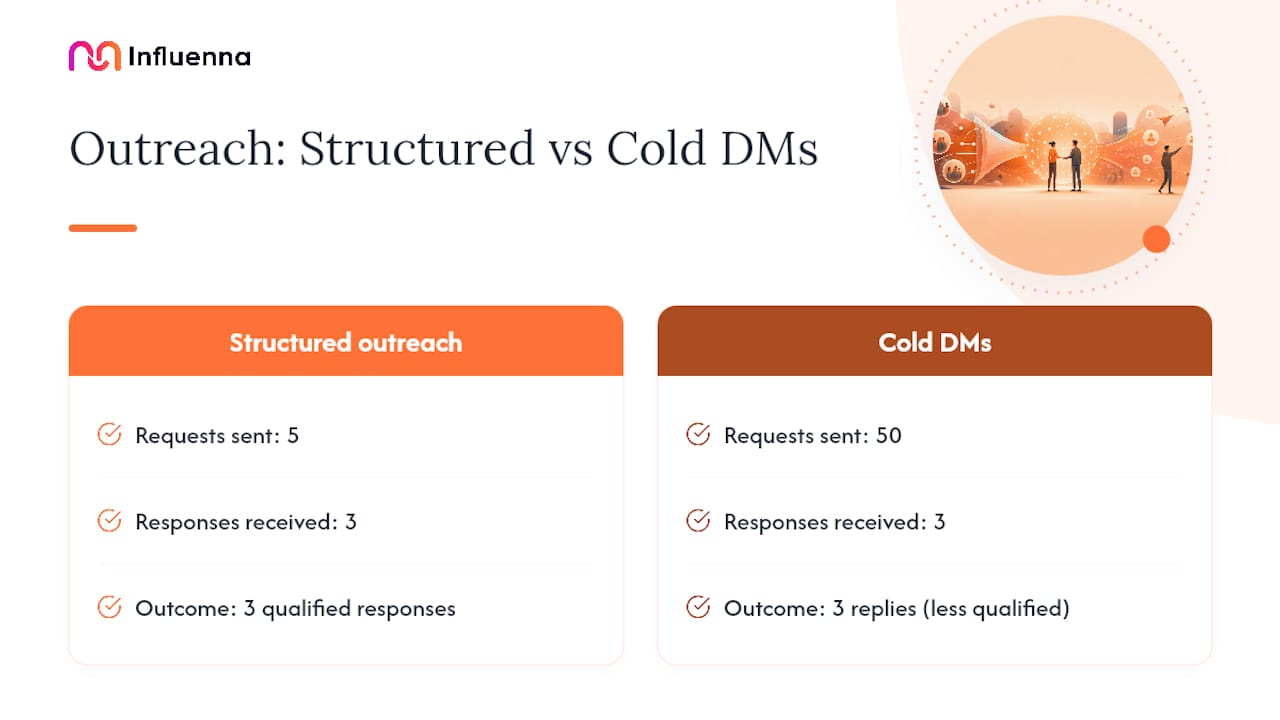
For curated platforms, the success signal looks different. It's less about a single breakout campaign and more about the reduction in wasted outreach. A brand that sends five structured requests and gets three qualified responses has a fundamentally better hit rate than one that sends fifty cold DMs and gets three replies, even though the raw output number is smaller. That efficiency gain is the actual return on curated marketplaces, and it shows up in time saved more than in a single flashy metric.
Can These Platforms Scale With Your Campaign Size?
Platform scalability isn't just about handling more creators. It's about whether the workflow still makes sense once your campaign volume triples. A tool that works beautifully for one campaign a quarter can fall apart under ten simultaneous campaigns if it lacks the reporting and management layer to keep them organized.
Enterprise suites like CreatorIQ and Meltwater are built explicitly for that kind of scale, with compliance tooling and multi-market support baked into the core product rather than bolted on later. That depth comes at a cost that smaller teams often can't justify until their program grows into it.
Mid-size platforms like GRIN and Influencity scale reasonably well for brands moving from occasional campaigns into always-on programs, particularly once a brand's creator roster grows past a handful of regular partners. Curated marketplaces like Influenna scale differently: the structure holds steady whether you're sending five requests a month or fifty, since the review and request process doesn't change shape as volume grows. What does change is the range of partners available to you as more creators, brands, and agencies join, which is a scaling dimension worth asking about directly if your program is still in its early stages.
What the Research Actually Supports (and What It Doesn't)
Most guides in this category rank platforms by feature count, which is the wrong lens. A platform with more filters isn't automatically the better fit. The real differentiator is whether the platform's trust model matches your brand's risk tolerance, and that's the piece conventional advice skips entirely.
Open marketplaces optimize for speed and volume. Enterprise suites optimize for compliance and scale. Curated marketplaces optimize for signal quality, filtering out the noise before it ever reaches your inbox. None of these is universally "best." The mistake brand teams make is picking based on brand name recognition instead of matching platform type to actual campaign risk and complexity.
If I had to prioritize one thing for a brand manager reading this before their first demo, it would be this: ask about data provenance before you ask about pricing. A platform that can't clearly explain whether its audience numbers are verified, estimated, or self-reported is a bigger long-term risk than a slightly higher subscription fee. Everything else on the checklist matters, but that one question filters out more bad vendor fits than any other single line item.
— Igor
Ready to Try a Curated Marketplace? Here's What to Prepare
This platform gives you something most open marketplaces can't: every account on the other side of a match has already been reviewed by a person, and no contact details change hands until both sides say yes. That's the direct trade-off against the cold-DM chaos most brand managers deal with daily. Instead of guessing at a creator's intent or fielding pitches with no context, you send a structured request with your budget and deliverables already on the table.
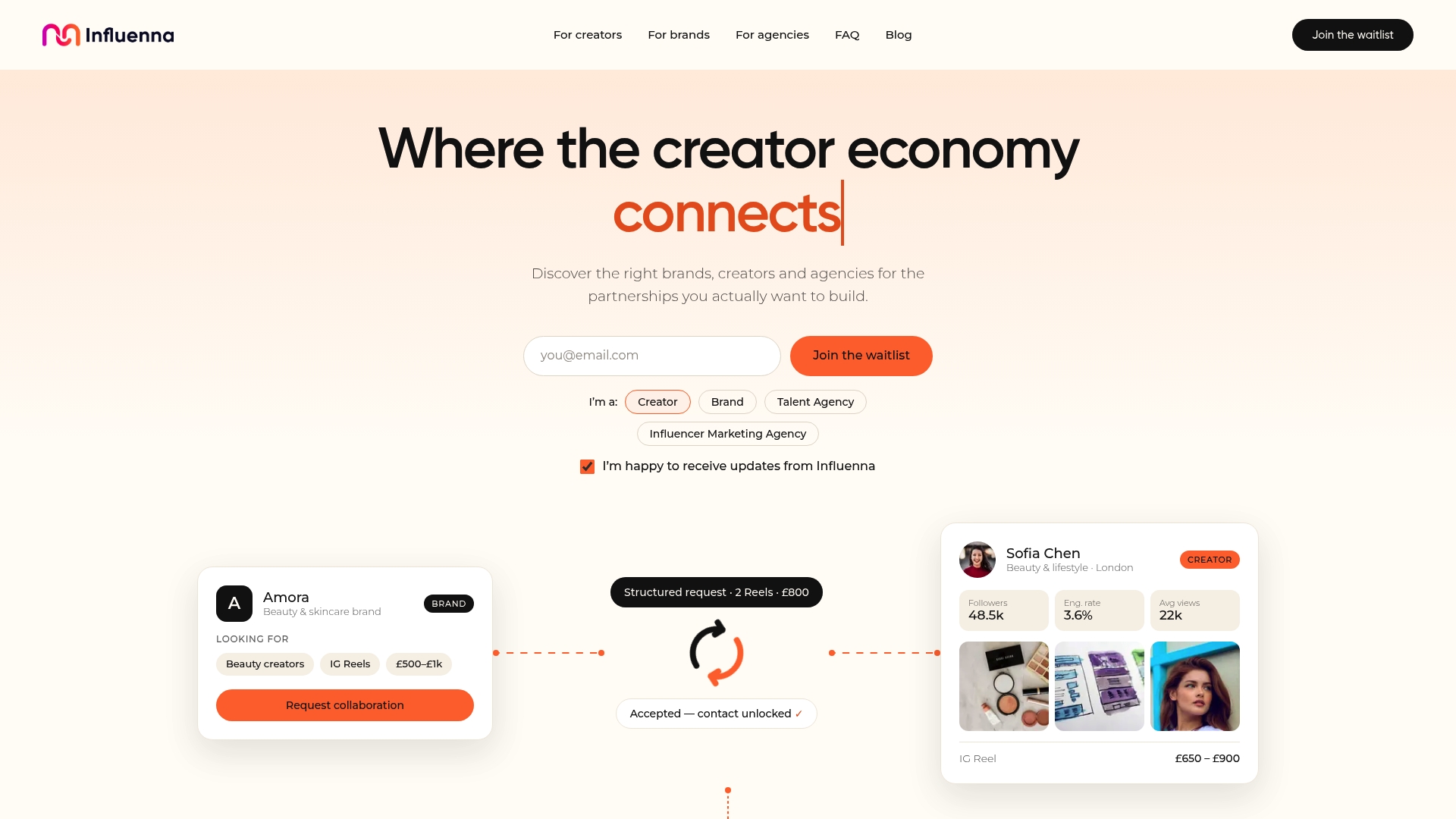
Before you join the waitlist, get three things ready: a clear campaign objective (launch, ambassador program, or performance push), a rough audience profile for the creators you want to reach, and one example brief you'd actually send. Having that ready means you can move the moment marketplace access opens, rather than figuring it out from scratch. For budgeting reference points before that conversation, this influencer marketing budget method breaks down typical fee structures by campaign size.
Join the Influenna waitlist to get early access once your account type opens up.
FAQ
What Are Some Good Marketplaces for Influencers?
Influenna, Upfluence, GRIN, LTK, Shopify Collabs, and CreatorIQ each serve different needs, from curated private introductions to enterprise-scale program management. The right choice depends on whether you need vetted creators, sales attribution, or large multi-market compliance support.
How Many Influencers Make Over $100,000?
Publicly available figures on creator earnings vary widely by platform, niche, and audience size, and no single reliable figure covers the full creator economy. Treat any specific dollar-threshold claim you see elsewhere with caution unless it cites a named, dated source.
What Are the Top Influencer Niches?
Beauty, fitness, fashion, food, tech, gaming, parenting, travel, finance, and home decor consistently rank among the most active influencer categories across major platforms. The strongest niches tend to combine high engagement rates with clear purchase intent, which is why beauty and fitness content performs so well for ecommerce-attributed campaigns.
How Do I Know If a Marketplace's Audience Data Is Trustworthy?
Ask whether follower and engagement numbers are labeled as verified, estimated, or self-reported, and be wary of any platform that blends these into one unlabeled figure. Platforms that separate this data by provenance, rather than presenting a single blended number, give you a clearer picture of real audience quality.
Is a Curated Marketplace Better Than an Open One for Brand Safety?
Curated marketplaces add a human review step before accounts gain access, which filters out low-intent or fake profiles before they reach your inbox. Open marketplaces move faster but require your team to do more vetting manually, which shifts the brand-safety workload onto you instead of the platform.