4 Step Creator Brand Fit Workflow Brands Must Run Before Outreach
14 min read

Creator brand fit is the measurable match between a creator's audience, tone, and values, and a brand's identity and campaign goals. It's not follower count and it's not vibes. If you manage influencer partnerships, the immediate move is to build a campaign-specific fit checklist and run every candidate through a quick first-pass score before anyone drafts an outreach message. The rest of this guide shows you exactly how.
TL;DR:
- Follower count measures reach, not relevance; a smaller creator with highly aligned content and audience can outperform a larger, less relevant influencer.
- Evaluating audience overlap and comment keywords provides a clearer picture of relevance and topical fit than surface-level demographic data.
- Prioritizing creator's content format, disclosure history, and engagement quality ensures compliance and authentic collaboration success.
- Establishing campaign-specific fit criteria before outreach helps prevent mismatched partnerships and streamlines vetting.
- Regularly reassessing creator fit after campaigns can maintain relevance and strengthen long-term influencer-brand relationships.
Table of Contents
- What Creator Brand Fit Actually Means
- Why Fit Beats Reach for Campaign Results
- How to Vet Creator Brand Fit Step by Step
- Metrics and Signals That Actually Predict Fit
- Disclosure and Compliance Checks You Can't Skip
- The Campaign Brief and Fit-Assessment Checklist
- Why Influenna Builds Around Fit, Not Follower Count
- Making Fit a Habit, Not a One-Off Checklist
- Find Creators Who Actually Fit Your Brand, Not Just Your Budget
- Sources
- FAQ
What Creator Brand Fit Actually Means
Most teams treat brand fit like a gut check. That's how campaigns end up with a fitness creator hawking a fintech app to an audience that couldn't care less about compound interest.
Real fit has four moving parts. Editorial territory is whether the creator's content already lives near your category. A skincare brand working with a dermatology nurse has editorial fit. The same brand working with a gaming streamer does not, no matter how large that streamer's following looks. Audience overlap measures whether the people watching actually match your buyer profile. Value and image alignment asks whether the creator's public persona, politics, and past brand deals sit comfortably next to your brand identity. Creative execution fit covers something brands underrate constantly: can this creator actually produce the format you need, in the tone you need, without it feeling like a hostage video?
Here's where most vetting breaks down:
- Follower count measures reach, not relevance. A creator with 800,000 followers and a scattershot audience can convert worse than one with 40,000 people who all care about the same three topics.
- Engagement rate alone tells you activity, not affinity. High engagement on unrelated content doesn't transfer to your product.
- Automated compatibility tools, like Sprout Social's Brand Fit Score, score creators using content themes and audience interest data. That's a useful filter, not a verdict. It skips engagement quality and disclosure history entirely. So, treat a high score as a reason to dig deeper, not a reason to sign.
Why Fit Beats Reach for Campaign Results
The case for prioritizing fit over follower count isn't a hunch. It shows up in both academic research and industry surveys.
A peer-reviewed study on brand-influencer relationships found that both functional fit (does the creator's content logically connect to the product category) and image fit (does the creator's persona match the brand's image) raise consumer brand attitude, with functional fit producing the stronger effect. That's the academic version of "relevance beats vibe."
Deloitte's research on creator partnerships found that about 70% of consumers who engage with creators return to them regularly, and a significant portion follow a creator specifically because that creator covers a topic they care about.
That repeat behavior is the whole argument for community-first selection. A smaller, topically locked-in creator with a loyal, returning audience often outperforms a larger creator whose followers showed up for a viral moment and never came back. Industry survey data backs this up outside the lab too: creator suitability now often outranks follower count as a brand's top selection factor, even though follower count still drives most of the pay negotiation. Misfit partnerships don't just underperform. They read as inauthentic to an audience that can smell a mismatched sponsorship from a mile away, and that skepticism transfers to the brand.
How to Vet Creator Brand Fit Step by Step
A workflow beats a vibe check every time. Here's the four-stage process that turns "does this creator seem right?" into a decision you can defend to your CMO.

1. Translate campaign goals into fit criteria. Before you look at a single creator profile, write down what "fit" means for this specific campaign. That means naming the target audience segment, the tone you need (playful, clinical, aspirational), the non-negotiable values your brand won't compromise on, and the deliverable format (a 30-second Reel, a long-form YouTube review, a blog integration). Skipping this step is why teams end up chasing whoever's trending instead of who's right.
2. Shortlist using filters and a Brand Fit Score as a first pass. Use platform search filters for category, audience geography, and platform, then run candidates through an automated compatibility score if you have access to one. Treat a high score as a green light to investigate further, a medium score as a signal to inspect actual posts and engagement trends, and a low score as disqualifying unless the creator has strong niche relevance you can't get elsewhere.
3. Run a content and audience audit. Pull ten to fifteen recent posts and actually watch or read them. Check comment sections for the topics people bring up unprompted. Are commenters mentioning your product category, or are they there for unrelated reasons entirely? This is where topical alignment either confirms itself or falls apart.
4. Qualify through disclosure history, past collaborations, and a short test. Ask for examples of previous sponsored content and confirm the creator disclosed those partnerships properly. A creator who's sloppy about disclosure history is a compliance risk waiting to happen. Consider a small paid test deliverable before committing to a full campaign, especially with a creator you haven't worked with before.
Pro Tip: Ask every shortlisted creator for one recent sponsored post and one recent organic post on the same general topic. If the tone, pacing, and production quality don't match, that's your creative execution answer right there. Don't wait until the brief to find out.
Red flags that should stop the process outright: a creator who can't produce a single example of proper disclosure, comment sections dominated by bot-like engagement, audience demographics that don't remotely track with your buyer profile, or a creator whose recent content pivoted hard away from the category you're hiring them for.
Metrics and Signals That Actually Predict Fit
Numbers matter, but only the right ones, read the right way.
Audience overlap shows up in specific, checkable places. Scan comment sections for the keywords your category cares about. Check whether the creator's stated audience interests (available on most platform analytics dashboards) match your buyer persona, not just demographic age and location.
Engagement quality matters more than engagement quantity. A few signals worth checking:
- Comment sentiment: are people asking genuine questions, or leaving generic emoji spam that suggests bot activity?
- Repeat viewers: does the creator's community return episode after episode, or is each post drawing a fresh, disconnected crowd?
- Watch-time patterns on video: a creator whose audience drops off at the fifteen-second mark isn't going to hold attention through your product mention either.
Content style fit is about format suitability. A creator who's brilliant at fast-cut TikTok humor might flatline doing a slow, narrative YouTube review, and vice versa. Match the creator's strongest format to your deliverable, not the other way around.
One operational note that trips up a lot of teams: audience metrics come labeled as verified, estimated, or self-reported, and those labels matter. Instagram, TikTok, and YouTube numbers aren't directly comparable to each other either, since each platform measures reach and engagement differently. Never blend them into one "average" number when you're building a fit assessment. Reviewing platform-specific audience demographics separately, rather than as a combined average, gives you a far more honest read.
Disclosure and Compliance Checks You Can't Skip
Fit assessment isn't complete until you've confirmed the creator can meet disclosure requirements, because a legally shaky partnership erases whatever fit you've established.
The FTC requires creators to disclose material connections, including payment, free products, or any employment relationship, clearly and conspicuously. Brands share that responsibility. The FTC's endorsement guidance recommends disclosures use plain language like "ad" or "sponsored," placed with the endorsement itself, and never left solely to a platform's built-in disclosure tool.
Bake these into your brief and approval process:
- Specify exact disclosure wording and placement in the brief itself, not as an afterthought.
- Require a review step before content goes live to confirm the disclosure is visible in both audio and video where applicable.
- Ask for examples of past disclosed content during qualification, not after the contract is signed.
- Remember that regulatory definitions of "endorsement" are broad, covering verbal statements, tags, and depictions of likeness, so a casual mention can still count.
Rules vary by country. If your content runs in multiple markets, check each jurisdiction's disclosure standards before launch rather than assuming FTC guidance covers you everywhere.
The Campaign Brief and Fit-Assessment Checklist
A brief that skips fit criteria is how brands end up negotiating with the wrong creator three weeks into outreach. Build these fields into every brief you send:
- Campaign goal: what you're actually trying to achieve (awareness, conversion, community building).
- Target audience segment: demographic and interest profile, specific enough to score against.
- Non-negotiables: values, competitor exclusions, tone requirements.
- Deliverables: exact format, length, and platform.
- Disclosure instructions: wording and placement, specified up front.
- Payment and terms outline: enough detail to avoid a second negotiation round later. A standard influencer brief template can save you from rebuilding this from scratch each time.
Run every shortlisted creator through this quick assessment:
| Check | What you're confirming | Pass/fail or scale |
|---|---|---|
| Audience overlap | Comments and stated interests match your buyer profile | 1 to 5 fit scale |
| Content alignment | Recent posts sit in your editorial territory | 1 to 5 fit scale |
| Past sponsorships | Prior branded work is relevant and well disclosed | Pass/fail |
| Disclosure behavior | Clear, conspicuous disclosure on past sponsored posts | Pass/fail |
| Sample KPI signals | Engagement quality supports your campaign goal | 1 to 5 fit scale |
A creator who fails any pass/fail check gets removed from the shortlist regardless of score elsewhere. Everything else feeds into an average fit score you can compare across candidates side by side.
Why Influenna Builds Around Fit, Not Follower Count
Vetting creator fit takes real work: reviewing content, checking disclosure history, confirming audience overlap. The pattern that shows up across the research is consistent. Suitability, not scale, drives outcomes that last.
Influenna's structure reflects that. Every account, creator, brand, talent agency, or influencer marketing agency, goes through human review before joining, and collaboration requests carry structured details instead of a cold pitch. That format alone forces the kind of upfront clarity a good fit assessment demands: audience specifics, deliverables, and terms, stated before anyone reaches out. Contact information only unlocks once both sides approve, which keeps the vetting process, not the guesswork, in charge of who gets in touch with whom.

Making Fit a Habit, Not a One-Off Checklist
Most teams treat fit assessment as a one-time gate before a campaign launches, then never look at it again. That's a mistake. Audiences shift, creators pivot content categories, and a partnership that fit perfectly a year ago can drift without anyone noticing until performance drops.
The fix is boring but effective: rerun the shortlist criteria every renewal cycle, not just at intake. Fold fit questions into post-campaign reporting alongside the usual KPI review. Teams that treat this as a recurring habit, not a launch checklist, tend to build the kind of repeat partnerships Deloitte's research points to as the real payoff. Try the checklist on your next brief before your next renewal conversation, not after.
— Igor
Find Creators Who Actually Fit Your Brand, Not Just Your Budget
Running the vetting steps above manually, across DMs, spreadsheets, and media kits, is exactly the friction Influenna was built to remove. Instead of guessing at fit from a cold pitch, you get structured collaboration requests that surface the details this checklist asks for upfront: audience specifics, rates, and deliverables, before anyone exchanges contact information.
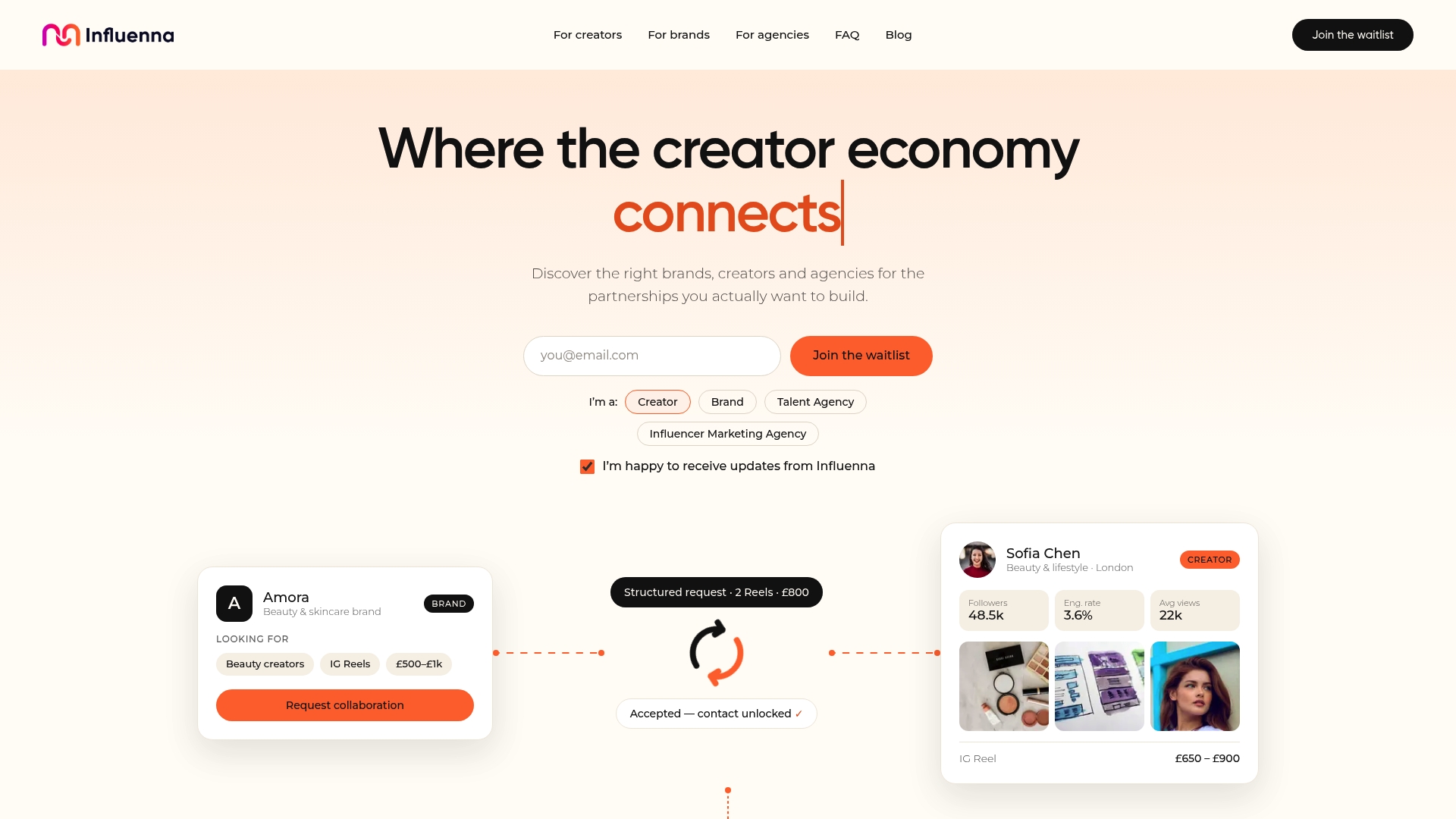
Accounts on the platform are reviewed by a person before going live, which helps reduce fake profiles and mismatched pitches that make cold outreach inefficient. Users can search and filter for partners who match their campaign criteria, send structured requests instead of cold DMs, and unlock contact details only once both sides approve. The platform does not broker deals or take a cut, focusing instead on facilitating worthwhile connections. Join the waitlist to get access when the marketplace opens.
Sources
- FTC — Endorsement guides plain-language brochure
- Seeking effective fit: The impact of brand-influencer fit types on consumer brand attitude (Journal article)
- Federal Register — Guides concerning endorsements and testimonials (2023)
FAQ
What are the five levels of brand recognition?
Brand recognition models typically move from no awareness, to recognition (recall when prompted), to recall (unprompted recall), to top-of-mind awareness, and finally to brand loyalty or insistence. Creator partnerships built on strong fit tend to move audiences up this ladder faster because the association feels native rather than forced.
What is the 5-3-2 rule on Instagram marketing?
The 5-3-2 rule suggests posting five pieces of content curated from others, three original posts about your own brand or expertise, and two personal or off-topic posts, per set of ten. It's a content-mix guideline, not a fit metric, but brands sometimes ask creators to structure sponsored content around a similar rhythm to keep partnerships feeling organic.
Which brands pay influencers?
Brands across categories, including beauty, fitness, consumer tech, finance, and consumer packaged goods, regularly pay creators for sponsored content, and payment scales largely with follower count and platform. Selection, however, increasingly hinges on suitability and topical fit rather than reach alone, which is why smaller, well-matched creators can win deals over larger misaligned ones.
Do influencers get paid money?
Yes, most influencers who work with brands are paid in cash, free products, affiliate commissions, or some combination of the three, depending on the deal structure. Rates vary widely by platform, audience size, and format, and payment terms should always be spelled out clearly in the campaign brief before work begins.
How is Influenna different from cold outreach or a talent agency?
Influenna is a curated marketplace where creators, brands, talent agencies, and influencer marketing agencies apply and get reviewed by a person before joining, rather than a database for mass outreach. Members send structured collaboration requests with real details upfront, and contact information unlocks only after both sides approve, which keeps early conversations focused on fit instead of guesswork.