Brief First: Build a Defensible Influencer Shortlist Marketers Can Trust
17 min read

A shortlist is a decision, not a spreadsheet dump. The deliverable is one recommendation sentence plus 5 to 10 named creators, each with a confidence label and a one-line reason tied to evidence. You get there by writing a brief before you search, pulling a candidate pool of 15 to 20, running a two-pass filter, and scoring what's left against a consistent rubric.
TL;DR:
- Shortlists should be based on a written brief with clear criteria, not just follower counts, to ensure relevance and reduce bias.
- A candidate pool of 15 to 20 creators is recommended to produce a focused, defensible shortlist of 5 to 10 names after filtering.
- Use a two-pass filtering process: quickly eliminate non-eligible creators and then score remaining candidates with weighted criteria, ensuring transparency.
- Confidence labels distinguish verified data from estimates or guesses, with unscored or excluded creators clearly documented to maintain transparency.
- Regularly update the discovery pipeline and review campaign outcomes to refine scoring weights and improve future shortlist accuracy.
Table of Contents
- How Do You Build an Influencer Shortlist Stakeholders Trust?
- Write a Research Brief, Then Build the Candidate Pool
- The Two-Pass Filter and a Weighted Scoring Rubric
- What a Scoring Sheet Actually Looks Like
- Where to Source Candidates and Which Tools Actually Help
- Vetting, Brand Safety, and What FTC Rules Require
- How to Label Confidence and Handle Creators You Can't Fully Vet
- Handing Off the Shortlist and Keeping It Current
- Why This Workflow Holds Up in Practice
- Publish the Rule, Then Cut Early
- A Curated Way to Skip the Validation Grind
- Sources
- FAQ
How Do You Build an Influencer Shortlist Stakeholders Trust?
The finished document needs to answer one question before anyone reads past the first line: who do we recommend, and why. Everything else in the shortlist exists to back that sentence up.
Start with a top-line recommendation. Something like "We recommend @creatorname for the Q3 skincare launch based on audience match and verified engagement." Name who owns the final call. In most teams that's a brand manager or campaign lead, not committee consensus, because a name attached to a decision is a name that can explain it later.
Below the recommendation, list each shortlisted creator with one or two sentences of reasoning per name. Not a bio. A reason: what evidence put them here, and what makes them a fit for this specific brief.
A usable shortlist deliverable includes:
- One-sentence recommendation naming the top pick and the decision owner
- 5 to 10 names, each with a confidence label (high, medium, low) and a checkable reason
- A short limitations note (who was excluded and why, what data was missing)
- Format as a shareable document (Google Doc, Notion page, or slide), never a raw CSV handed over cold
That last point matters more than it sounds. A CSV full of follower counts asks the reader to do your analysis for you. A doc with reasoning attached is something a VP can skim in ninety seconds and either approve or push back on with specifics. The EngageCheck method frames this as attaching a checkable reason to every name, precisely so nobody has to take the shortlist on faith.
Archive the doc with the brief that generated it. When someone asks in six months why a creator got cut, you want the answer to take thirty seconds to find, not an afternoon of digging through Slack.
Write a Research Brief, Then Build the Candidate Pool
Skipping the brief is the single most common reason shortlists turn into weeks of unfocused scrolling. A five-field brief written before you open any platform search app keeps the process honest and repeatable.
- Objective. What does this creator relationship need to accomplish: awareness, conversions, UGC assets, or a launch moment? Be specific enough that "brand awareness" isn't the whole answer.
- Category. The content niche and adjacent categories you'll accept (beauty and wellness crossover, for instance, not just beauty).
- Markets. Geographic and language scope. A creator with a great English-speaking audience is irrelevant if your campaign runs in Brazil.
- Audience size range. Set a floor and ceiling in followers or subscribers so nano, micro, and macro tiers don't get mixed into one undifferentiated pile. If tier selection is still unclear, a comparison of micro and macro creators is worth reading before you finalize this field.
- Exclusions. Competitor conflicts, content types the brand won't touch, prior controversies that are automatic disqualifiers.
Writing this down first reduces bias, because it forces the criteria to exist before any specific creator's face or follower count can influence them. It also enables a conflict check up front: if a creator already worked with a direct competitor last quarter, you find out before you fall in love with their content, not after.
With the brief written, build a candidate pool larger than your target shortlist. A pool of 15 to 20 candidates is the sweet spot for producing a defensible shortlist of 5 to 10, because it gives you enough range to eliminate weak fits without starving the scoring stage of real options.
Source that pool from three lanes: native platform search using hashtags and sound trends, competitor adjacency (who is already working with brands like yours, and who follows those creators), and dedicated discovery tools that index creator data at scale. On TikTok, sound and hashtag pages surface momentum faster than a bio search ever will. On YouTube, the "similar channels" panel and comment sections of category leaders are underused. On Instagram, Reels remix chains and tagged-post activity reveal who is actually collaborating right now, not just who has a big following.

The Two-Pass Filter and a Weighted Scoring Rubric
Run your candidate pool through two distinct passes instead of trying to judge everything at once. The first pass eliminates. The second scores what survives.

Pass one: instant eliminations. Cut anyone who fails a non-negotiable, no scoring required. That means wrong language or market for the campaign, exclusivity conflicts with a competitor, or a brand-safety red flag serious enough that no amount of reach compensates. This pass should move fast. If you're debating a candidate for more than a minute here, they probably belong in pass two instead.
Pass two: weighted scoring. Score everyone who survives against a consistent rubric using 5 to 7 criteria on a 1 to 5 scale. A workable set looks like this:
- Audience fit (weight 25%): does their audience match your brief's demographic and interest targets
- Audience quality (weight 20%): engagement patterns and follower authenticity, not raw count
- Proof of performance (weight 20%): past brand work with visible results
- Content quality (weight 15%): production value and creative consistency
- Delivery reliability (weight 10%): history of hitting deadlines and deliverables
- Compliance history (weight 10%): track record on disclosure and platform rules
Multiply each score by its weight, sum the total, and convert that number into a verdict: approve, investigate further, or reject. Set your thresholds before you start scoring, not after you see how a favorite candidate lands. A common split is 4.0+ for approve, 3.0 to 3.9 for investigate, below 3.0 for reject. For ties, break by audience quality first since that criterion is hardest to fake and most predictive of real performance, an emphasis the IAB's push toward decision-grade metrics backs directly.
What a Scoring Sheet Actually Looks Like
A scoring sheet only works if every reviewer fills it out the same way. That means fixed columns, not a free-text notes field that turns into six different formats across six reviewers.
Your columns, in order:
- Creator name and platform
- Metric provenance (verified, estimated, or self-reported)
- Score per criterion (one column for each of your 5 to 7 weighted criteria)
- Weighted total
- Verdict (approve, investigate, reject)
- Confidence label (high, medium, low)
- Reason (one sentence, checkable against the evidence)
Here's an illustrative row using placeholder data: a mid-tier beauty creator scores 4.2 on audience fit, 3.8 on audience quality, 4.5 on proof of performance, 4.0 on content quality, and 4.6 on delivery. Weighted total lands at 4.15. Verdict: approve. Confidence: high.
Notice that confidence and score are two separate fields, not one blended number. A creator can score a mediocre 3.2 with high confidence, because you have complete verified data and the number is simply average. Another creator might score a strong 4.3 with low confidence, because half the inputs are self-reported and unverifiable. Collapsing those into one number hides exactly the information a reviewer needs to know how much to trust the result.
Label every metric honestly. "Verified" means you pulled it from a platform API or a third-party audience tool. "Estimated" means a tool inferred it from public signals. "Self-reported" means the creator or their agency told you, and you haven't checked. The IAB's measurement guidance exists precisely because blending provenance levels produces shortlists that look rigorous and aren't.
Where to Source Candidates and Which Tools Actually Help
Sourcing splits into three practical lanes, and most teams underuse at least one of them.
Platform-native discovery costs nothing but time. TikTok's Creative Center and trending sound pages surface who's driving a trend before it peaks. YouTube's related-channel sidebar and comment sections on category-leading videos reveal engaged niche audiences a hashtag search misses entirely. Instagram's Reels remix trail and the "tagged" tab on brand accounts show you who is actively collaborating with businesses right now, which is a stronger signal than a polished bio.
Competitor adjacency means studying who already works with brands adjacent to yours. If three creators show up across two competitors' campaigns in the same quarter, that's a signal worth investigating, not necessarily a disqualifier. Community signals count here too: Discord servers, niche subreddits, and creator collectives often surface talent before they hit a brand's radar through paid discovery tools.
Discovery tool categories break into four functions worth knowing apart: catalog platforms that index creators by niche and size, audience verification tools that check for follower authenticity, fraud and attention-check tools that flag engagement pod activity or bot traffic, and CRM or workflow tools that track outreach status once your shortlist becomes an active campaign.
Set a cadence so the pipeline doesn't go stale between campaigns:
- Weekly discovery runs to keep the candidate pool current
- Monthly refresh of the shortlist against new campaign briefs
- Brief-triggered deep dives whenever a specific campaign needs a fast, focused search
A structured discovery strategy tied to actual KPIs keeps this cadence from turning into busywork disconnected from what campaigns actually need.
Vetting, Brand Safety, and What FTC Rules Require
Vetting happens after scoring, before outreach. It's a narrower, sharper check than the scoring rubric, focused entirely on risk rather than fit.
Run through this checklist before any creator moves to outreach:
- Comment quality: real conversation versus generic emoji spam or bot patterns
- Posting cadence: consistent activity versus a dormant account suddenly reactivated
- Content alignment: does their recent content actually match the tone your brand needs
- Prior brand work: any public fallout, cancelled partnerships, or unresolved disputes
- Language and market fit: confirm audience geography matches your brief, not just follower count
Fraud signals worth flagging immediately include sudden follower spikes with no matching engagement bump, comment sections dominated by generic praise with no specifics, and engagement rates that look identical across every single post, a pattern that suggests pods rather than organic reach.
Pro Tip: Cross-check a spike in followers against a spike in engagement. Real growth moves both numbers together; purchased growth moves only one.
Disclosure isn't optional and it isn't vague. FTC guidance requires that material connections between a brand and a creator be disclosed clearly and conspicuously, and the disclosure has to live inside the endorsement itself, not buried in a bio link or an easily-skipped caption tail. The FTC's staff brochure on influencer disclosures spells out exact placement rules for video, images, and livestreams, down to how long a disclosure needs to stay visible on screen.
Build pre-approval into your contract terms, monitor posts once they go live, and have a remediation plan (a required edit, a follow-up post, or contract termination) ready before you need it.
How to Label Confidence and Handle Creators You Can't Fully Vet
Confidence labels exist to separate "we're sure" from "we're guessing," and skipping this step is how shortlists quietly become biased toward whoever posts the most.
Apply the labels this way: high confidence means multiple verified data points across platforms and at least one prior brand campaign with visible results. Medium confidence means some verified data but gaps, maybe strong platform metrics with no campaign history to check against. Low confidence means mostly estimated or self-reported figures with limited history to verify them.
For creators you genuinely can't analyze, whether their account is private, their audience data is locked, or engagement history is too sparse, pick one of three honest treatments:
- Mark them unavailable and unscored, with a note explaining why
- List them as unavailable in the final document rather than silently dropping them
- Drop them transparently, with the exclusion reason logged in your limitations section
Every shortlisted name needs a reason sentence specific enough that someone could check it against real data. A creator who posts daily isn't automatically a better fit than one who posts twice a month with sharper targeting, and separating confidence from raw activity is what stops that bias from creeping in unnoticed.
Handing Off the Shortlist and Keeping It Current
The handover package needs five components: the recommendation, the evidence behind it, the full scoring sheet, a limitations note, and clearly stated next steps for whoever owns outreach.
- Package the recommendation and evidence as a shareable document, with the scoring sheet linked or attached as backup, not the headline.
- Set a cadence: weekly discovery to keep the pool fresh, monthly shortlist refresh against active briefs, and a post-campaign review that feeds results back into your scoring criteria.
- Track a small set of performance metrics after the campaign runs, engagement rate, conversion or click data where available, and delivery reliability, then use those results to adjust your rubric weights going forward.
- Close the loop by updating the brief template itself when a category of creator consistently underperforms or overperforms relative to their score.
This is also where measurement stops being an afterthought. Reviewing outcomes against a structured reporting template turns each campaign into evidence for the next shortlist instead of a one-off bet, which matters more as budgets tighten and discovery becomes more automated across the industry.
Why This Workflow Holds Up in Practice
Igor writes for Influenna and has spent time documenting how repeatable evaluation systems hold up against ad hoc creator selection. The pattern that keeps showing up: shortlists built on a published rule survive scrutiny from finance and leadership far better than lists built on gut feel and follower counts.
Influenna's structure reflects the same logic this workflow depends on:
- Every account is human-reviewed before it enters the marketplace, cutting the fraud-checking burden described above
- Structured collaboration requests replace cold outreach, so the brief-to-request step has a defined format instead of a guessing game
- Contact details unlock only after mutual approval, keeping the process privacy-first at the exact stage where most outreach breaks down
Influenna is presented here as one operational option consistent with the brief-first, evidence-backed approach this guide recommends, not as a replacement for the judgment a rubric and a human reviewer bring.
Publish the Rule, Then Cut Early
The habit that separates a defensible shortlist from an endless scroll session is simple: one person owns the decision, and the scoring rule gets written down before anyone falls for a creator's reel. Run discovery weekly, apply the two-pass filter without exception, and cut candidates early rather than dragging marginal names through three rounds of debate. A shortlist built this way holds up when someone asks why, six months later.
— Igor
A Curated Way to Skip the Validation Grind
This workflow spends the most time solving the bottleneck of verifying who's real before outreach hours are spent. A human review step before profiles become visible ensures the vetting checklist starts from a cleaner baseline instead of zero.
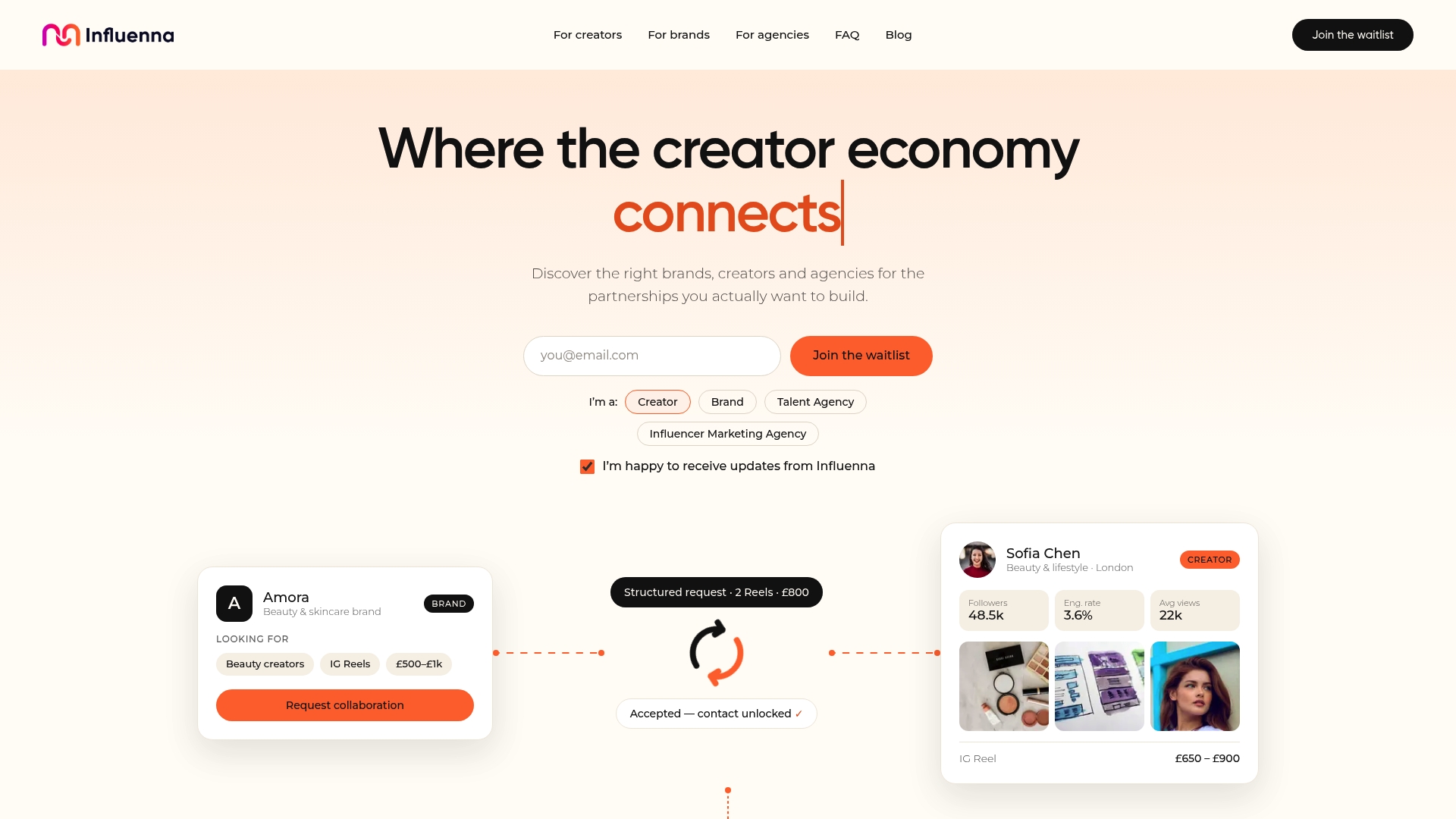
Structured collaboration requests replace the cold DM entirely, so a brand's brief translates directly into a request a creator can evaluate on its own terms, no guessing at intent from a generic pitch. Contact details remain private until mutual approval, preserving the privacy-first principle at the critical step where most shortlists leak time and risk. If your team wants a discovery channel built around that same brief-first logic, join the Influenna waitlist to get access when the curated marketplace opens.
Sources
For the legal side, the FTC's endorsement guidance covers disclosure law directly. For measurement standards, the IAB's ongoing framework work explains why decision-grade metrics beat vanity numbers. For the shortlist method itself, EngageCheck's evidence-backed process is the closest thing to a field manual this article draws from.
- How to build an evidence-backed creator shortlist | EngageCheck
- FTC: Truth in Advertising / Endorsements topic page
- Influencer Marketing Benchmark Report 2026
FAQ
What Should a Finished Influencer Shortlist Include?
A finished shortlist opens with one recommendation sentence, followed by 5 to 10 named creators, each carrying a confidence label and a checkable reason. It should read as a document, not a spreadsheet, with a limitations note explaining any exclusions.
How Many Creators Should Be in the Candidate Pool Before Filtering?
A pool of 15 to 20 candidates generally produces a defensible shortlist of 5 to 10 names after the two-pass filter. Fewer candidates leave too little room to eliminate weak fits without weakening the final list.
What Are the Top Influencer Niches Brands Look For?
Beauty, fitness, food, fashion, tech, finance, parenting, travel, gaming, and home or lifestyle content consistently draw the most brand interest across platforms. The right niche for any given shortlist still depends entirely on the campaign brief's audience and category fields, not general popularity.
What Are the FTC's Rules on Influencer Disclosure?
The FTC requires clear and conspicuous disclosure of any material connection between a brand and a creator, placed within the endorsement itself rather than a bio or a buried caption line. The FTC's staff brochure gives specific placement guidance for video, image, and livestream content.
How Do Influencers Get Added to a Brand's PR or Gifting List?
Brands typically build PR lists from the same shortlist process: a brief defining audience and category fit, then scoring candidates on engagement quality and past brand alignment rather than follower count alone. Curated marketplaces like Influenna, where profiles are human-reviewed and requests are structured, are one way brands find creators for these lists without relying on cold outreach.
What Is a Reasonable Posting Frequency to Look for in an Influencer?
There's no single fixed ratio that fits every platform or niche, but consistency matters more than raw volume. A creator posting several times a week with steady engagement is generally a stronger, more checkable signal than one who posts daily but shows erratic engagement patterns.