Stop 30% Cuts Creator Pay Transparency Contracts for Brands & Creators
10 min read

Creator pay transparency means every party in a sponsored deal, brand, agency, and creator, can see exactly what was billed, what was kept, and what was paid out. Only 51% of marketers say they have full visibility into what their own agencies pay creators. The single move that fixes the most damage fastest: require itemized pay disclosure in every contract, tied to deliverables and KPIs, before any campaign launches.
TL;DR:
- Over half of marketers lack full visibility into creator payment details, and most agencies take around 30% of campaign spend as their cut.
- Transparent pay structures, including itemized payouts and clear contract clauses, can improve ROI calculation, fairness, and reduce disputes.
- Hidden costs like agency markups, gifts instead of cash, late payments, and opaque pricing contribute to pay gaps and mistrust in influencer marketing.
- Effective negotiation requires data-driven rate benchmarks based on platform, creator tier, and content type, not just follower count.
- Using curated marketplaces with human reviews and explicit rate and audience transparency can enforce fairer, more accountable creator deals.
Table of Contents
- What the Data Shows About Pay Visibility and Budget Splits
- Why Pay Transparency Is a Business Strategy, Not Just Fairness
- The Hidden Costs of Opaque Creator Payment Practices
- How to Build Pay Transparency Into Contracts and Reporting
- What Are Realistic Rate Benchmarks by Platform?
- How Influenna Thinks About Transparent Collaboration
- Where Influenna Fits Into a Transparent Workflow
- Sources
- FAQ
What the Data Shows About Pay Visibility and Budget Splits
Half the industry is negotiating blind. The ANA found that just 51% of marketers have full visibility into what their agencies actually pay the creators on a campaign, and 55% say they're likely to change how they handle compensation within the next year. That's not a minor tweak. That's an industry admitting its own accounting is broken.
By the Numbers: Nearly half of marketers can't confirm what creators were actually paid on their own campaigns, and industry reporting pegs the typical agency cut at roughly 30% of spend, with 70% reaching creators.
That 30/70 split isn't universal, but it's the benchmark most buyers should ask agencies to explain when a quote comes in outside that range. Payment data referenced in industry coverage (the Lumanu dataset) also points to real platform variance: Instagram tends to carry the highest deal volume but a lower average payout per collaboration than YouTube, where longer-form production work commands more per project.
Why Pay Transparency Is a Business Strategy, Not Just Fairness
Transparent pay isn't a favor to creators. It's a performance lever. When a brand knows exactly what went to production, usage rights, and creator fees, it can actually calculate ROI per dollar spent instead of guessing from a lump-sum invoice.
Creators get something just as concrete: predictable income instead of a string of gifted product offers, plus real leverage in negotiation once they can point to what comparable creators earned for comparable work. Brands get auditability, which cuts regulatory exposure and makes it far easier to run a pay equity check across a roster. Transparency in influencer earnings turns a relationship built on trust alone into one backed by a paper trail both sides can defend.
The Hidden Costs of Opaque Creator Payment Practices
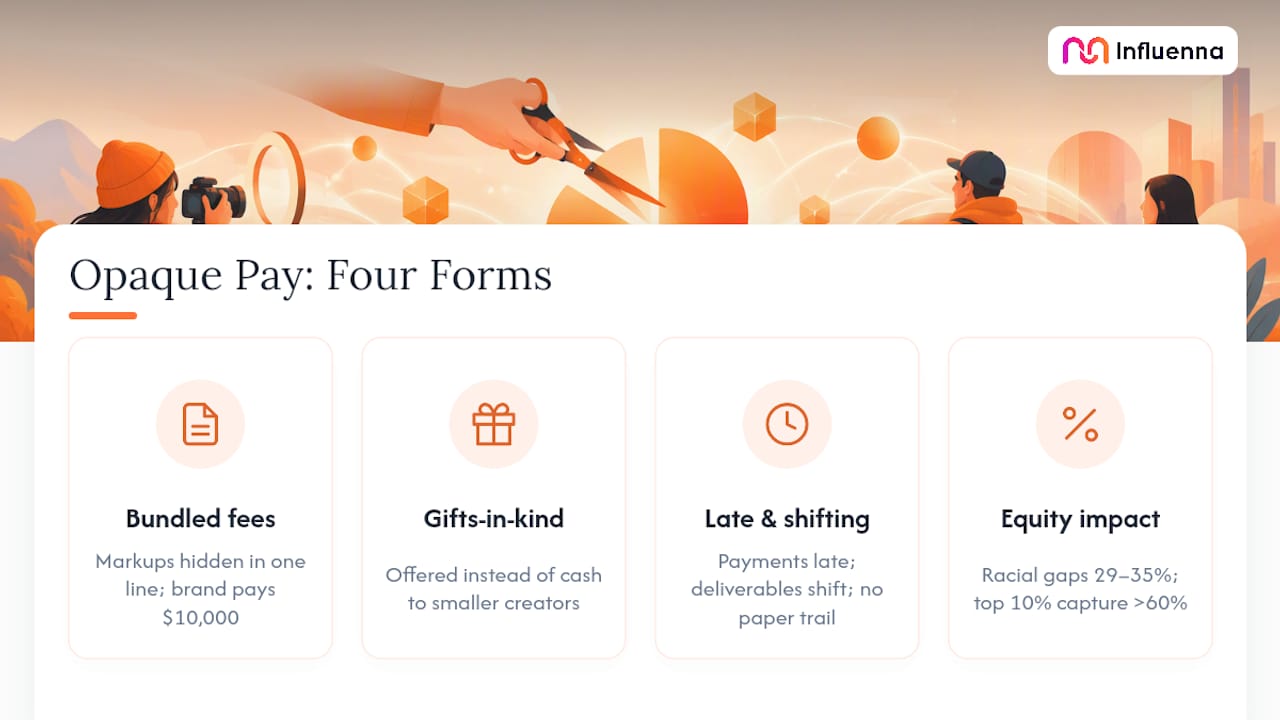
Opaque pay shows up in four familiar shapes. Bundled agency fees hide markups inside a single line item, so a brand pays $10,000 without knowing how much of it actually reached the creator; understanding different pricing models can clarify these opaque payout systems. Gifts-in-kind get offered in place of cash, especially to smaller creators who lack the leverage to push back. Payments arrive late, deliverables shift after the fact, and disputes drag on without a paper trail to resolve them.
The equity cost is the sharpest one. Industry analyses have cited racial pay gaps in the 29% to 35% range between white creators and creators of color for comparable work, and separate research on platform economics found the top 10% of creators capturing over 60% of available revenue on some platforms. Opacity doesn't just hide numbers. It hides who's losing.
How to Build Pay Transparency Into Contracts and Reporting
Fixing this isn't a policy statement. It's a checklist you apply to the next contract you sign.
Contract clauses to add:
- Itemized talent payouts listed as a contract exhibit, separate from agency service fees.
- Usage rights spelled out by duration and territory, priced as their own line item.
- A payment schedule with a fixed window (net 15 or net 30 from invoice) and a stated late-payment penalty.
- Audit rights letting the brand or creator request payout confirmation on request.
A payment terms guide and contract basics checklist are available that walk through specific language for each of these.
Reporting to require every cycle:
- Per-creator line items showing gross fee, agency fee, and net payout.
- KPIs tied to the deliverable (views, engagement rate, conversion where trackable).
- Proof of payout, not just proof of invoice.
Operational changes that make this stick:
- Centralize payment records in one system instead of scattered agency invoices.
- Require itemized invoices from every agency partner, no exceptions.
- Add transparency requirements directly into your RFP criteria before you pick a vendor.
Negotiation tactics for creators: Come to the table with quantified metrics, not follower counts. Present a rate anchor based on past campaign performance, and get payment terms in writing before any content is filmed. University of Bath research on the "gifts-in-kind trap" backs this up directly: creators break out of unpaid or product-only deals by combining authenticity, relational networks, and quantified impact into one negotiating case.
Pro Tip: Ask any agency partner for a sample itemized invoice before you sign anything. If they can't produce one, that tells you exactly how transparent this relationship is going to be.
What Are Realistic Rate Benchmarks by Platform?
Follower count is the weakest predictor of rate. Platform, content type, and creator tier tell you far more.
- Instagram: higher deal volume, but average payout per collaboration tends to run lower than long-form video work.
- YouTube: fewer deals overall, but average payout per collaboration tends to run higher given production time and watch-time value.
- TikTok: rates cluster around cost-per-view models more than flat fees; a TikTok rate guide breaks down how to price a CPV-based quote.
- UGC-only content (no posting rights, brand distributes it): typically priced separately from influencer posting fees, detailed in a UGC rate breakdown.
By the Numbers: With agencies averaging a 30% cut of spend, any rate card you build should separate the creator's base fee from the agency's service fee as two distinct numbers, not one blended total.
Build your own rate card by cross-referencing a platform benchmark against creator tier (nano, micro, mid, macro) rather than treating any single average as a universal number. The dataset gaps are real. Treat platform averages as a starting anchor for negotiation, never as a fixed price.
How Influenna Thinks About Transparent Collaboration
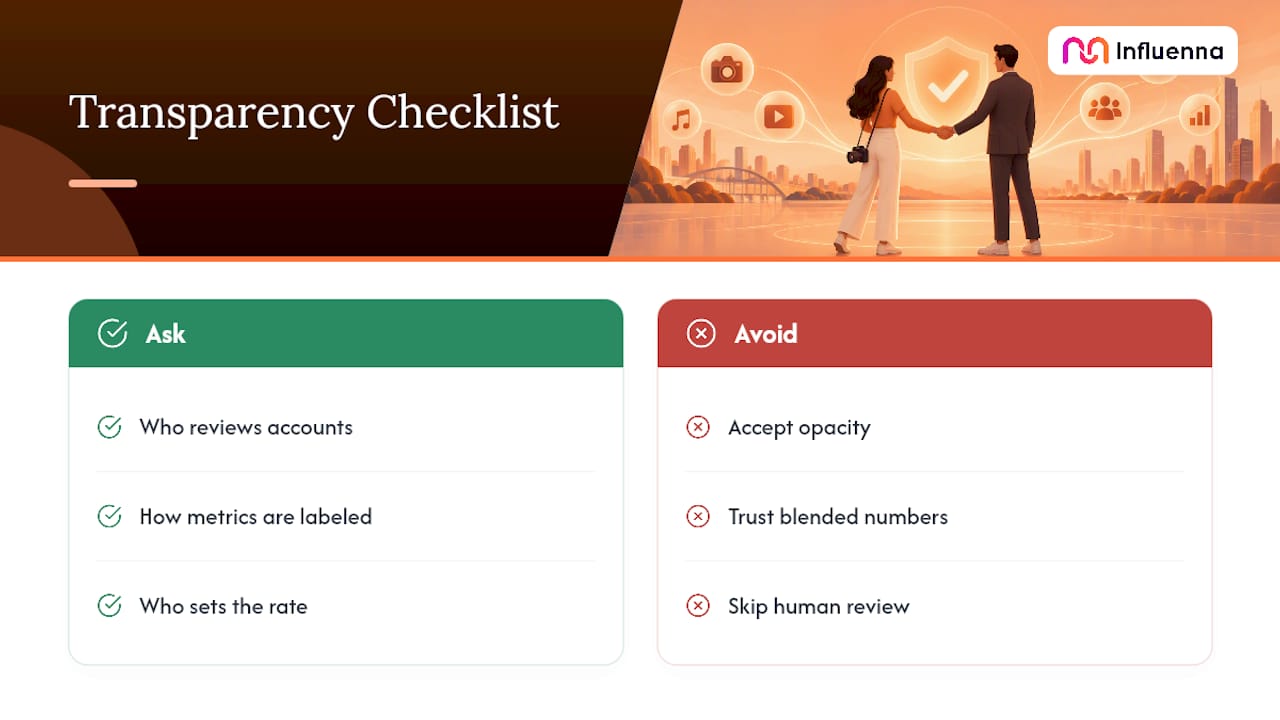
The pattern in this data is consistent: opacity survives wherever there's no structured process forcing disclosure. That's the problem Influenna was built to work against. Every account, creator, brand, agency, is reviewed by a person before it gets marketplace access, and every audience metric is labeled by how it was sourced, verified, estimated, or self-reported, rather than blended into one flattering number.
Rates get set on the creator's own terms, and contact details unlock only once both sides approve a structured request. If you're evaluating any marketplace on transparency, ask it directly: who reviews accounts, how are metrics labeled, and who sets the rate. Those three answers tell you more than any feature list.
— Igor
Where Influenna Fits Into a Transparent Workflow
Influenna is a curated collaboration marketplace where every creator, brand, talent agency, and influencer marketing agency account is reviewed by a person before it goes live. Instead of cold DMs and guesswork, members send structured collaboration requests that lay out rates and expectations up front, and contact details exchange only once both sides say yes.
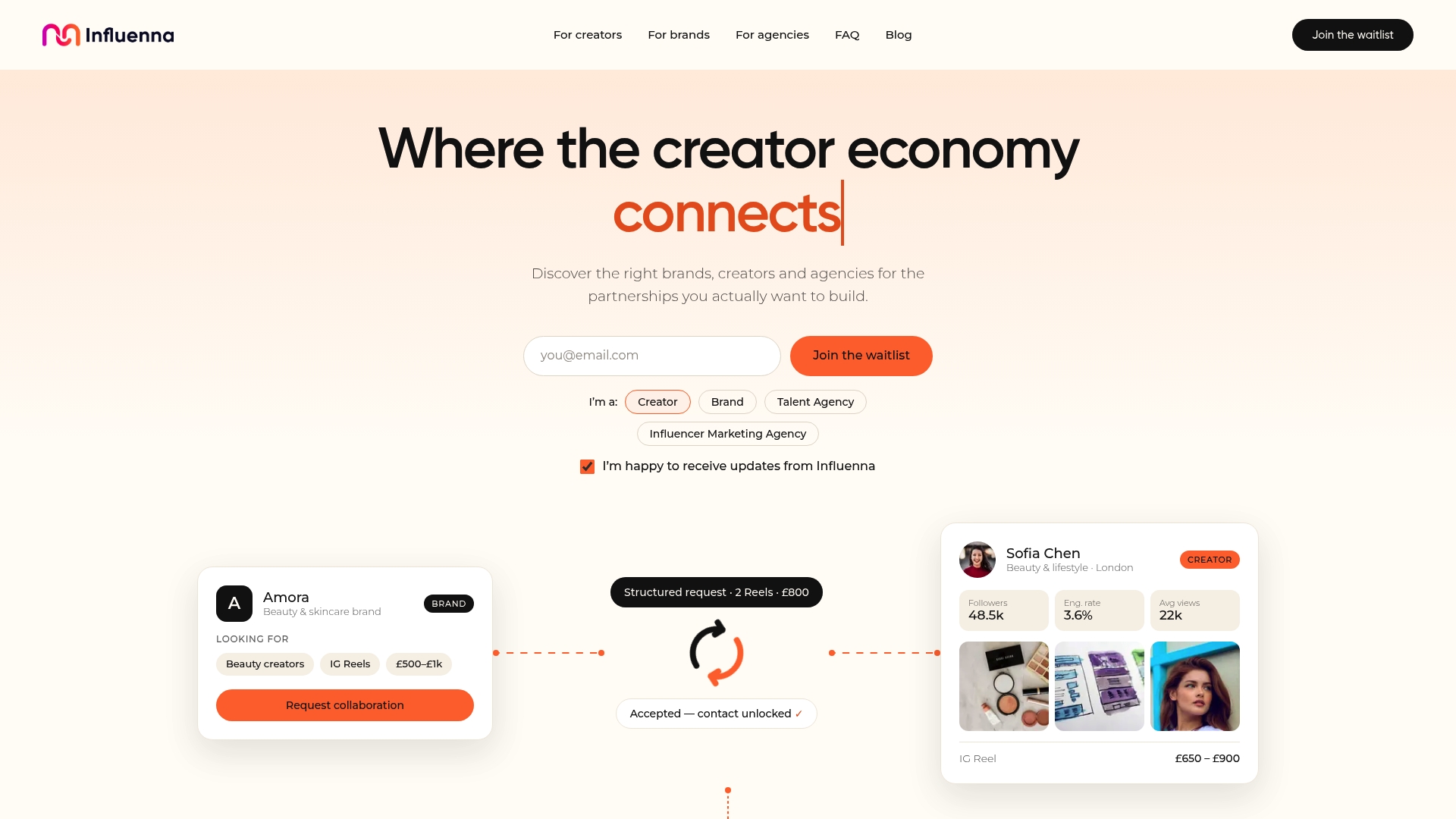
That structure maps directly onto the transparency problem this article just walked through: labeled audience metrics instead of blended vanity numbers, rates set by creators on their own terms instead of buried in an agency markup, and a request format that puts compensation expectations on the table before either side commits. Influenna doesn't broker the deal or take a cut. It makes the introduction, and the collaboration, and its pay terms, stay directly between the two parties. The public site is currently a waitlist. If you want a clearer starting point for your next creator partnership, join the Influenna waitlist and get notified when marketplace access opens.
Sources
- Influencer pay lacks transparency: Here’s what the numbers say | Marketing Dive
- ANA Finds Influencer Marketing Agencies Averaging 30% Commissions | MediaPost
- Avoiding the gifts-in-kind trap – new research shows how influencers can make their work pay | University of Bath
- Academia
FAQ
How many followers do you need to make $100,000?
There's no fixed follower count that guarantees that income. Earnings depend far more on niche, engagement rate, platform, and deal structure than on audience size alone, which is why rate benchmarks by platform and tier matter more than follower totals when creators price their work.
What are the downsides of pay transparency?
Full disclosure can expose uncomfortable pay gaps between creators of similar size, and some agencies argue it complicates proprietary pricing models. Those are real friction points, but they're smaller than the cost of the status quo, where only 51% of marketers can even see what their own campaigns actually paid creators.
What states have pay transparency laws in 2026?
Several US states require salary or pay-range disclosure in job postings, but those laws generally target traditional employment relationships, not independent creator contracts. Creator pay compensation disclosure in the influencer space is currently driven by industry practice and contract terms rather than a specific statute, so the itemized-invoice clauses covered above are the practical substitute for now.
Does Instagram pay per 1,000 views?
Instagram doesn't have a single fixed per-view payout; posted content is typically priced through brand deals rather than platform ad revenue. Some bonus programs tied to Reels views have existed, but sponsored collaboration rates, not view counts, drive most Instagram creator income.
How does a curated collaboration marketplace support transparent creator deals?
A curated marketplace could require every account to pass a human review, label audience metrics by how they were sourced, and let creators set rates on their own terms before a brand or agency ever sees their contact details. That structure gives both sides clear terms to negotiate from instead of a cold pitch with no context.