Building an Influencer Discovery Strategy That Actually Fits Your KPIs
12 min read

The fastest way to build an effective influencer discovery strategy is to lock a one-page brief, pick a primary KPI, choose your platforms, and creator tier, then run a two-week discovery sprint before you vet and score a shortlist. Skip the brief and you end up chasing follower counts instead of results.
Most teams do it backward: they start scrolling Instagram or TikTok for "good" creators before deciding what "good" means for this campaign. That's why so many partnerships fizzle after one post.
Here's the sequence that works, in three moves you can copy into a doc right now:
- Write the brief — objective, audience, primary KPI, platform priority, creator tier, and an owner.
- Run a seed search — pull 30 to 50 candidates across two or three channels (manual search, competitor mapping, one database or marketplace).
- Cut to a shortlist — apply the vetting checklist and scoring rubric to get to your top 8 to 12.
This sequence beats random searching because it ties every decision back to a measurable goal instead of a gut feeling about who "seems influential."
Key Takeaways
An effective influencer discovery strategy pairs a written brief and multi-channel search with a weighted vetting rubric, because that combination filters for business results instead of follower counts.
| Point | Details |
|---|---|
| Brief before browsing | Write objective, KPI, platform, and tier down before searching to avoid chasing vanity metrics. |
| Stack discovery channels | Combine manual search, competitor mapping, social listening, and databases; no single channel covers every stage. |
| Vet in under 10 minutes | Check engagement quality, growth patterns, recency, and disclosure habits per profile. |
| Score before you outreach | Weight audience fit, engagement, style, and cost by campaign type, then set a 3.5-out-of-5 cutoff. |
| Use a curated marketplace | Influenna offers manually reviewed creators with provenance-labeled metrics and structured collaboration requests. |
Table of Contents
- What Is an Influencer Discovery Strategy?
- 1. Lock the Brief: Goals, Audience, and KPIs
- 2. Where to Look: Discovery Channels and Search Tactics
- 3. Vetting Checklist: Fast Signals and Red Flags
- 4. Prioritize and Score: A Simple Rubric to Rank Candidates
- 5. Outreach That Gets Replies: The Collaboration Request Template
- 6. Measuring Results and Feeding Learnings Back
- Why Human Curation and Provenance Labels Matter
- Influenna: A Curated Shortcut to Vetted Creators
- Sources
- FAQ
What Is an Influencer Discovery Strategy?
An influencer discovery strategy is the repeatable process a brand or agency uses to find, vet, and rank creators against specific campaign goals rather than picking names off a trending list. It replaces ad hoc searching with a documented workflow: a brief that defines success, a discovery stack that matches the brief, and a scoring rubric that turns a long list into a short, defensible one.
1. Lock the Brief: Goals, Audience, and KPIs
Discovery starts with a written brief, not a browser tab full of profiles. According to Brandwatch's influencer discovery guide, defining goals and KPIs before you search prevents teams from choosing creators for vanity metrics instead of business outcomes.
A one-page brief should cover:
- Objective: awareness, consideration, conversion, or UGC asset production
- Primary KPI: reach and impressions for awareness; click-through rate for consideration; cost per acquisition for conversion; number of usable assets for UGC campaigns
- Geography and language: where the audience actually lives
- Platform priority: which platform carries the most weight for this goal
- Creator tier: nano, micro, mid-tier, or macro
- Deal type: gifted product, flat fee, commission, or a mix
- Exclusions: competitor conflicts, brand safety limits, content restrictions
- Owner and timeline: who signs off and by when
The brief is a compass, not paperwork. Every creator you evaluate later is measured against these lines, which is what stops a campaign from drifting toward whoever has the biggest following instead of the audience you actually need.
Without this step, discovery turns into browsing. With it, discovery turns into hypothesis testing: you're checking whether a candidate fits criteria you already wrote down.
2. Where to Look: Discovery Channels and Search Tactics
No single channel covers every stage of an influencer discovery strategy. Manual platform search, competitor mapping, social listening, creator databases, inbound applications, and agency or freelancer sourcing each solve a different problem, and most brands end up stacking two or three.
Platform-specific shortcuts save real time:
-
TikTok creator discovery: combine the Discover tab with a hashtag mix (branded, category, and adjacent-niche tags) to surface creators the algorithm already favors for that content type.
-
Instagram creator discovery: use Explore plus the branded content tool to find accounts already tagging sponsored posts in your category.
-
YouTube niche channels: search by long-tail topic terms rather than broad category names. YouTube reaches 2.7 billion monthly active users, and niche validation matters more there than almost anywhere else, because a channel with a small but tightly defined audience often outperforms a general one on watch time.
-
Local micro influencers: pair location tags and geo-filtered hashtags with city or neighborhood search terms to find influencers by location for regional launches.
For sequencing, start profile-based for volume, since databases and marketplaces surface hundreds of candidates fast. Then layer in content-first tools; AI-powered discovery platforms can now match creators by visual style, tone, and audience sentiment instead of just follower tags. Finally, run social listening to catch creators already talking about your category organically, since those tend to convert into warmer outreach conversations.
3. Vetting Checklist: Fast Signals and Red Flags
You can screen most creator profiles in 5 to 10 minutes if you know what to check. The goal isn't a forensic audit. It's a fast filter that catches the obvious problems before you invest time in outreach.
Run through this on every candidate:
- Engagement quality: read the actual comments. Are people responding to the content, or is it "🔥🔥 love this!!" from accounts with no profile photo?
- Follower growth pattern: a steady climb is normal; a sudden spike often means a purchased boost or a viral moment that inflated the base without building loyalty.
- Content recency: check the last 10 to 15 posts. Dead accounts that suddenly post again for a sponsorship are a warning sign.
- Audience geography: confirm the audience actually lives where your campaign needs it, especially for anyone claiming to find local micro influencers.
- Disclosure habits: look for #ad or paid-partnership labels on past sponsored content. Creators who skip disclosure create legal exposure for your brand.
Red flags worth an automatic pass: generic comment patterns, frequent posts for direct competitors within the same category, or content that skirts brand safety on tone, language, or subject matter.
Engagement rate and comment quality correlate with actual influence better than raw follower counts, and automated Audience Quality Scores help, but they don't replace a human reading the comments.

Pro Tip: Open the comments and sort by "most recent" instead of "most relevant." Fake engagement clusters right after a post goes up; organic conversation trickles in over days.
4. Prioritize and Score: A Simple Rubric to Rank Candidates
A weighted scorecard turns a messy longlist into a ranked shortlist your whole team can agree on. Score each candidate from 1 to 5 across five dimensions, then multiply by a weight that matches your campaign type.
- Audience fit — does their audience match your brief's demographics and geography?
- Engagement quality — real comments and saves, not bot noise
- Content style — does their tone match your brand voice?
- Commercial maturity — do they have a media kit, rate card, and history of paid partnerships?
- Logistics and cost — turnaround time, usage rights, and fee relative to reach
Set a threshold score, say 3.5 out of 5, as your cutoff to move a candidate to outreach; anything below goes into a "test small first" bucket. Micro creators in the 10,000 to 100,000 follower range frequently beat macro accounts on conversion ROI, so treat tier as a band to weigh, not a hard cutoff based on follower count alone.
5. Outreach That Gets Replies: The Collaboration Request Template
A generic "Hi, love your content!" DM gets ignored. A structured request that references specific work and states the offer clearly gets answered.
Structure every outreach message the same way:
- Opener: one sentence referencing a specific recent post, not a generic compliment.
- The offer: gifted product, flat fee, or commission, stated plainly.
- Soft CTA: ask if they're open to a quick chat, not a hard yes/no.
Every initial request should include:
- Link to the campaign brief
- Specific deliverables (post count, format, platform)
- Usage and content rights terms
- Payment model and amount range
- Proposed timeline
Follow up on day 5, day 10, and day 17 if you hear nothing. Send messages mid-week, and account for the creator's timezone. A message sent at 11 PM their time lands at the bottom of an inbox by morning.
6. Measuring Results and Feeding Learnings Back
Track performance during the campaign, not just after it ends. Attach UTM codes or affiliate links to every creator's content, tag posts by creator and format, and set a conversion attribution window before the campaign launches, typically 7 to 14 days depending on your sales cycle.
Build a short post-campaign scorecard:
- Cost per activation (spend divided by clicks, sign-ups, or sales)
- Engagement quality relative to the creator's baseline
- Content reusability for paid ads or owned channels
- One-line note on what traits predicted success
Clear KPI benchmarks set before launch, similar to what a paid media strategy requires for owned and paid performance tracking, make it far easier to judge whether a creator partnership actually worked or just looked good. Feed the traits that predicted success back into your next brief. That's how a discovery process gets sharper every cycle instead of starting from zero each time.
Why Human Curation and Provenance Labels Matter
Automated tools are fast at surfacing candidates but blind to context: brand fit, creative tone, and how a creator actually behaved in past partnerships. A follower count doesn't tell you if a creator ghosts brands after payment or delivers late.
Provenance matters as much as the metric itself. A follower count labeled "verified" carries different weight than one that's "self-reported," and treating them the same is how brands get burned by inflated numbers.
Labeling audience data as verified, estimated, or self-reported cuts negotiation friction, because both sides start from the same understanding of what the number actually means. This is the logic behind marketplaces that pair manual human review with structured collaboration requests instead of open, unvetted databases. AI can narrow a field of thousands down to dozens fast, but a human still has to confirm the creative fit before money changes hands.
Author's Note: Practical Trade-Offs I See in Discovery
Databases and AI give you scale; human review gives you nuance, and you need both. If your team is two people, skip building an in-house discovery machine and run a two-week sprint against one metric instead. Constrained teams win by narrowing focus, not by buying more tools.
Influenna: A Curated Shortcut to Vetted Creators
If steps 1 through 5 sound like a lot to build from scratch, that's because they are. Influenna cuts the manual vetting load by starting every relationship from a pool of creators, brands, and agencies that have already passed a human review before joining.
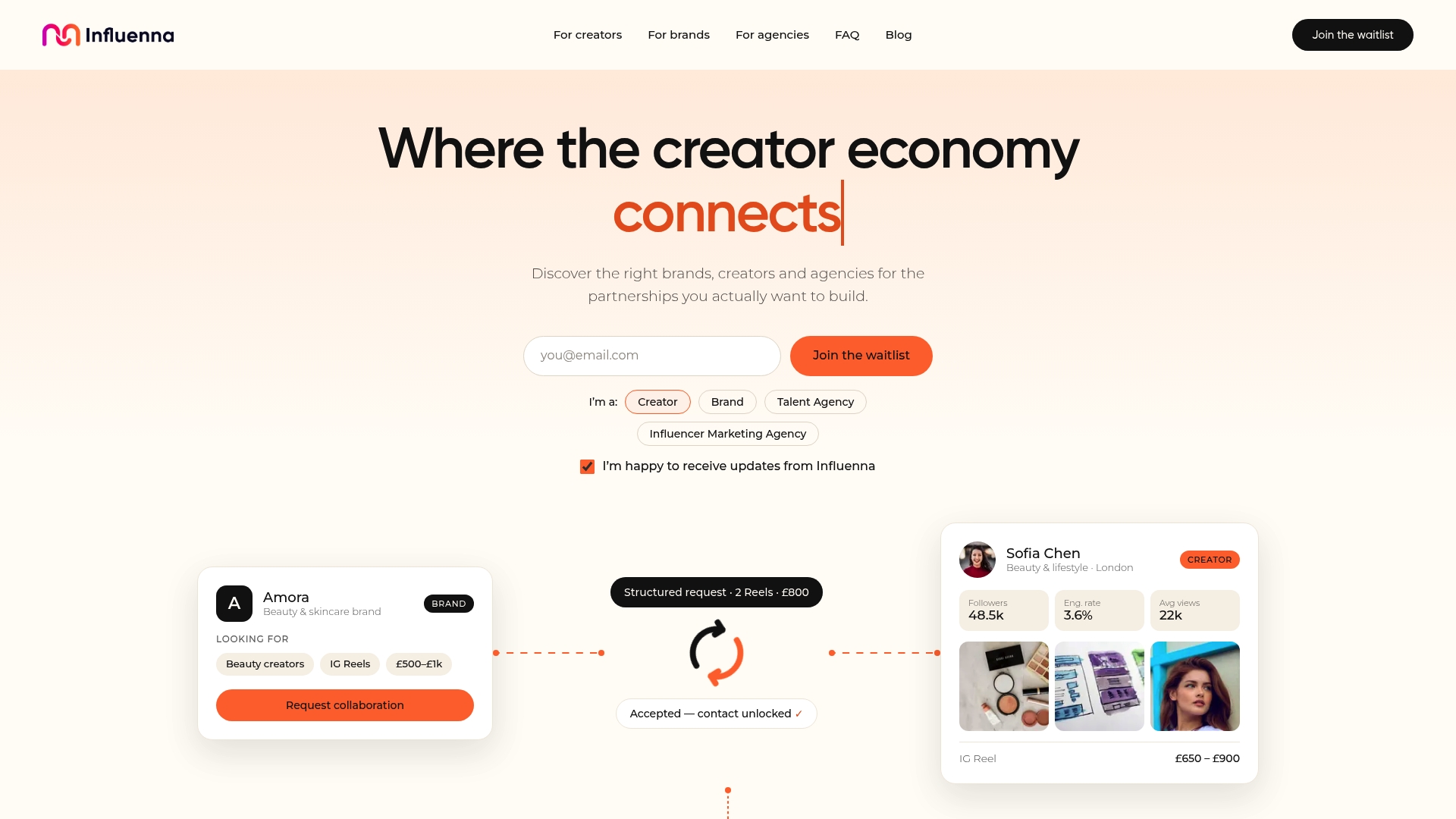
Every creator profile on Influenna shows audience metrics labeled by provenance, verified, estimated, or self-reported, across Instagram, TikTok, and YouTube separately, so you're not guessing what a number actually means before you reach out. Instead of a cold DM that gets buried, you send a structured collaboration request with your deliverables and terms already spelled out, and contact details only unlock once both sides say yes. That structure does a lot of the vetting legwork this article just walked through, built into the platform itself. If you're tired of chasing profiles that go quiet, join the Influenna waitlist and get in line for access when it opens.
Sources
- influencer-discovery-from-scratch-5-step-playbook-2026
- With over 2.7 billion monthly active users, there’s truly a niche for every interest on YouTube
- How to Find Influencers: In-House, Agency, Programs & More (2026)
FAQ
What Is the First Step in an Influencer Discovery Strategy?
Write a one-page brief covering your objective, primary KPI, platform priority, and creator tier before you start searching for candidates.
How Long Should a Discovery Sprint Take?
Two weeks is enough to build a longlist, cut it to a shortlist, and test initial outreach against your brief.
How Do I Find Local Micro Influencers?
Combine geo-filtered hashtags and location tags with city-specific search terms, then verify audience geography during vetting since claimed location and actual audience location don't always match.
What Red Flags Should I Watch for When Vetting Creators?
Watch for sudden follower spikes, generic comment patterns, frequent posts for competing brands, and missing disclosure on past sponsored content.
Is Influenna a Good Option for Finding Vetted Creators?
Influenna is a curated marketplace where every creator, brand, and agency account is manually reviewed before joining, and audience metrics are labeled by provenance so you know what you're evaluating.