3 Questions: Choose Talent Agency, Influencer Agency, or Marketplace
11 min read

A talent agency represents the creator. An influencer marketing agency represents the brand. That single fact decides everything else: who negotiates your rate, who reports campaign results to a client, and whose interests get protected when a deal gets tense. If you're a creator building a career, you want a talent or management agency in your corner. If you're a brand running a campaign, you want an influencer marketing agency handling execution.
TL;DR:
- Creator-focused talent agencies prioritize long-term career strategy and protect creator interests, often taking a commission on booked deals.
- Brand-oriented influencer marketing agencies execute campaigns, measure ROI, and charge brands either per campaign or via retainers, focusing on immediate results.
- Agencies claiming dual representation often conceal conflicts of interest, so asking who pays and who signs contracts can reveal the true loyalty.
- A curated marketplace offers a low-friction, conflict-free way for creators and brands to connect directly before entering formal agency relationships.
- Testing one campaign or a small-scale collaboration first is advisable before committing to long-term representation or agency contracts.
Table of Contents
- Talent Agency vs Influencer Agency: The Core Comparison
- What Are the Pros and Cons of Each Model?
- What Do Fees and Contracts Typically Look Like?
- Why "We Represent Both Sides" Should Worry You
- How Do You Choose Between Talent and Influencer Agencies?
- How Does a Curated Marketplace Fit Into This Choice?
- What Should Creators and Brands Do Next?
- A Faster Way to Connect Without Signing Anything Yet
- Sources
- FAQ
Talent Agency vs Influencer Agency: The Core Comparison
The distinction comes down to one question: who does the agency answer to? An influencer management agency primarily represents creators and protects creator-side interests, the same way a traditional talent manager protects an actor's career trajectory rather than just closing the next booking. An influencer marketing agency represents the brand, building and running campaigns designed to hit that brand's marketing goals.
This maps closely to the classic talent manager vs agent split in entertainment. Agents are deal closers, hunting down immediate opportunities and negotiating specific bookings. Managers are career architects, shaping long-term positioning, brand partnerships, and the slow accumulation of leverage that turns a working creator into a household name. Modern talent management agencies in the creator space have adopted the manager model almost entirely. They act as business partners, handling strategy and contract negotiation rather than just chasing the next check.
Here's how the two models split on the fundamentals:
- Who they represent: talent agencies represent the creator; influencer marketing agencies represent the brand client.
- Core service: talent agencies negotiate deals and build long-term career strategy; influencer marketing agencies plan, execute, and report on campaigns.
- Success metric: talent agencies measure creator income growth and brand fit; influencer marketing agencies measure campaign ROI and delivery against a brief.
- Revenue model: talent agencies typically take a commission (often a percentage of booked deals) or a flat management fee; influencer marketing agencies charge retainers or per-campaign fees billed to the brand.
The stakes behind this split are real money. Influencer marketing has grown into a multi-billion-dollar category, and brands increasingly treat influencer spend as a core line item rather than an experiment. That scale is exactly why specialized influencer marketing agencies exist: a brand running dozens of campaigns a year needs execution expertise a solo creator's manager was never built to provide.
What Are the Pros and Cons of Each Model?
Creators working with a talent agency generally get rate protection and someone thinking three years ahead instead of three weeks. The trade-off is a commission on every deal and, at some agencies, gatekeeping if your niche doesn't fit their roster strategy.
Brands working with an influencer marketing agency get campaign expertise, vetted creator lists, and full-funnel execution from brief to reporting. The trade-off is cost, plus limited access to creators who are exclusively signed elsewhere.
- Long-term brand ambassador deals favor talent agency representation, since career-minded negotiation protects the creator across multiple renewals.
- One-off product launches or seasonal activations favor influencer marketing agencies, since speed and campaign-specific expertise matter more than career strategy.
- A creator testing a new platform (say, moving from Instagram to TikTok) often benefits more from a manager's guidance than a campaign-focused agency's execution skills.
Pro Tip: If a creator is being pitched by an agency claiming to represent them "and" the brands they'd work with, ask directly which side the agency gets paid by. The answer tells you everything about whose interests come first.
What Do Fees and Contracts Typically Look Like?
Fee structures follow the same representation line. Talent agencies usually bill the creator, taking a commission on booked work or a flat management retainer. Influencer marketing agencies bill the brand, through campaign fees or monthly retainers tied to deliverables.

Contracts differ on the clauses that matter most. Usage rights (how long a brand can reuse your content), exclusivity windows, kill fees for canceled campaigns, and reporting obligations are the practitioner-recommended checkpoints worth confirming before signing anything, and Influenna's own contract basics checklist walks through each one in detail.
Before signing with either model, ask:
- Who pays for content usage rights beyond the first six months?
- What's the kill fee if the campaign or booking falls through after content is delivered?
- Who controls exclusivity, and for how long does it lock out competing brands?
- What reporting format and cadence does the agency provide, and to whom?
Why "We Represent Both Sides" Should Worry You
An agency claiming to represent both creators and brands equally has a structural problem: someone's interests come second the moment negotiation gets uncomfortable. When a single agency serves both sides, it often hedges language about whose interests it actually protects, and that hedge is diagnostic of a conflict worth catching early.
Run the Representation Direction test on any agency pitch:
- Ask point-blank: "If we disagree on rate, whose side are you on?" A clean answer names one side. A hedge names neither.
- Ask who signs your contract and who pays the agency's invoice. Money usually reveals loyalty.
- Watch for agencies that offer "separate teams" as a fix. It can work, but only with genuinely separate contracts and no shared commission pool.
Pro Tip: A transparent dual-model agency will tell you upfront which team handles you and show you their internal wall. If they get vague or annoyed at the question, that's your answer.
— Igor
How Do You Choose Between Talent and Influencer Agencies?
Start with a short screening call and ask these questions in order:
- Who is your paying client, the creator or the brand?
- How do you get paid, commission, retainer, or campaign fee?
- Can you show a reporting sample from a past campaign or deal?
- How do you handle a conflict between what a brand wants and what a creator needs?
- What's your typical contract length and exit clause?
Decision rules simplify fast once you know your role:
- Creators building a multi-year career: choose a talent or management agency, prioritizing career strategy over immediate booking volume.
- Brands running a defined campaign with a deadline and budget: choose an influencer marketing agency, prioritizing execution speed and reporting quality.
- Anyone unsure yet, or wary of long-term lock-in: consider a curated marketplace for a direct, structured introduction instead of formal representation.
Before committing long-term, run a small pilot. Brands should scope one campaign with three deliverables and a fixed reporting date, not an open-ended retainer. Creators should test one negotiated deal through a prospective manager before signing an exclusive contract. A discovery strategy built around your KPIs makes that pilot easier to design on the brand side, and a clear grasp of typical influencer payment terms protects the creator side.
How Does a Curated Marketplace Fit Into This Choice?
A curated marketplace sits outside the agency model entirely. Every account gets reviewed by a person before it can send or receive requests, and contact details stay private until both sides approve a match. That structure removes the representation question altogether: nobody is negotiating on your behalf, so there's no conflict to diagnose.
The biggest friction in this industry isn't a lack of talented creators or serious brands. It's the gap between them: cold DMs that go nowhere, media kits nobody reads, agencies that take weeks to respond. A structured introduction skips straight past that gap.
For a brand testing a single campaign or a creator who wants direct control before ever hiring representation, this route is often faster and cheaper than either agency model.
What Should Creators and Brands Do Next?
Creators building a career need long-term advocacy; brands running campaigns need execution and reporting. Match the model to the goal, not the other way around. Creators: draft three screening questions for your next agency call. Brands: write one pilot brief with fixed deliverables before signing any retainer.
A Faster Way to Connect Without Signing Anything Yet
A curated marketplace gives creators and brands a direct, structured way to find each other before either side commits to formal representation. Every account is reviewed by a person before joining, avoiding spam or fake profiles. Instead of a cold DM or a lengthy agency pitch, users send a structured collaboration request with real details upfront, and contact information only unlocks once both sides say yes.
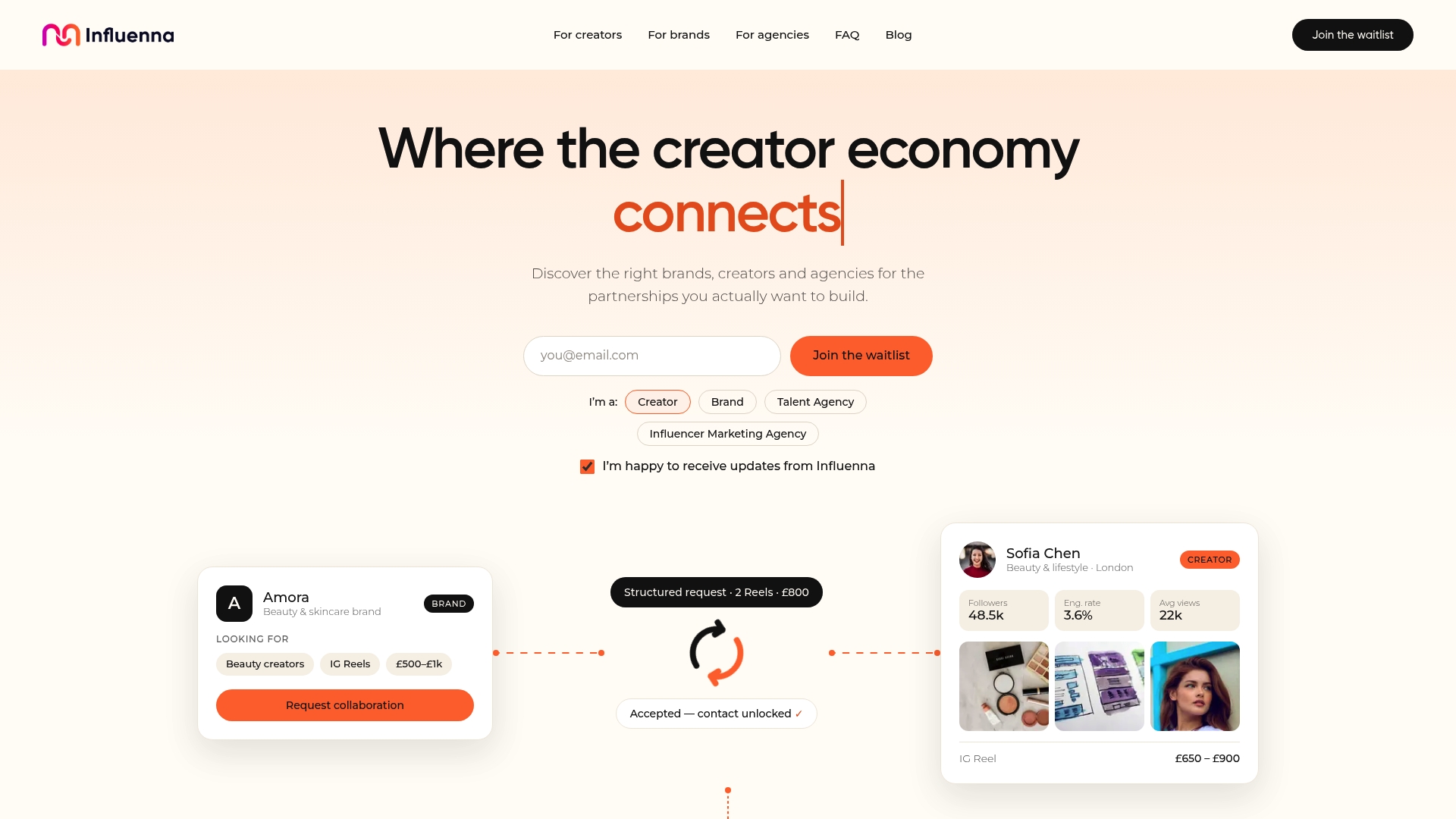
This fits best for a creator who wants to test the market before signing an exclusive contract, or a brand that wants to run one focused campaign without committing to a retainer. Influenna doesn't broker the deal or take a cut. It makes the introduction, and the collaboration stays between you and the other party. If that sounds like the low-friction first step you've been missing, join the Influenna waitlist and get in line for early access.
Sources
- Dan Scott — Entrepreneur (agent vs manager distinction)
- Influencer management agency vs influencer marketing agency: What brands need to know — Searchlight Social
- Influencer Marketing Hub — influencer marketing benchmark report
- What does a talent management agency actually do? — BeInfluence
FAQ
How much do influencer talent agents make?
Talent agents and managers in this space typically earn through commission on booked deals, often a percentage of the creator's negotiated fee, rather than a fixed salary. Exact commission rates vary widely by agency size and creator earning potential, and are rarely published publicly.
What are the big 5 talent agencies?
The "big five" label traditionally refers to major entertainment talent agencies like WME, CAA, UTA, ICM Partners, and Paradigm, which represent actors, musicians, and increasingly digital creators. The influencer-specific agency space is more fragmented, with many boutique and mid-size agencies specializing by platform or niche rather than one dominant handful.
Is it hard to get signed by a talent agency?
Getting signed by a talent agency depends heavily on your existing audience, engagement, and brand fit rather than follower count alone. Established agencies often look for creators who already show consistent growth or a distinct niche, which makes early-stage creators a harder sell without a track record.
What are the four types of influencers?
Influencers are commonly grouped by audience size into tiers like nano, micro, macro, and mega or celebrity influencers. Agencies and brands use these tiers differently, with talent agencies often focused on larger creators while influencer marketing agencies run campaigns across every tier depending on budget.
What's the difference between a talent agency and an influencer marketing agency?
A talent agency represents the creator and negotiates deals in the creator's interest, while an influencer marketing agency represents the brand and executes campaigns on the brand's behalf. If you want a neutral alternative to either model, a curated marketplace like Influenna lets creators and brands connect directly without either side hiring formal representation.