Cut Approvals to Four Days: Agency Playbook for Influencer Content
15 min read

The right approval process is a five-stage workflow: submission, internal review, project approval, client review, and a final approved or rejected status. Each stage checks one thing (brief fit, compliance, brand sign-off, client sign-off) and every approval is logged against an exact asset version. Get this right and, per Truleado's analysis, average approval time drops to roughly four days.
TL;DR:
- An effective approval process requires clear ownership at each stage, with only one designated approver per step to reduce conflicting feedback.
- Separating internal review from client review shortens approval time and ensures quality checks like disclosures and claims are completed upfront.
- Using a detailed, asset-specific checklist for both internal and client reviews ensures consistency and minimizes back-and-forth.
- Centralized approval queues and SLA enforcement are essential to prevent delays and maintain accountability across stages.
- Recording precise approval details, including version, timestamp, and usage rights, reduces disputes and facilitates quick post-approval checks.
Table of Contents
- What Does an Influencer Content Approval Workflow Actually Look Like?
- What Should Be on Your Influencer Content Approval Checklist?
- Who Should Own Each Approval Stage?
- How Do You Speed Up Approvals Without Losing Creator Voice?
- What Do the FTC and Platforms Require Before You Approve?
- What Should You Record at Final Sign-Off?
- What Templates Actually Reduce Approval Friction?
- Why Do Approvals Get Stuck, and How Do You Fix It?
- The Trade-Offs Nobody Talks About in Approval Workflows
- Want to Skip the Cold Outreach and Find Vetted Partners Faster?
- Where to Check the Rules Yourself
- Sources
- FAQ
What Does an Influencer Content Approval Workflow Actually Look Like?
Most agencies treat approvals as a single vague step: send the draft, wait, hope. That's why campaigns stall. A working content approval workflow has five distinct stages, each with one job and one owner.
- Submission. The creator uploads the asset and caption to a shared queue, not a group chat. This stage's only job is capturing a clean, timestamped starting point.
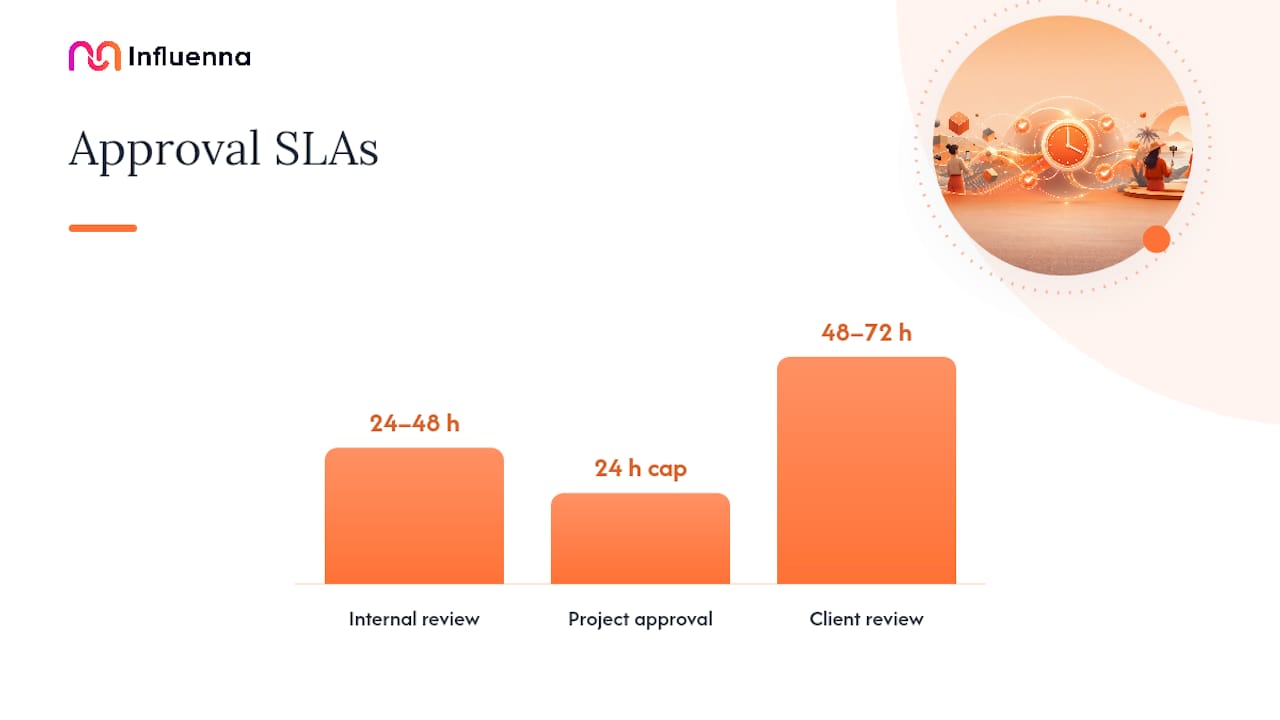
- Internal review. An agency reviewer checks the draft against the brief, brand guidelines, and legal basics before anyone outside the team sees it. Give this stage a 24 to 48 hour SLA. Skipping it is the single most common reason client review turns into a mess.
- Project approval. A senior strategist or account lead signs off that the internal review is complete and the asset is ready for the client's eyes. This is a fast checkpoint, not a second full review, so cap it at 24 hours.
- Client review. The brand or client stakeholder gives (or withholds) sign-off. Set a firm 48 to 72 hour SLA here, because client-side delay is where most campaigns actually lose their runway.
- Approved or rejected. The asset either gets a final status and moves to publishing, or it gets sent back with specific, written feedback tied to the exact version reviewed.
Internal review has to happen before client review, not alongside it. When agencies skip that separation, brand-side reviewers end up flagging typos, missing disclosures, or off-brief claims that a junior staffer should have caught first. That erodes client confidence fast, and it burns revision rounds on problems that had nothing to do with the client's actual judgment call. Truleado's research backs this up directly: separating the two review types is one of the clearest time savers in the whole process.
A centralized approvals queue, rather than scattered email threads, is what makes the SLAs enforceable in the first place. If a deliverable isn't visible in one place with a deadline attached, it quietly stalls, and nobody notices until the posting date is already blown.
What Should Be on Your Influencer Content Approval Checklist?
A checklist only works if it's specific enough that two different reviewers reach the same conclusion. Vague guidance like "make sure it matches the brand" produces inconsistent approvals and endless back and forth. The fix is a checklist that ties every check to something concrete: an exact file, a specific line of caption text, a named regulation.
Run these checks during internal review:
- Brief match. Does the asset hit every required talking point, without adding claims the brief didn't authorize?
- Brand fit. Tone, visuals, and product framing align with brand guidelines, not just "looks fine."
- Claims accuracy. Any pricing, performance, or comparative statement is checked against the source document it came from, not the creator's memory of a call.
- Disclosure presence. A disclosure exists in both the caption and, where applicable, on the asset itself.
- Tags and links. Handles, product tags, and tracking links are correct and functional, not placeholder text.
- Usage rights. The intended use (organic only, paid boost, repurposing) is confirmed before approval, not after the asset goes live.
Run these checks during client review:
- Final asset check. The version being approved is the exact version that will publish, not an earlier draft.
- CTA clarity. The call to action matches the campaign goal (link click, code redemption, comment engagement).
- Disclosure wording and placement. Language is unambiguous and sits where it can't be missed, per FTC guidance on clear and conspicuous disclosure.
Pro Tip: Treat every approval as sign-off on a specific asset and caption version, never on "the concept." Multilogin's checklist framework makes this explicit: approving a version, not an idea, is what prevents disputes when the creator swaps a photo after the fact.
Who Should Own Each Approval Stage?
Approval paralysis almost always traces back to one problem: too many people with veto power and nobody with final say. Fix the ownership structure first, and most bottlenecks disappear on their own.
- Internal reviewer. Usually a coordinator or associate. Owns compliance, brief match, and disclosure checks. One person, not a committee.
- Project approver. An account lead or strategist. Confirms internal review is genuinely done and green-lights client visibility.
- Client approver. One named stakeholder on the brand side, not a distribution list. If the brand insists on multiple reviewers, designate one as the tiebreaker in writing before the campaign starts.
One approver per stage cuts revision rounds because feedback stops contradicting itself. Two reviewers giving opposite notes on the same draft is the fastest way to burn a week.
Escalation should trigger automatically, not case by case, for three situations: a legal or regulatory claim in question, a request to reuse content in paid media beyond the original agreement, or a request to replace the creative concept entirely. Route those straight to legal or a senior lead instead of letting them cycle through normal revision rounds.
How Do You Speed Up Approvals Without Losing Creator Voice?
Speed and creator authenticity aren't actually in tension. Most delay comes from ambiguous feedback, not from creators being difficult.
Cap revision rounds at two by default. A third round should only happen when there's a genuine compliance issue (a missing disclosure, an inaccurate claim) or a client-side change to campaign objectives, not a stylistic preference someone forgot to mention earlier. Write that cap into the brief before the campaign starts so nobody's surprised when round three gets pushed back.
Pre-approve concepts before full production. A one-line concept sign-off ("green kitchen setting, product held in frame, casual tone") on a rough outline or a quick sample draft catches direction problems before a creator spends hours filming the wrong thing. A tool like AmmarAI's URL-to-video generator can produce a rough preview from a product link fast enough to use for this exact step.
Feedback has to reference the file version. "Make it punchier" is useless. "In v3, swap the opening line at 0:02 for a direct question" is actionable and closes the loop in one pass.
Pro Tip: Ask reviewers to write feedback as a direct instruction plus the timestamp or version it applies to. It reads longer on the page but resolves in a single round, which is the actual goal.
What Do the FTC and Platforms Require Before You Approve?
Compliance checks belong inside the approval workflow, not bolted on after a post goes live. The FTC's Endorsement Guides require that any material connection between a brand and creator be disclosed clearly and conspicuously, meaning a person shouldn't have to click "more" or hunt through hashtags to find it. Recent Federal Register commentary reinforces this, and explicitly addresses fabricated or misleading endorsements as a compliance risk, not just a disclosure formatting issue.
Build these into your review stage:
- Caption disclosure. Language like "#ad" or "Paid partnership with [Brand]" appears near the start of the caption, not buried at the end after ten other hashtags.
- On-asset disclosure for video. The FTC recommends disclosure in both audio and on-screen text for video, and repeated disclosure for live content, since viewers may join partway through.
- Platform-native labels. Instagram's Paid Partnership tag and TikTok's branded content disclosure toggle should be used alongside caption language, not instead of it.
- Consistency across reposts. If the brand reshares creator content, the disclosure has to travel with it.
If your campaigns run across multiple countries, don't assume US rules cover you everywhere. The UK's ISBA influencer code and Canada's Ad Standards guidelines both set their own placement and wording expectations. When a campaign spans jurisdictions, check the local regulator directly rather than relying on a single checklist to cover every market.
What Should You Record at Final Sign-Off?
The record you keep at approval matters more than most teams realize, mainly because disputes never show up until months later, when someone wants to repurpose an asset or run it as a paid ad and nobody remembers what was actually agreed.
Capture these fields at the moment of approval, not after:
| Field | Why it matters |
|---|---|
| Asset file name and version | Confirms exactly what was approved, not an earlier or later draft |
| Caption version | Prevents disputes when captions get edited after approval |
| Approver name | Assigns accountability if a claim or disclosure issue surfaces later |
| Timestamp | Establishes the approval record's timing relative to the post date |
| Platform | Ties the approval to platform-specific disclosure requirements |
| Usage rights granted | Documents whether paid boosting or repurposing was authorized |
Any change after sign-off, a swapped photo, an edited caption, a new CTA, should trigger re-approval rather than sliding through on the original sign-off. Attach the usage-rights statement directly to the approved version so a later request to boost the post as an ad doesn't turn into a scramble to confirm what was actually agreed. For the contractual side of usage rights, it helps to have clear clauses set before the campaign even starts.
Once the post is live, run one more quick check: confirm the live URL matches the approved asset, the disclosure is visible as posted, and links resolve correctly. That final check catches the rare case where a creator edits after publishing.
What Templates Actually Reduce Approval Friction?
A one-page brief with a fixed set of fields removes most of the ambiguity that causes slow approvals. At minimum, the brief needs: campaign goal, required talking points, disclosure requirement, deliverable format and length, deadline for each stage, and the name of the client approver. A ready-made brief template works well as a starting point instead of rebuilding one for every campaign.
Revision requests work best in a fixed phrasing pattern: version number, exact location, exact change. "V2, caption line 1: add '#ad' before the first hashtag" resolves in one pass. "Make the caption feel more branded" does not.
Confusion at the start of a collaboration often causes confusion at approval time, since a creator who didn't fully understand the deliverable format going in tends to submit something that misses the brief. Pre-briefing with clear outreach messaging before the contract is signed cuts down on that mismatch considerably.
Pro Tip: Build the brief's disclosure requirement as a specific sentence the creator can copy, not a general instruction to "disclose appropriately." Specificity here removes an entire category of revision rounds.
Why Do Approvals Get Stuck, and How Do You Fix It?
Most approval bottlenecks trace back to a short list of repeat offenders:
- Scattered feedback across email, Slack, and comments. Fix: one centralized approvals queue where every note lives against the specific version it addresses.
- Too many reviewers with equal authority. Fix: one named approver per stage, with a documented tiebreaker for client-side disagreements.
- Requirements introduced after the brief is signed. Fix: lock disclosure, claims, and usage-rights requirements into the brief itself, before production starts.
- No deadline attached to a stage. Fix: an SLA on every stage, visible in the same queue everyone else uses.
To know if any of this is actually working, track average review time per stage, average number of revision rounds per asset, and how often a compliance check gets skipped before an asset ships. If revision rounds are trending down and review time per stage is shrinking, the workflow is doing its job.
The Trade-Offs Nobody Talks About in Approval Workflows
Every agency wants faster approvals and zero compliance risk at the same time, and in practice you're always trading one against the other at the margins. The teams that get this right aren't the ones with the most reviewers. They're the ones with the fewest, each with a clearly defined job.
Two things worth applying on your next campaign: cap revision rounds before the brief goes out, not after the first draft comes back frustrated, and make disclosure a checklist item in internal review, not an afterthought client-side reviewers catch. Both cost nothing to implement and both save real time.
— Igor
Want to Skip the Cold Outreach and Find Vetted Partners Faster?
A tight approval workflow only matters once you're actually working with the right creator, and that search is where most agencies lose the most time before a brief even gets written. There are curated marketplaces where every creator, brand, talent agency, and influencer marketing agency account is reviewed by a person before it gets access, so you're not sorting through cold DMs or guessing whether a profile is even real.
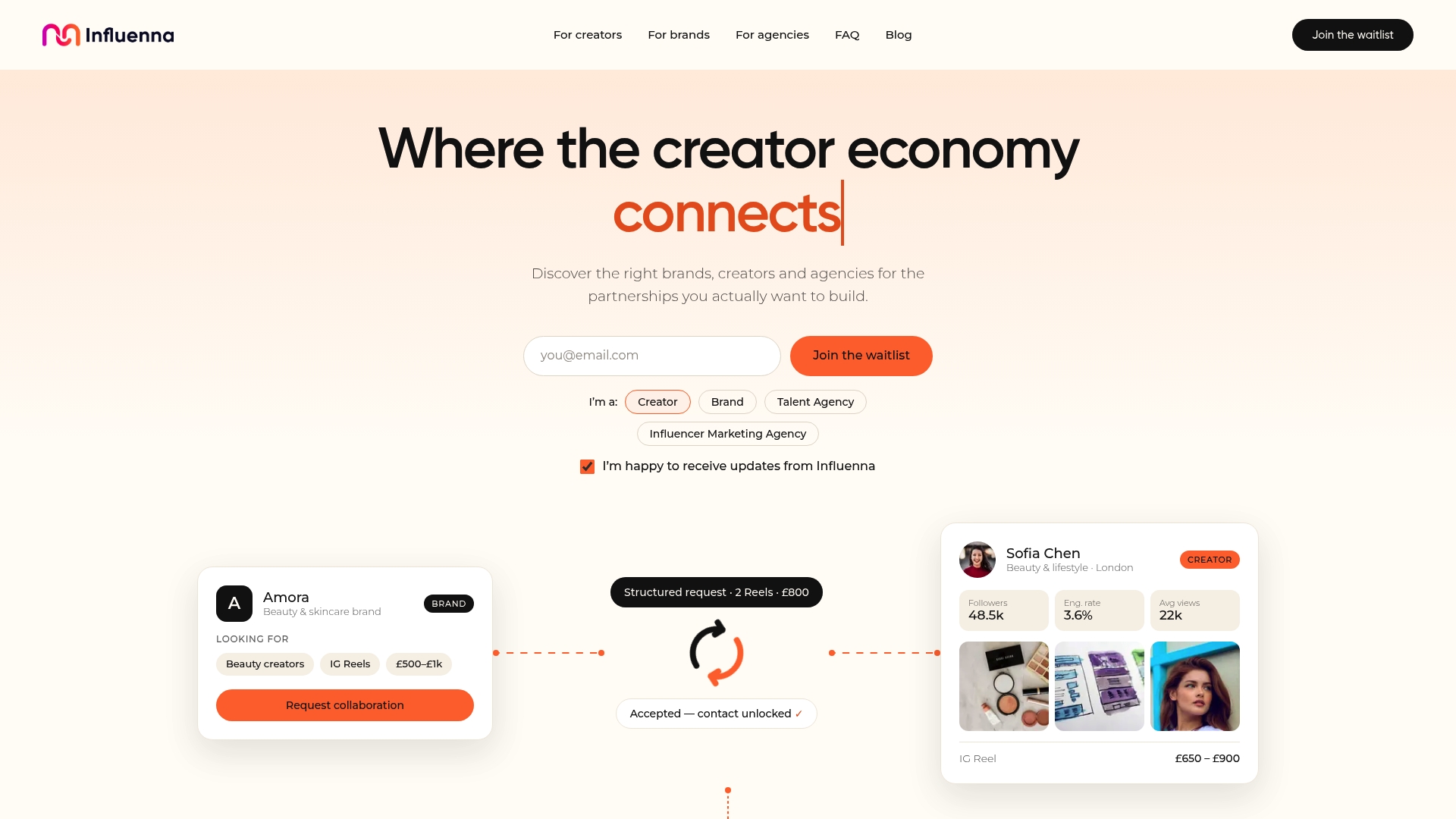
Instead of cold outreach, you send a structured collaboration request with real details upfront, budget expectations, deliverable type, timeline, and contact information only unlocks once both sides say yes. That means the approval workflow above starts with a partner who already knows the scope, instead of a creator you're still vetting mid-campaign. This type of service is currently pre-launch, with the public site running as a waitlist. Join the waitlist to get early access when discovery opens up.
Where to Check the Rules Yourself
Before you finalize a compliance checklist, read the source guidance directly rather than relying on secondhand summaries.
- The FTC's Disclosures 101 guide covers placement and wording examples for US campaigns.
- Multilogin's approval checklist breaks down asset-level sign-off practices.
- Truleado's workflow guide details stage sequencing and SLA benchmarks.
- The ISBA code applies to UK-facing campaigns specifically.
Sources
- Disclosures 101 for Social Media Influencers — FTC
- Influencer campaign checklist: Content approval guide — Multilogin
- Content approval workflow for influencer marketing — Truleado
- Federal Register: revisions and examples on endorsement rules (2023)
FAQ
What Is the Process for Approving Influencer Content?
The process runs through five stages: submission, internal review, project approval, client review, and a final approved or rejected status, with every sign-off recorded against a specific asset version.
What Are the Legal Requirements for Influencer Content?
Any material connection between a brand and creator must be disclosed clearly and conspicuously under FTC Endorsement Guides, with placement in both the caption and, for video, the on-screen or audio content.
How Do You Limit Revision Rounds Without Frustrating Creators?
Cap default rounds at two, lock disclosure and claims requirements into the brief before production starts, and require feedback that references the exact file version and location of the requested change.
Can Creators With 1,000 Followers Land Brand Deals?
Yes. Brands increasingly work with smaller creators for niche audience fit and engagement, and a curated platform like Influenna lets brands filter and discover creators by relevance rather than follower count alone.
What Belongs on an Influencer Content Approval Checklist?
Brief match, brand fit, factual claims, disclosure placement and wording, correct tags and links, final CTA, and confirmed usage rights before the asset publishes, per checklist guidance from Multilogin.