Creator Rate Card That Closes Deals in One Minute
15 min read

A creator rate card is a one-page document that lists what you charge for each platform and deliverable, plus what you charge extra for. Send it as a dated PDF with base rates, add-ons, and your booking contact listed separately from production costs. Brands move faster when the numbers are upfront, and clear line items stop a $500 post from quietly becoming a $2,000 job.
TL;DR:
- Setting your rates based on a range and adjusting for engagement ensures you are neither undervaluing nor overpricing your services.
- Clearly separating add-ons like usage rights, exclusivity, and rush fees from base rates helps brands see the full value and prevents hidden charges.
- Regularly updating your rate card and recording negotiated exceptions protects your income and provides leverage in future negotiations.
- A structured, easy-to-read format in a single-page PDF or live link improves clarity and speeds up brand responses.
- Crafting a private internal floor and a flexible range allows room to negotiate upwards with high-value partners without undermining your baseline.
Table of Contents
- What to Include on Your Creator Rate Card
- How to Set Your Rates: Benchmarks and a Defensible Method
- Add-Ons and Rights: Pricing Usage, Exclusivity, and Rush Work
- Layout, Templates, and How to Export Your Rate Card
- How and When to Share Your Rate Card
- When to Update Your Rate Card
- Why a Clear Rate Card Works: The Case for Structure
- Legal Considerations and Contract Integration
- Customizing Your Rate Card by Client Type
- Handling Pushback and Rate Disputes
- Common Mistakes Creators Make With Rate Cards
- Where Creators Get Rate Cards Wrong
- Sources
- FAQ
What to Include on Your Creator Rate Card
A rate card only works if a brand's marketing manager can read it in under a minute and know exactly what they're buying. That means structure matters as much as the numbers themselves. An itemized rate card that separates deliverables, base rates, and add-ons cuts down the back-and-forth that usually eats up a week of email.
Build your card around these sections:
- Header: your legal name, handle(s), primary platform(s), the date it was last updated, your currency, and a booking or contact link.
- Metrics: follower counts by platform, engagement rate, and a short line on your top audience geographies.
- Deliverables: each platform and format as its own line item (Instagram Reel, TikTok video, YouTube integration) with a base rate and a one-line scope note.
- Bundles: package pricing for multi-post deals, shown as a discount off the sum of individual line items, not a mystery number.
- Add-ons: usage rights, whitelisting, exclusivity, rush fees, and extra revisions, kept visually separate from your base rates so nobody assumes they're included.
- Exclusions: what you don't cover, plus any production costs (props, editing software, a second shooter) that get billed separately.
End with a short booking summary: how to reach you, your typical turnaround, and whether you require a signed agreement before production starts. That last point matters more than creators think. A card without it invites brands to treat your rates as a suggestion rather than a starting point.
How to Set Your Rates: Benchmarks and a Defensible Method
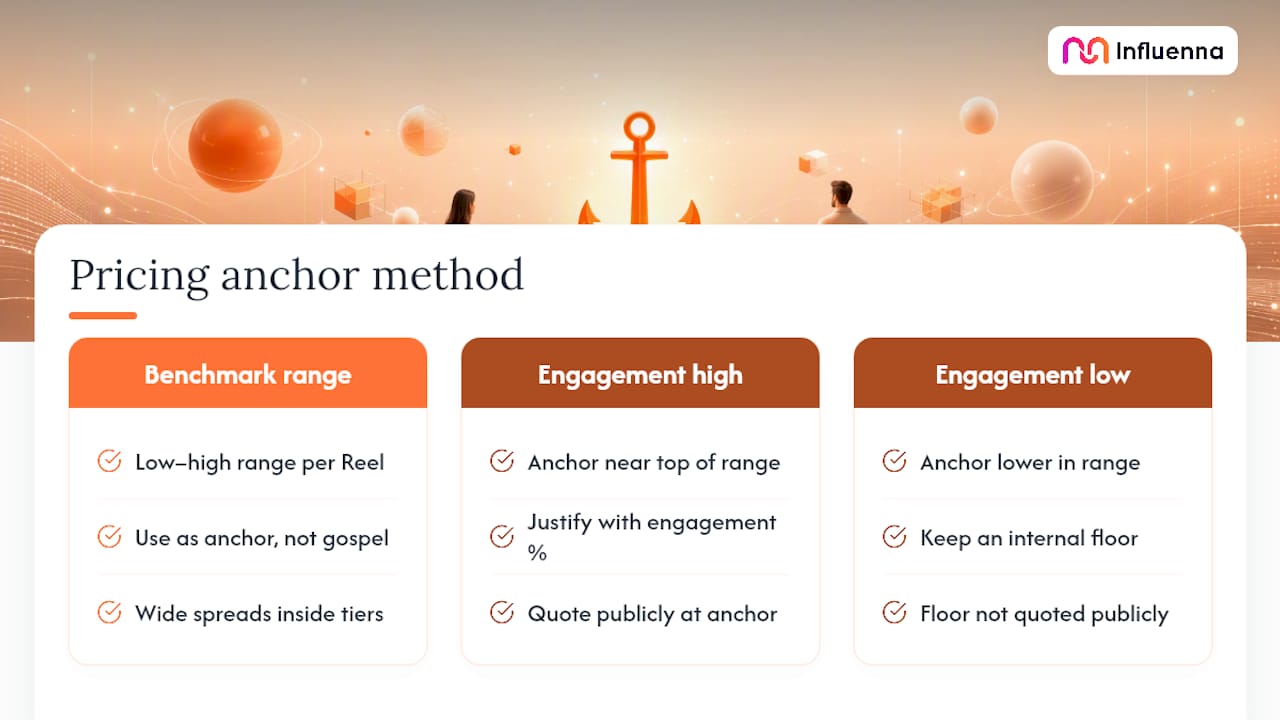
Start with a market range, not a market number. Published benchmarks by tier work as anchors, not gospel.
Benchmark ranges to anchor from: rate guidance sorted by creator tier shows nano and micro creators charging noticeably less per post than mid-tier and macro creators, with wide spreads inside each tier. Niche, engagement, and production complexity swing the number as much as follower count does.
Follower count alone tells a brand almost nothing about whether your audience actually acts. Engagement rate is the corrective. Calculate it as (likes + comments + saves + shares) ÷ followers, averaged over your last 10 to 15 posts, then expressed as a percentage. If your engagement rate sits meaningfully above the average for your tier, that's your justification for pricing at the top of the range instead of the middle.
Here's a simple worked approach: say your tier's benchmark range for a single Reel runs from a low to a high figure. If your engagement rate is running well above your tier's typical average, you anchor near the top of that range and justify it with the number. If it's below average, you anchor lower but hold a floor you never quote under, no matter how the negotiation goes. That floor lives in your internal notes, not on the public card. Ranges work better than single fixed prices when you're early in a tier or your niche has thin comparable data; fixed prices work once you have a track record of deals closing near a specific number.
Add-Ons and Rights: Pricing Usage, Exclusivity, and Rush Work
Base rates cover creating and posting content. Everything else, brands treat as optional until you make it clear it isn't. Rate cards that spell out usage rights, whitelisting, and exclusivity as separate items close bigger deals because the value is visible instead of assumed.
Define each add-on plainly on the card:
- Usage rights: the brand's license to repost your content on owned channels. Price this as a percentage of the base rate (commonly a modifier in the 50 to 100 percent range) tied to a duration, like 30, 90, or 180 days.
- Whitelisting/paid amplification: letting the brand run ads through your handle. This carries its own fee because it extends reach well past your organic audience.
- Exclusivity: you agree not to work with competing brands for a set window. Price by category and duration, not as a flat add-on.
- Rush fees: a flat surcharge or percentage bump for turnaround shorter than your standard timeline.
- Revisions: your first round is usually included; additional rounds get a flat fee per revision.
Always attach a duration and a territory to usage and exclusivity terms. "Usage rights, 90 days, North America" tells a brand exactly what they're budgeting for. "Usage rights included" does not, and it's the fastest way to give away paid media value for free.
Pro Tip: If a brand pushes back on a usage fee, ask what channels and budget they plan to run it through. Whitelisting for a six-figure ad spend is worth far more than a repost on the brand's own Instagram Stories, and your price should reflect that gap.
Layout, Templates, and How to Export Your Rate Card
Format decisions are not cosmetic. A clean, one-page layout with a clear grid reduces the friction that kills deals before a brand even replies.
- PDF for sending: locks the layout regardless of the device or software the brand opens it on.
- A live link for editing: a Notion page or slide deck works well as your internal, frequently updated master, with the PDF exported from it when you send to a brand.
- Three-column grid: deliverable, scope, and base price, with add-ons in a visually distinct block below or beside it.
- Legible typography: aligned price columns, consistent font sizing, and enough white space that a scanning eye finds the number fast.
- File naming: something like "YourName_RateCard_March2026.pdf" with "Updated: March 2026" printed on the card itself.
If you'd rather skip manual formatting entirely, tools like CollabKit's rate card generator can produce a shareable live link, which is handy when your rates change often enough that re-exporting a PDF every few weeks feels wasteful.
How and When to Share Your Rate Card
Timing changes how much leverage you keep. Send your rate card too early and you anchor a negotiation before you know the scope; send it too late and you waste days on email that a PDF could have settled in one reply.
- Send after the brief, not before. If a brand hasn't shared deliverables, timeline, and usage needs, ask for those first, then quote against the actual scope.
- Pair it with a short media kit when the brand is new to you, or send the rate card alone once you already have a relationship.
- Keep your outreach reply short: thank them, attach the card, and end with a direct call to book a call or confirm the deliverable.
- Follow up once after three to five business days if you hear nothing.
- Log any negotiated exception (a discount, a bundle you improvised) in your private master card so it doesn't quietly become your new default rate.
When to Update Your Rate Card
Check your numbers lightly every quarter and do a full reset annually. Update sooner if you cross a meaningful follower milestone, your engagement holds steady above your tier's average for two or three months, or you've closed several deals above your published rate without pushback. Keep an internal master card with your real floors, and archive each past version. Old cards become useful negotiation evidence when a returning brand tries to book you at last year's price.
Why a Clear Rate Card Works: The Case for Structure
A rate card only does its job if the person receiving it can act on it without a phone call. That's the gap Influenna was built to close on the discovery side: creators set rates and preferences on their own terms, brands and agencies see structured information upfront, and both sides send structured collaboration requests instead of cold DMs. Every account, whether creator, brand, talent agency, or influencer marketing agency, is reviewed by a person before it gets marketplace access, which cuts down the noise that makes outreach exhausting in the first place.
The logic behind a good rate card and the logic behind structured requests are the same: specificity saves everyone's time. A vague DM asking "what's your rate?" forces a creator to guess at scope. A rate card removes the guessing. Once you've built yours, pair it with the surrounding paperwork:
| Resource | What it covers |
|---|---|
| Influencer Contract Basics | Key clauses to add once a brand accepts your rate |
| UGC Rates in 2026 | Separate pricing for production-only content, no posting required |
| Media Kit Examples | What belongs in a media kit versus a rate card |
Legal Considerations and Contract Integration
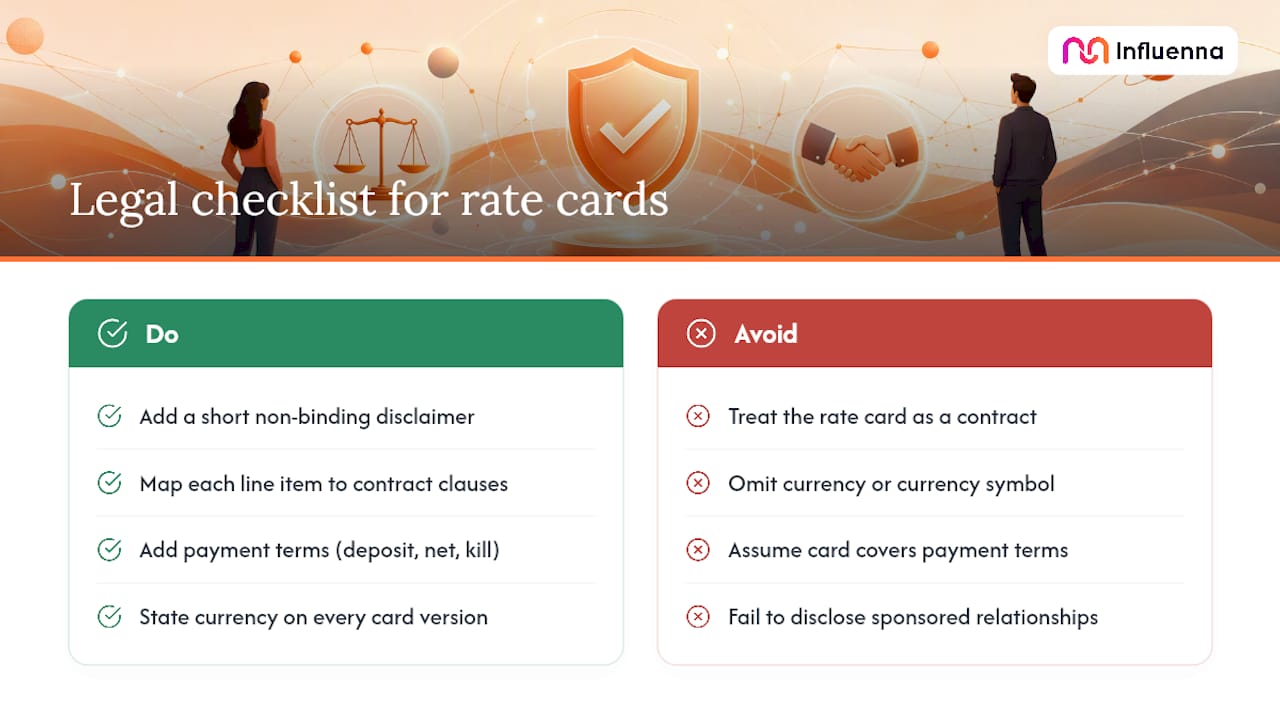
A rate card is not a contract, and treating it like one is a common source of disputes. It states your prices; it doesn't bind either party to specific dates, revision limits, or payment terms the way a signed agreement does. Add a short, non-binding disclaimer near the bottom, something like "Rates subject to change; final terms confirmed in a signed agreement," so nobody mistakes your published numbers for a locked quote.
Once a brand accepts your pricing, the rate card's line items should map directly into the contract: each deliverable becomes a clause, each add-on becomes its own paragraph with the duration and territory spelled out, and payment terms (deposit percentage, net payment window, kill fee) get added fresh since a rate card rarely covers them. If you're running sponsored content, the FTC's disclosure guidance requires you to make the commercial relationship clear to your audience regardless of what your contract says internally. That's a separate obligation from your pricing paperwork, but it's worth noting on your card or in your standard contract template so brands know you'll disclose and expect them to support that requirement rather than push against it.
Currency matters here too. If you work with international brands, state your currency explicitly on every version of the card. A number with no currency symbol invites the wrong assumption, usually in the brand's favor.
Customizing Your Rate Card by Client Type
A single flat card works fine for casual inbound interest, but it undersells you once you're negotiating with different kinds of buyers. Agencies, for instance, often manage multiple creators and multiple brand clients from one seat, and they're comparing your card against a roster of other creators in real time. For agency-facing versions, lead with your strongest metrics and keep bundle pricing visible, since agencies frequently buy in volume across a campaign.
Direct-to-brand deals, especially with a marketing manager who's new to influencer work, benefit from more explanatory language: a short definition of what usage rights actually mean, rather than assuming they already know the term. Enterprise brands running larger campaigns tend to ask about whitelisting and exclusivity early, so keep those add-ons prominent rather than buried at the bottom.
If you work across industries (beauty, tech, finance, food) consider a version of your card with industry-specific scope notes. A tech brand might need a longer usage window for evergreen ad creative; a food brand might want to discuss recipe adaptation as a separate line item. You don't need five different documents, but a few swappable scope lines saves you from re-explaining the same thing every time a new vertical reaches out.
Handling Pushback and Rate Disputes
Pushback is normal, and how you respond sets the tone for every future deal with that brand. When a brand says your rate is too high, ask what budget they're working with before you drop your number. Sometimes the real issue is scope, not price, and trimming a deliverable solves it without touching your rate.
If a brand cites a competitor's lower price, resist matching it blind. Ask what that competitor's deal actually included. Rates without matching scope and add-ons aren't comparable, and pointing that out usually ends the comparison quickly. When a brand insists on usage rights or exclusivity "for free" as part of the base deal, hold your line on pricing that add-on separately. It's the single most common way creators quietly lose money.
Document every negotiated exception. If you agreed to a discount for a first-time brand or bundled two deliverables at a lower combined rate, note it in your internal master card. That record protects you the next time the same brand comes back expecting the same discount as a permanent rate rather than a one-time concession.
Common Mistakes Creators Make With Rate Cards
The most expensive mistake is bundling usage rights and exclusivity into the base rate instead of pricing them separately. It feels simpler in the moment, but it trains brands to expect full usage for free, and unwinding that expectation later is much harder than setting it correctly from the start.
Close behind that: no expiration date on the card. Rates without a visible "Updated: [Month] [Year]" stamp get quoted back at you a year later at outdated prices. Conflating sponsorship pricing with UGC production fees is another common trap. Sponsorship includes your distribution and audience; UGC is a production-only fee for content the brand posts themselves. They deserve separate menus, not one blended number.
Other frequent errors: sending a rate card before knowing the brief, so you quote against guesswork instead of actual scope; skipping the non-binding disclaimer, which lets brands treat a quote as a locked deal; and never adjusting rates as engagement grows, which quietly erodes income even as your audience and results improve.
Where Creators Get Rate Cards Wrong
Most rate card advice treats pricing as a math problem: plug in your follower count, apply a formula, get a number. That's backwards. The number matters less than the structure around it. A creator charging a modest rate with clean line items for usage, exclusivity, and rush work will out-earn a creator charging double with a vague, bundled price, because the first creator has room to add value on top of the base rate and the second one doesn't.
The conventional wisdom to publish exact fixed prices also deserves pushback. Fixed numbers work once you have a track record, but early on, a published range with a private floor gives you room to price up for strong-fit brands without looking like you're gouging a smaller one. What matters most, in order: separate your add-ons before you touch your base rate, know your floor before a brand asks, and update the card on a real schedule instead of leaving it stale for two years. Everything else, fonts, layout, exact dollar figures, is secondary to getting those three things right.
— Igor
Sources
- Disclosures 101 for Social Media Influencers — FTC
- Influencer Rate Card 2026: Complete Pricing Benchmarks for Every Creator Tier — InfluencerFee
- Influencer rate card template — Selene the Lawyer
- How to create an influencer rate card — Backstage
FAQ
How Do I Make an Influencer Rate Card?
List each platform and deliverable as its own line item with a base rate, add a separate block for add-ons like usage rights and exclusivity, and export it as a dated one-page PDF with your currency and contact link.
What Rates Should Influencers Expect in 2026?
Rates vary widely by tier, niche, and engagement, so treat published benchmark ranges as starting anchors rather than fixed numbers, and adjust up or down based on your own engagement rate.
What Rate Should I Charge as an Influencer?
Start with your tier's benchmark range, then anchor near the top if your engagement rate runs above average for that tier and lower if it runs below, while keeping a private floor you never quote under.
How Much Should a Brand Pay a Content Creator?
Pay should reflect the base deliverable plus any add-ons requested, since usage rights, whitelisting, and exclusivity each carry separate value beyond the cost of simply creating and posting the content.