Creators & Brands: Price Influencer Exclusivity Clauses (25%–150%)
13 min read

Exclusivity is reasonable when it's scoped to a specific campaign or a paid ambassador relationship, not when it locks out a creator's entire category for a year with no extra pay. If a brand asks for it, do two things immediately: pin down the exact scope in writing, and price exclusivity as its own line item, separate from the content fee. The benchmarks, redlines, and scripts below show exactly how.
TL;DR:
- Exclusivity should be limited to specific campaigns or paid ambassador relationships, with clear scope and separate pricing, not long-term category bans without extra compensation.
- Narrow, 30-day exclusivity generally adds about 25% to the base fee, while six-month or annual broad exclusivity can require a 75% to 150% increase.
- Ambiguous language like "adjacent" categories or open-ended brand discretion increases legal risk and should be replaced with specific competitor lists and defined content types.
- A fair exclusivity clause involves defined start and end dates, carve-outs for existing deals, and limits on post-term restrictions, ideally focusing on pay-per-blocked revenue.
- Enforceability depends on proportionate restrictions and clear contractual terms; unpaid posts and organic content remain outside the scope of exclusivity.
Table of Contents
- What Is an Influencer Exclusivity Clause, and When Does It Make Sense?
- The Four Types of Exclusivity Clauses You'll Actually See
- How Much Should You Charge for Exclusivity? Pricing Benchmarks and the Math
- Scope and Redlines: The Contract Language to Fix Before You Sign
- Duration, Post-Term Tails, and Geographic Scope
- Is an Exclusivity Clause Legally Enforceable?
- Sample Exclusivity Clauses You Can Adapt
- How to Negotiate Exclusivity Without Losing the Deal
- Why Clarity on Exclusivity Terms Changes the Whole Deal
- Find Brand Deals With Exclusivity Terms Spelled Out From the Start
- Sources
- FAQ
What Is an Influencer Exclusivity Clause, and When Does It Make Sense?
An influencer exclusivity clause is contract language that stops a creator from working with a brand's competitors for a set window, in exchange for the current deal. Brands ask for it because a campaign loses value fast if a creator posts a rival's product the next week. A skincare brand paying for a launch video doesn't want that same face selling a competing serum before the campaign even finishes running its course. That's a legitimate commercial interest, and it's the standard most jurisdictions use to judge whether the clause is fair.
The trade-off lands entirely on the creator's side. Turning down other category deals means real opportunity cost, and for someone running a content business, a six-month lockout can mean a real dip in pipeline. Whether that trade is worth it depends on the deal type:
- One-off campaign deals justify narrow, short exclusivity: a few weeks around the launch, tied to a specific product.
- Ambassador or retainer deals justify broader exclusivity, but only with proportionally higher pay.
- High campaign investment (paid media spend, major production budget) gives the brand a stronger case for asking.
- Frequent category deals on the creator's side should push the fee up, since more deals get blocked.
The Four Types of Exclusivity Clauses You'll Actually See
Exclusivity clauses vary a lot in how they're written, and the wording is what determines how much they actually cost a creator. CreatorLane's breakdown of exclusivity language identifies a few recurring structures worth knowing before you sign anything:
- Category exclusivity blocks an entire product category ("skincare," "meal delivery"). This is the broadest and most abused version. Brands often write it wider than they need, catching adjacent categories the creator never touched.
- Named-competitor exclusivity lists specific rival companies by name instead of a whole category. Creators should push hard for this version. It's narrower, easier to comply with, and far easier to defend if a dispute ever comes up.
- Platform-limited exclusivity restricts only one channel, say, Instagram paid posts, while leaving TikTok or YouTube open. Brands legitimately ask for this when their spend is concentrated on a single platform and they don't need broader control.
- Ambassador or full exclusivity covers every platform, every category-adjacent brand, sometimes even personal social use. This only makes sense attached to a retainer, and it should carry the highest fee on this list by a wide margin.
How Much Should You Charge for Exclusivity? Pricing Benchmarks and the Math
Exclusivity has a market price, and it should never be folded quietly into the base content fee. According to CreatorLane's pricing data, narrow 30 day exclusivity typically adds around 25% on top of the base fee.
| Exclusivity window | Scope | Typical uplift |
|---|---|---|
| 30 days | Narrow, single product | ~25% |
| 60 to 90 days | Named competitors, one category | 40% to 75% |
| annual | Broad category or ambassador | 75% to 150% |
The cleanest way to land on a number is the opportunity-cost method. Estimate how many category deals you'd realistically turn down during the window, multiply by your average deal rate, then apply a multiplier for uncertainty. Flare's guidance on non-compete clauses recommends a 1.5x to 2x multiplier on that blocked-revenue figure, since you're pricing risk, not just lost income.
A worked example: if you'd normally land two $2,000 category deals over a 90-day span, that's $4,000 in blocked revenue. Itemizing this way does two things: it gives the brand a defensible number instead of a guess, and it creates separate consideration, which matters if the clause is ever challenged.
Scope and Redlines: The Contract Language to Fix Before You Sign
Vague exclusivity language is where most creators get burned, not the fact of exclusivity itself. Three words show up constantly in first-draft contracts, and all three deserve a redline:
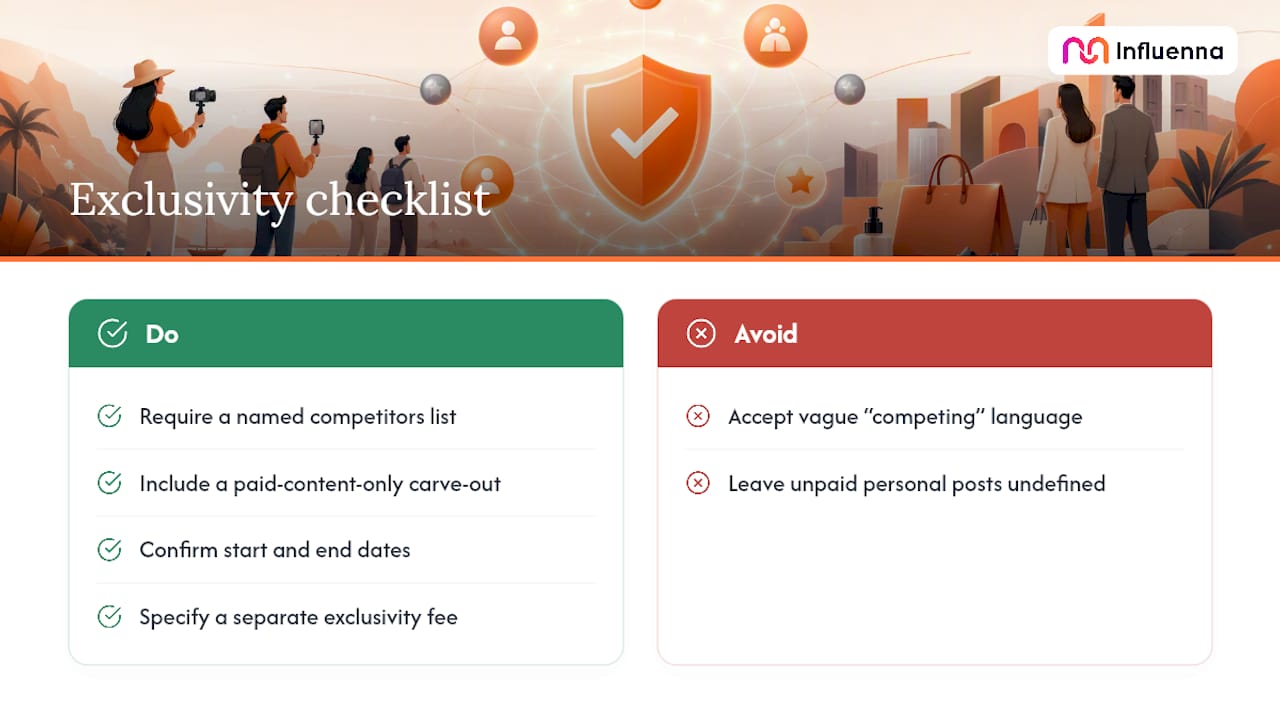
- "Promote" with no definition. Does liking a competitor's post count? Following them? Get it narrowed to "paid, sponsored content" only.
- "Adjacent" categories or brands. This word alone can turn a skincare deal into a ban on haircare, supplements, and wellness apps. Ask for a named list instead.
- Open-ended brand discretion ("brand may determine competitors at its sole discretion"). This lets the other side redefine the restriction after signing. Strike it entirely.
Paperclip's negotiation guide recommends demanding a specific competitor list or a narrow product category instead of open language, and limiting the restriction to paid or sponsored content so organic posts, personal opinions, and unpaid mentions stay untouched. Also insist on a carve-out for any deals already signed before this contract, dated and listed by name, plus explicit start and end dates for the exclusivity window itself, not "upon posting" or another vague trigger.
Pro Tip: Keep a running list of every brand deal you've signed, with dates. When a new contract lands, you can carve out existing deals in minutes instead of scrambling to remember what you agreed to six weeks ago.
Duration, Post-Term Tails, and Geographic Scope
How long exclusivity runs, and what happens after it technically ends, changes the math more than most creators expect. A 30 to 60 day window tied to a single launch is proportionate for most one-off deals. Anything past 90 days should come with ambassador-level pay, not campaign-level pay.
- Post-term tails extend restrictions past the contract's end date, often 30 to 60 days, according to Flare's negotiation guidance. Cap the tail at that range unless the brand compensates for it separately.
- Global exclusivity costs a lot more than market-limited exclusivity, since it blocks every regional deal, not just local ones. Push for a specific country or region whenever the brand's own campaign is regional anyway.
- Platform-only exclusivity (Instagram paid posts only, say) is often the best compromise on the table. It protects the brand's specific investment while leaving YouTube or TikTok fully open for other income.
Is an Exclusivity Clause Legally Enforceable?
Enforceability isn't automatic just because a clause is signed. Courts generally weigh whether the restriction is proportionate to a legitimate business interest, and Gowling WLG's overview of influencer law notes that exclusivity has measurable market value and should be priced against the income it actually blocks. A few practical points matter here regardless of jurisdiction:
- Broad, undefined restrictions are the ones most likely to get challenged as unreasonable, according to LegalLens's analysis of UK exclusivity clauses.
- A separately paid exclusivity fee, documented in writing, gives the clause stronger legal footing than exclusivity buried inside a flat content fee.
- Disclosure obligations for paid partnerships don't disappear because of an exclusivity clause. Creators still need to flag sponsored content clearly, on every platform, every time.
- Long windows, high-value retainers, or anything crossing borders is worth a short call with a lawyer before signing, not after a dispute starts.
Sample Exclusivity Clauses You Can Adapt
Seeing the actual language helps more than a description of it. Here are two short samples, with notes on what to change before either goes near a signature.
Sample 1, named-competitor exclusivity: "Creator agrees not to publish paid content promoting [Competitor A], [Competitor B], or [Competitor C] between [start date] and [end date]." Redline note: the named list is doing the work here. If a brand's draft says "any competing skincare brand" instead, push back until it names names.
Sample 2, paid-content-only carve-out: "This exclusivity applies solely to sponsored or paid content. Creator's organic, unpaid posts and personal social activity are expressly excluded." Redline note: without this line, a brand could argue an unpaid personal post violates the clause. Get it in writing.
Before signing anything with an exclusivity clause attached, run through a short checklist: confirmed start date, confirmed end date, named carve-outs for existing deals, and a separate dollar figure for the exclusivity itself, not folded into the content fee.
How to Negotiate Exclusivity Without Losing the Deal
Pushing back on exclusivity doesn't have to sound confrontational. Framing it as a pricing conversation, not a refusal, keeps the deal alive while getting you paid fairly. A short email response might read: "I'm glad to include exclusivity for the campaign window. Since it limits other category income during that time, I'd like to add a separate exclusivity fee of [amount], and narrow the competitor list to the three named brands you mentioned."
Three levers move in a negotiation like this, and you rarely need to touch all three at once:
- Scope — narrow category language down to a named list.
- Duration — shrink the window, or push the fee up if the brand won't budge on length.
- Fee — add or increase the exclusivity payment to match whatever scope and duration you land on.
Know your walk-away signals ahead of time. Open-ended exclusivity with no end date, an organic-content ban with no separate pay, or "brand's sole discretion" language are all reasons to stop the conversation rather than keep negotiating. Once you agree on changes, get every one of them written into the signed contract itself, not left as a verbal understanding in an email thread that nobody reads again. The MYB Workshops guide to working with influencers covers similar ground from the brand side, worth a read if you're structuring the offer rather than receiving it.
Why Clarity on Exclusivity Terms Changes the Whole Deal
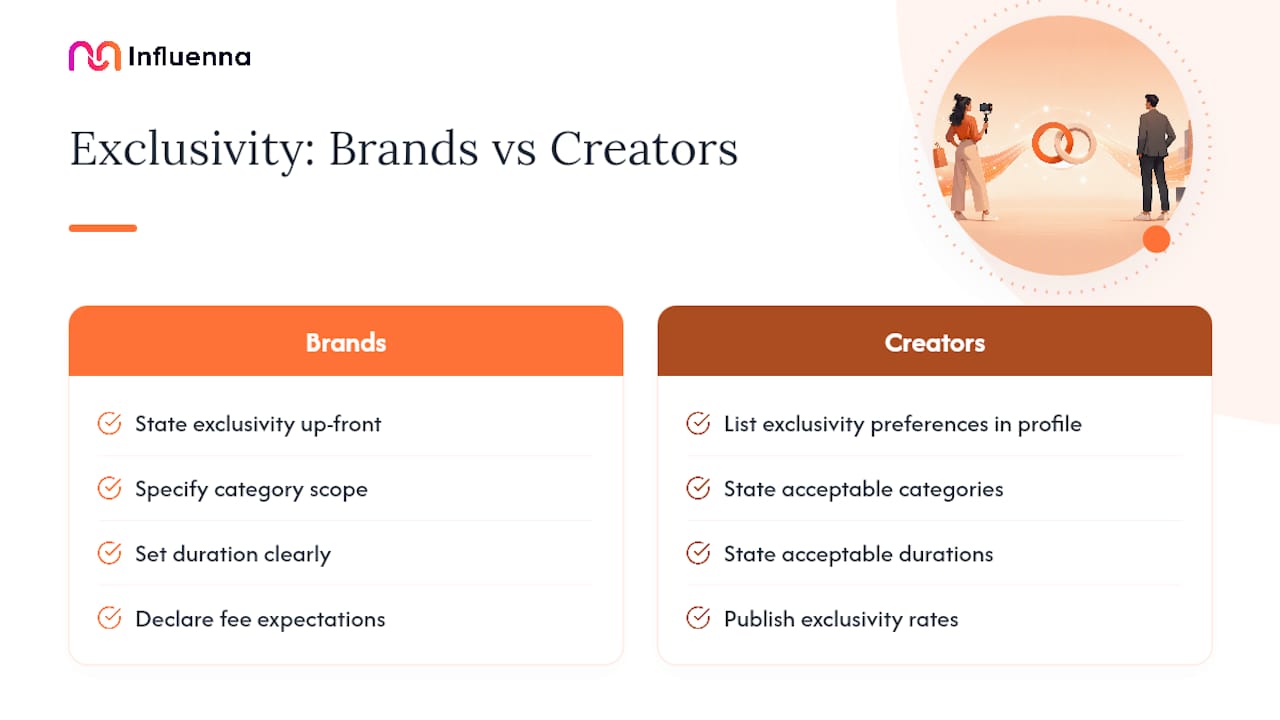
Most exclusivity disputes trace back to the same root problem: nobody stated the terms clearly before work started. A brand assumes "exclusivity" means one thing, a creator assumes another, and the gap only surfaces once someone posts for a competitor. Structured collaboration requests fix this by forcing scope and terms onto the table before either side commits to anything.
Brands get better outcomes when they state exclusivity requirements up front, category, duration, fee expectations, rather than negotiating it after a creator has already said yes to the broader deal. Creators benefit just as much from listing their own exclusivity preferences and rates in their profile, since it filters out mismatched offers before a conversation even starts. Clear terms early save both sides a renegotiation later, and they tend to produce partnerships that actually last past one campaign.
— Igor
Find Brand Deals With Exclusivity Terms Spelled Out From the Start
Cold DMs and vague briefs are exactly where exclusivity disputes start, because nobody defines scope until the contract is already in someone's inbox. Influenna works differently: creators list their rates and exclusivity preferences on their profile, brands send structured collaboration requests instead of cold outreach, and contact details only unlock once both sides approve the match.
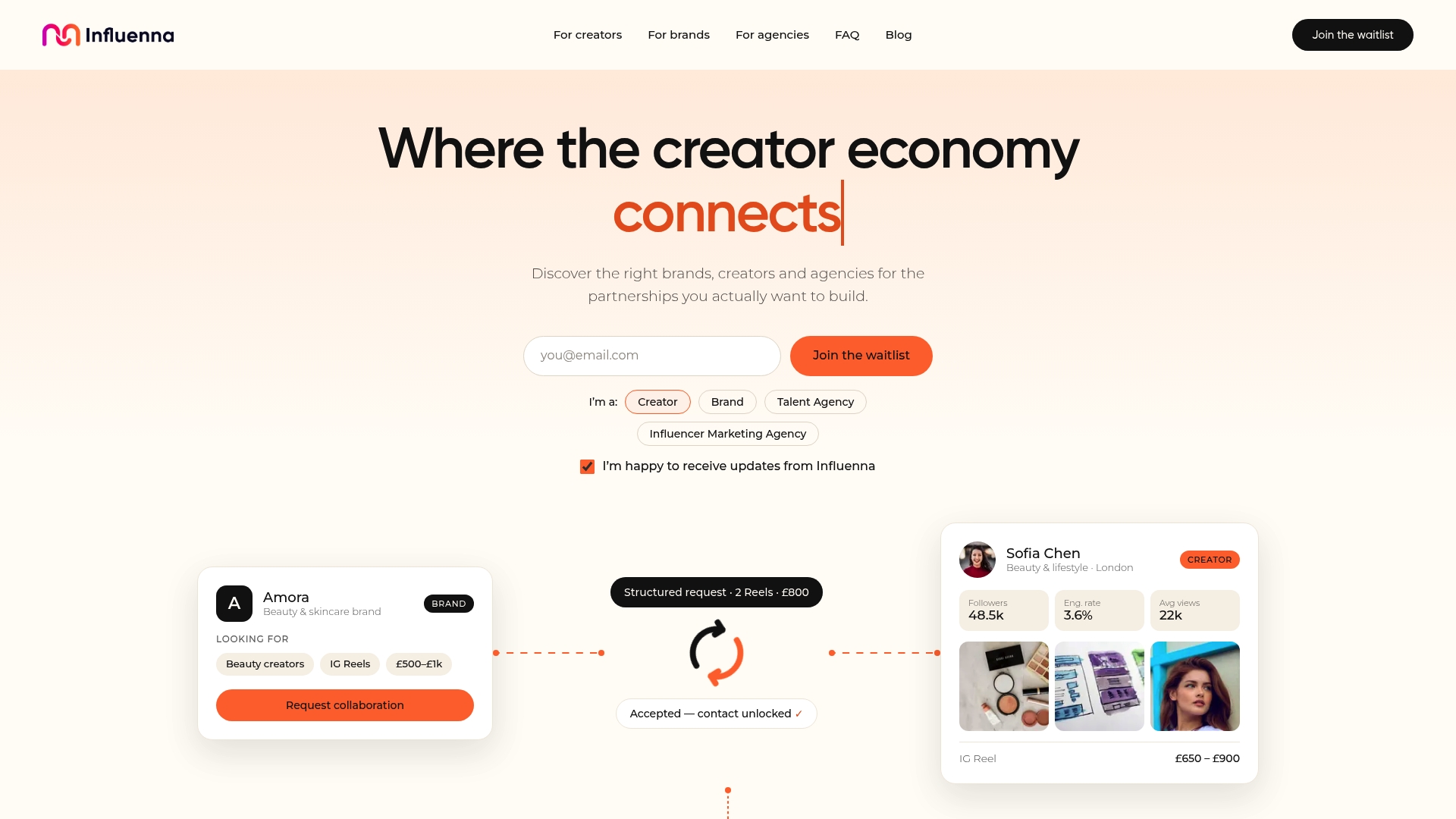
That means a creator can state upfront that they'll consider named-competitor exclusivity for a fee, but won't touch category-wide bans, before a single message gets exchanged. A brand marketer structuring an ambassador deal can filter for creators already open to that kind of commitment, instead of pitching blind and negotiating scope from scratch every time. Every account on Influenna is reviewed by a person before joining, so the requests you receive come from real, vetted partners, not spam. If you want your exclusivity terms clear before a conversation even starts, join the Influenna waitlist and set your preferences before your next deal lands.
Sources
- Exclusivity Clause — Definition & Examples (CreatorLane)
- Non-compete clause in brand deals: what creators must know (Flare)
- Influencer exclusivity clauses UK 2026: What they mean and how to negotiate (LegalLens)
- Influencer Law 101: influencer exclusivity (Gowling WLG)
FAQ
What is an exclusivity clause in an influencer agreement?
It's contract language that stops a creator from working with a brand's competitors for a defined period, usually in exchange for compensation tied specifically to that restriction, not the base content fee.
How much should influencers charge for exclusivity?
Benchmarks vary by duration: narrow 30 day exclusivity often adds around 25% to the base fee, 60 to 90 days commonly adds 40% to 75%, and broad exclusivity running six months or a year can reach 75% to 150% depending on scope and usage rights.
What is an example of an exclusivity clause?
A typical version reads: "Creator agrees not to publish paid content promoting [named competitors] between [start date] and [end date]," with organic and unpaid posts explicitly excluded.
Do influencers have to disclose paid partnerships even under an exclusivity deal?
Yes. Disclosure obligations for sponsored content apply regardless of any exclusivity clause, and creators need to flag paid partnerships clearly on every platform where the content runs.
How long should an exclusivity window last?
Thirty to 60 days is proportionate for most single-campaign deals; anything longer, especially six months or a year, should come with ambassador-level pay rather than a standard content fee.