Marketers, Pick Brand Ambassador vs Influencer by Budget and Ownership
12 min read

Influencers rent you an audience for a moment; brand ambassadors compound trust over time. Pick influencers when you need to reach fast, for a launch or a seasonal spike. Pick ambassadors when repeat purchase and retention matter more than a single burst of impressions, and you have someone internally who can own the relationship.
TL;DR:
- Influencers are suited for quick, short-term campaigns focused on immediate visibility, while ambassadors build long-term trust and encourage repeat purchases.
- Contract durations for influencers typically last one to three campaigns, whereas ambassadors commit for three to twelve months with category exclusivity.
- Key performance indicators for influencer success are reach, impressions, and engagement, while ambassador metrics include repeat sales, customer lifetime value, and long-term revenue.
- Long-term ambassador programs require dedicated ownership and unified tracking to prevent budgets from becoming untracked sunk costs.
- It is advisable to test multiple creators over several campaigns before offering long-term ambassador agreements, ensuring their audience and performance align with brand goals.
Table of Contents
- Brand Ambassador vs Influencer: The Core Differences That Affect Campaign Planning
- How Do You Choose Between an Ambassador and an Influencer?
- What Should Contracts and Payment Terms Actually Include?
- Which Metrics Actually Prove Each Model Is Working?
- How Do You Turn a High-Performing Influencer Into an Ambassador?
- What Marketers Consistently Get Wrong About This Choice
- A Curated Way to Find the Right Creators for Either Model
- Sources
- FAQ
Brand Ambassador vs Influencer: The Core Differences That Affect Campaign Planning
The two roles get lumped together constantly, and that's the first mistake. An influencer is a creator paid per post or per campaign to promote a product to their existing audience, usually with no long-term obligation. A brand ambassador is a creator (or sometimes a customer) who commits to representing a brand over months, often exclusively within a category, in exchange for a retainer, commission, or ongoing product access. One is a transaction. The other is a relationship with a paycheck attached.
That distinction shows up everywhere once you look for it: contract length, how you pay, how much creative control you keep, and how fast you expect a return.
Time horizon and contract shape. Influencer deals are typically one-off or short bursts, three to five posts tied to a launch window. Ambassador agreements run three to twelve months, often with renewal options and category exclusivity clauses that keep the creator from repping a competitor. Shopify's guidance on influencer strategy recommends building a portfolio that blends both, then converting the strongest short-term performers into longer commitments.
Compensation shape. Influencer fees are usually flat, sometimes with a performance kicker. Ambassador pay tends to layer a smaller base retainer with commission on sales, plus free product. You're not paying for a post; you're paying for a standing relationship, which means the invoice looks different every month.
Content and production value. Influencer content is often more polished, shot with intention, built to convert in a single scroll as explained in personal branding photography for creatives. Ambassador content reads more like a real person actually using the product week after week, which is exactly the appeal; audiences trust it because it doesn't look like an ad campaign. HubSpot's research on influencer marketing found that a majority of marketers say influencer content outperforms branded content, and many consumers report buying items because of influencer posts. That number explains why influencer spend keeps climbing, but it also explains a blind spot: a single high-performing post tells you nothing about whether that creator will still be moving product in month six.
Operational ownership. A one-off influencer campaign can run through a single point of contact and a shared drive. An ambassador program needs someone who checks in weekly, manages a content calendar, and tracks whether the relationship is still paying for itself. Skip that step and a retainer quietly turns into dead weight.

ROI timing. Influencer campaigns produce a visible spike, then decay fast, usually within the first week or two after posting. LoudCrowd's analysis of ambassador versus influencer economics argues that ambassadors function as an always-on retention layer, converting trial customers into repeat buyers, with returns that compound rather than spike. The global influencer market has grown large enough that budget waste from short-term-only thinking is now a real line-item risk, not a rounding error.
Here's the quick-reference version:
- Contract length: influencer, one campaign; ambassador, 3 to 12 months minimum
- Pay structure: influencer, flat fee or commission; ambassador, retainer plus commission plus product
- Exclusivity: influencer, rare; ambassador, common within category
- Content style: influencer, polished and campaign-specific; ambassador, ongoing and lived-in
- Best ROI window: influencer, immediate; ambassador, after a payback period, commonly six to twelve months
How Do You Choose Between an Ambassador and an Influencer?
Start with three questions before you touch a budget spreadsheet.
- What's the business goal? Awareness and launch velocity point toward influencers. Retention, repeat purchase, and category trust point toward ambassadors.
- How does the product get bought? A one-time purchase (a course, an event ticket, a single gadget) rarely justifies a long ambassador retainer. A subscription, a consumable, or anything with a repeat-purchase cycle benefits from a face customers see again and again.
- Who inside the company owns this? If nobody has bandwidth to manage a relationship past the invoice, don't sign an ambassador contract. A one-off influencer post doesn't need a program manager. An ambassador does.
A simple decision rule: if the product has a repeat-purchase pattern and someone internally can own the relationship, go ambassador. If you need a burst of visibility for a launch and you have no bandwidth for ongoing management, go influencer, and revisit the decision after the campaign closes.
A skincare brand launching a new serum, for example, typically wants influencer reach in the first month to seed awareness, then shifts its best-performing creators into ambassador terms once repeat orders begin to appear. A software company launching a single feature update has less use for a long-term ambassador and more use for a wave of influencers who can each hit a different niche audience in the same week.
Pro Tip: Don't decide the model before you decide the metric. If you can't name the KPI that will tell you the campaign worked, you're not ready to sign either kind of contract.
What Should Contracts and Payment Terms Actually Include?
Money conversations get vague fast, mostly because nobody wants to say the quiet part: what you're actually buying is attention, and attention has wildly different price tags depending on the deal shape.
One-off influencer deals are usually priced as a flat fee per deliverable, sometimes with an affiliate-style commission layered on top for tracked sales. Ambassador agreements generally involve a monthly or quarterly retainer, a commission percentage on attributed revenue, and product access as part of the compensation.
A handful of contract clauses matter more than the rest:
- Exclusivity scope. Define the category, not just competitors by name. "No skincare brands" protects you better than a list of five logos.
- Content usage rights. Spell out whether you can repurpose creator content in paid ads, on your own site, or in future campaigns, and for how long.
- Notice and termination terms. Ambassador retainers need a clean exit clause. Thirty days' notice is common and fair to both sides.
- Disclosure language. Every paid or gifted post needs clear disclosure per FTC endorsement guidelines, regardless of whether the creator is a one-time influencer or a year-long ambassador.
Budget the way you'd budget headcount, not the way you'd budget a media buy: look at annual outlay per ambassador relationship, not the per-post rate. Monthly retainers for ambassadors may seem cheaper than single influencer posts but add to a significant annual commitment.
Which Metrics Actually Prove Each Model Is Working?
Influencer campaigns and ambassador programs fail when marketers judge them by the same yardstick. Sprout Social's guidance on influencer measurement draws the line clearly: influencer activations get measured with short-window ad-style metrics, while ambassador programs need to be evaluated against purchase and retention data that only shows up months later.
Short-term KPIs that fit influencer campaigns:
- Cost per thousand impressions (CPM)
- Reach and impressions
- Engagement rate and click-through rate (CTR)
- Promo-code redemptions in the days following a post
Long-term KPIs that fit ambassador programs:
- Attributed revenue tied to a unique code or link
- Repeat purchase lift among customers who engaged with an ambassador's content
- Customer lifetime value (LTV) uplift compared to non-exposed customers
- Earned media value (EMV) accumulated across the relationship
The practical measurement tactics overlap more than people expect. Unique promo codes and UTM-tagged links work for both models, but ambassador programs benefit from holdout groups, comparing a segment of customers exposed to ambassador content against a segment that wasn't, to isolate the lift. Get consent upfront to repurpose content for paid ads; it turns a single ambassador post into an asset you can run for months. Running both influencer campaigns and ambassador relationships through the same reporting system makes creator-level comparisons possible instead of guesswork.
That's real leverage, but it's leverage for awareness, not proof of retention.
How Do You Turn a High-Performing Influencer Into an Ambassador?
The lowest-risk way to build an ambassador roster isn't to go recruit strangers cold. It's to watch who already performs, then upgrade them.
- Run three to five short influencer campaigns across a category of creators before committing to anyone long-term. This gives you real performance data instead of a gut call.
- Track three signals during those campaigns: conversion performance (did their audience actually buy), ease of collaboration (did they hit deadlines and follow brief), and audience fit (does their following match your actual customer).
- Offer ambassador terms to the top one or two performers, typically after 60 to 90 days of visible results, with a trial period of three months before locking in a longer contract.
Once someone's in, the onboarding checklist matters more than the offer letter. Set a brief cadence (weekly or biweekly), define reporting expectations up front, and structure incentives so the creator earns more as attributed revenue grows, not just for showing up.
Pro Tip: Ask a candidate ambassador how they'd explain your product to a friend, unscripted. If the answer sounds like your own marketing copy, they're performing for you, not representing you. That's the wrong signal for a long-term deal.
What Marketers Consistently Get Wrong About This Choice
Most ambassador programs don't fail because the strategy was bad. They fail because nobody owned them. A retainer without a named internal manager quietly becomes a sunk cost, an invoice nobody remembers the reason for, a creator posting into the void because no one's giving feedback or tracking results.
The second recurring mistake is running influencer and ambassador data in separate spreadsheets, or worse, separate heads. If you can't compare a creator's performance as a one-off influencer against their potential as an ambassador, using the same numbers, you're deciding on instinct, not evidence.
The fix in both cases is structural, not creative. Assign ownership before signing anyone. Keep every creator relationship, short-term or long-term, in one place. And be honest that most of the wasted budget in this space comes from a tactical trap: running activations because a competitor did, without a documented reason tied to a business goal.
— Igor
A Curated Way to Find the Right Creators for Either Model
Sourcing creators for a one-off campaign or a long-term ambassador roster usually means the same slow grind: sifting through cold DMs, guessing at rates, and chasing media kits that never quite match what you need. Influenna approaches it differently. Every creator, brand, and agency account is reviewed by a person before it gets access, so you're searching a pool that's already been vetted rather than scraping profiles and hoping for a reply.
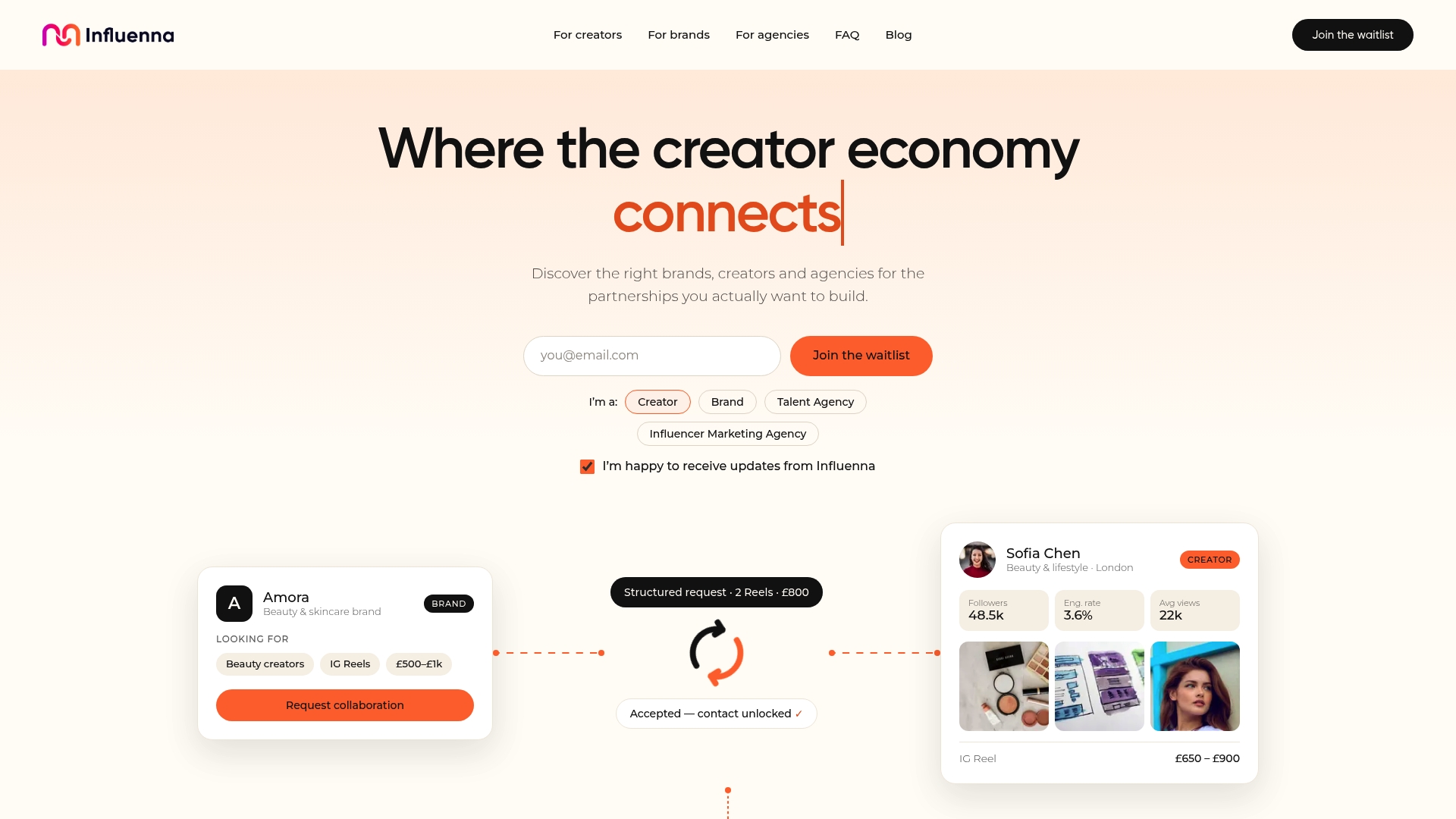
Instead of cold outreach, you send a structured collaboration request with real details upfront, budget range, deliverables, timeline, and contact information unlocks only once both sides approve. That structure matters more for ambassador searches than one-off influencer bookings, since you're evaluating fit for a relationship that might run a year, not a single post. Whether you're scouting a wave of influencers for a launch or trying to find the two or three creators worth a longer retainer, a curated pool beats a cold inbox. Join the Influenna waitlist to get access once the platform opens.
Sources
- Influencer Marketing Strategy: How to Build a Plan Creators & Customers Will Love + Templates — HubSpot
- Influencer marketing strategy — Shopify (Enterprise blog)
- Influencer marketing — Sprout Social
- Global influencer market size — Statista
- Brand Ambassador vs Influencer: Which One Actually Drives Revenue? — LoudCrowd
FAQ
Can a regular person become a brand ambassador?
Yes. Brands increasingly recruit ambassadors from their own customer base, not just established creators, especially for products with a loyal repeat-purchase audience.
What qualifies someone to be a brand ambassador?
Genuine product use, an engaged (not necessarily huge) audience, and reliability, showing up on schedule and representing the brand consistently over months matter more than follower count.
Is it better to be an affiliate or an ambassador?
Affiliates get paid purely on tracked sales with no ongoing relationship or exclusivity, while ambassadors typically combine a retainer, commission, and product access in exchange for a longer, more exclusive commitment.
Is being a brand ambassador actually a meaningful role?
For brands with repeat-purchase products, yes. LoudCrowd's data on ambassador programs shows the model driving compounding retention value that a single influencer post can't replicate.
How is influencer marketing different from traditional marketing?
Traditional advertising interrupts an audience with a brand's own message, while influencer marketing borrows a creator's existing trust and voice, which is why HubSpot found it consistently outperforms straight branded content in market research.